Will AI Agents Make Traditional SaaS Obsolete?
For the past few years, the tech world has been gripped by a singular, consuming obsession: the relentless race for artificial intelligence dominance. Behind closed doors in Silicon Valley and across global boardrooms, every ounce of capital and creativity has been funneled into a single question. And the answer is shifting faster than we can keep up.
We are no longer just looking at "AI-assisted" tools. We are entering the era of the autonomous AI Agent.
With tech leaders like Microsoft’s Satya Nadella suggesting that traditional business applications are essentially just databases with rigid business logic waiting to collapse, a massive question mark has been placed over the $300+ billion Software-as-a-Service (SaaS) industry.
Will AI agents completely obliterate traditional SaaS, or is the software landscape simply undergoing its most violent evolution yet?
Let’s dive into the architecture of this shift.
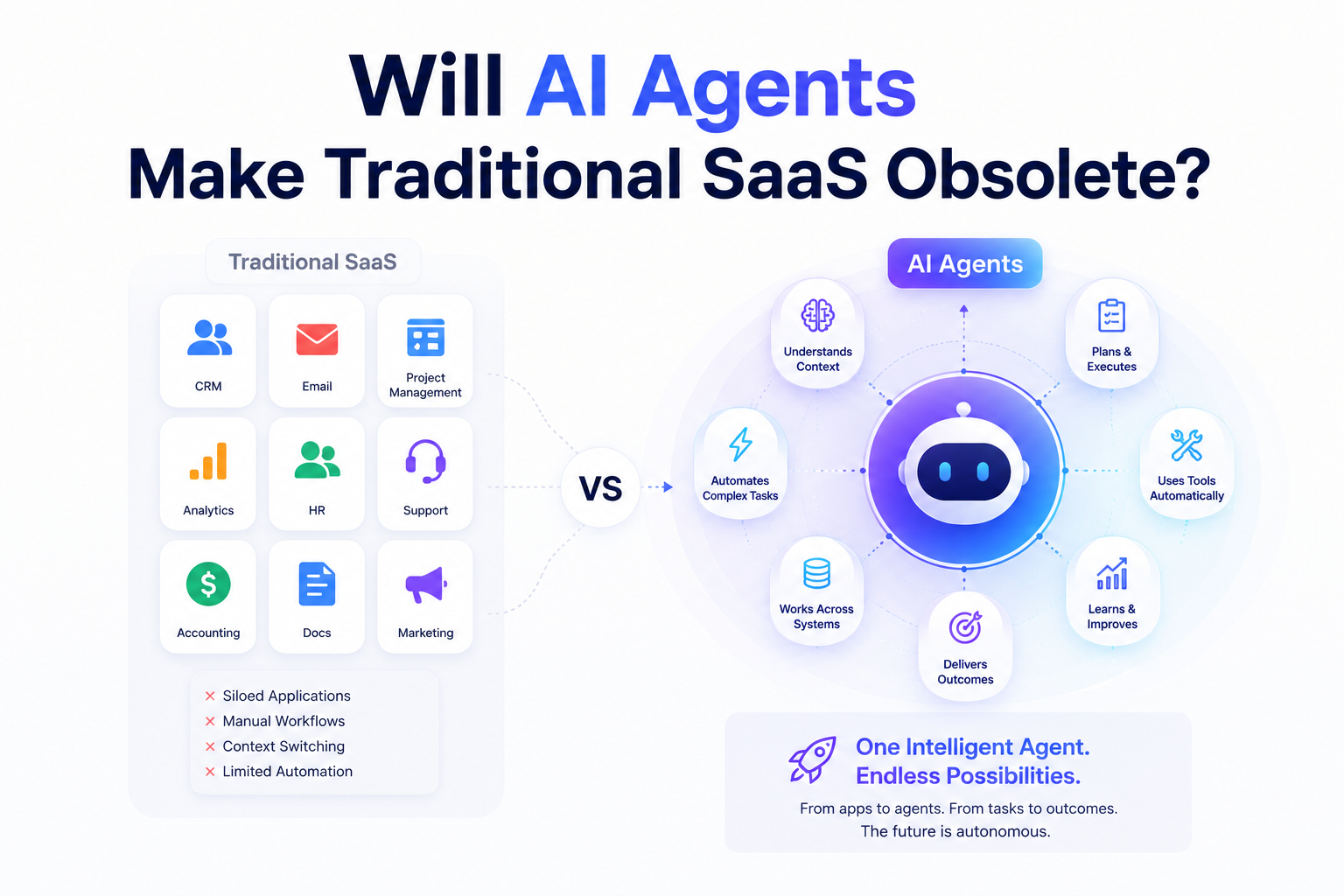
🛠️ The Fundamental Flaw of Traditional SaaS
To understand why SaaS is vulnerable, we have to look at what it actually does.
Traditional SaaS is passive. It is a "System of Record" wrapped in a pretty user interface (UI). Salesforce, HubSpot, Zendesk, and Notion all rely on the same fundamental loop: a human logs in, clicks buttons, enters data, interprets a dashboard, and manually executes a task.
SaaS helps you manage the workflow, but you still have to do the work.
Enter the Autonomous AI Agent
An AI agent doesn't want to look at your dashboard. It doesn't need a user interface at all.
Instead of waiting for human input, an AI agent operates on outcomes. You give it a high-level goal—"Analyze our Q2 churn, cross-reference it with support tickets, and autonomously launch a targeted email re-engagement campaign"—and it hooks directly into APIs, writes its own intermediate logic, and executes the task.
When software transitions from a tool you use to an entity that does the work for you, the traditional SaaS value proposition begins to crack.
⚠️ The Two Layers of SaaS Most At Risk
The software market shift has already caused massive ripples in tech valuations. The disruption isn't hitting every software company equally; it is targeted directly at specific layers of the enterprise stack.
1. The "Middleman" Workflows (Systems of Engagement)
SaaS applications that function purely as a "thin skin" over data—tools that simply move data from Point A to Point B or organize basic human tasks—are highly exposed. If an AI agent can bypass the UI entirely and connect data silos using natural language, the need to pay a monthly per-seat license for a middleman tool drops to zero.
2. Point Solutions and "GPT Wrappers"
The market for generic AI tools that simply put a sleek UI over a foundation model LLM is collapsing. If a unified enterprise AI agent can already generate copy, analyze spreadsheets, and write code natively, standalone micro-SaaS applications lose their defensible moat.
🔄 The Death of the "Per-Seat" Pricing Model
For two decades, SaaS companies got rich off the seat-based pricing model (paying $50/month per user). But this model inherently assumes that more human logins equal more value.
With AI agents, an enterprise might only need two or three human administrators to oversee a fleet of a hundred digital agents doing the heavy lifting. If human headcounts drop or users stop logging into UIs, SaaS vendors can no longer monetize user seats.
We are already seeing a rapid pivot toward consumption-based and outcome-driven pricing. In this new landscape, you don’t pay for the software itself; you pay for the result the software achieves.
🛡️ Why SaaS Won’t Disappear Entirely (The Defensible Moat)
Despite the "SaaS-pocalypse" headlines, traditional software isn't going the way of the dinosaur just yet. The future isn't a total eradication of SaaS; it’s an architectural hostile takeover.
SaaS giants possess three critical moats that AI agents cannot easily replicate from scratch:
Systems of Record (The Data Moat): AI agents are only as smart as the data they can access. Incumbent platforms hold the ultimate truth—the deeply entrenched, secure, structured databases of customer histories, financial records, and proprietary operational workflows.
Security, Permissions, and Governance: You cannot turn an autonomous agent loose in an enterprise stack without strict guardrails. Legacy SaaS providers already possess the complex compliance, SOC2 certifications, and permission hierarchies required to keep data safe.
The Pivot to "Agent-Native" Infrastructure: The smartest SaaS companies aren't fighting the wave—they are building the surfboard. Platforms are rapidly re-architecting their systems to launch their own agent ecosystems (such as Salesforce's Agentforce), transforming themselves into orchestration hubs.
The Bottom Line
Will AI agents make traditional SaaS obsolete?
The user-interface-centric, seat-licensed, passive SaaS model is dead. Software that relies solely on human clicks to generate value will face severe compression.
However, the underlying cloud infrastructure, secure data repositories, and complex compliance frameworks of enterprise SaaS will survive. They will simply be retrofitted. The future belongs to AI-Native SaaS—modular, API-first platforms built not for humans to click through, but for AI agents to run on.
The software stack isn’t vanishing. It’s just getting a new boss.
Tags
#AI #ArtificialIntelligence #AIAgents #AgenticAI #SaaS #FutureOfSaaS #SoftwareAsAService #GenerativeAI #EnterpriseAI #AIAutomation #DigitalTransformation #FutureOfWork #AIInnovation #BusinessTechnology #Automation #AIPlatforms #IntelligentAgents #Productivity #TechTrends #FutureOfAI #LLM #LargeLanguageModels #AIRevolution #TechnologyLeadership #CloudComputing #NextGenTech #DigitalInnovation #SmartSystems #EmergingTechnology #AITransformation