The Global Race for Sovereign AI Has Officially Begun
Look back at the tech headlines over the last few years, and you’ll notice a distinct, unshakeable pattern. The AI industry hasn't just been growing; it has been entirely hyper-focused on one massive, landscape-shifting goal. Everything else has just been background noise.
But beneath the relentless consumer hype of chatbots and video generators, a quieter, much more aggressive battle is being fought.
Governments and global enterprises are realizing a dangerous truth: relying entirely on a handful of foreign tech giants for core artificial intelligence infrastructure is a massive threat to national security, economic independence, and cultural identity.
The era of centralized global cloud AI is fragmenting. The race for Sovereign AI has officially begun.
What is Sovereign AI?
Sovereign AI is a nation’s or an organization's capacity to independently develop, govern, and control its entire artificial intelligence technology stack.
This isn't just about software; it means owning and controlling the four core pillars of the AI lifecycle:
Sovereign Compute: Domestic data centers, high-performance GPU clusters, and energy grids that cannot be throttled or shut off by a foreign power.
Sovereign Data: Ensuring citizen and national data stays strictly within physical borders, subject only to domestic data laws.
Sovereign Models: Large language models (LLMs) trained on local languages, local laws, and domestic cultural nuances, rather than foreign-biased internet data.
Sovereign Governance: The independent authority to regulate and deploy AI across critical infrastructure without foreign vendor dependency.
Why the World is Moving Away from Centralized AI
For the first few years of the AI boom, the world was content with using APIs hosted primarily in Silicon Valley. But running a country's critical infrastructure on a foreign cloud platform creates massive vulnerabilities.
1. Geopolitical Realignment and Export Controls
We have seen how quickly tech supply chains can become weaponized. Export restrictions on advanced semiconductors and chip-manufacturing equipment have proved that technology access can disappear overnight. Countries realize that if they do not own their own "AI factories"—the dedicated compute environments required to train and run models—they risk technological obsolescence.
2. Cultural Imperialism in Machine Learning
When an entire population uses an AI model trained predominantly on Western datasets, the AI naturally mirrors Western values, historical perspectives, and social norms. Countries like Japan, France, Saudi Arabia, and India are investing heavily in domestic models to preserve their own languages, cultural heritage, and legal frameworks in the digital age.
3. The Enterprise Shift to On-Premise Control
It isn't just nations making this pivot. Heavily regulated industries—such as banking, healthcare, and defense—are rejecting public AI platforms. They are building "private sovereign clouds" to protect highly confidential intellectual property from leaking into public training data pools.
🗺️ How the Global Power Map is Shifting
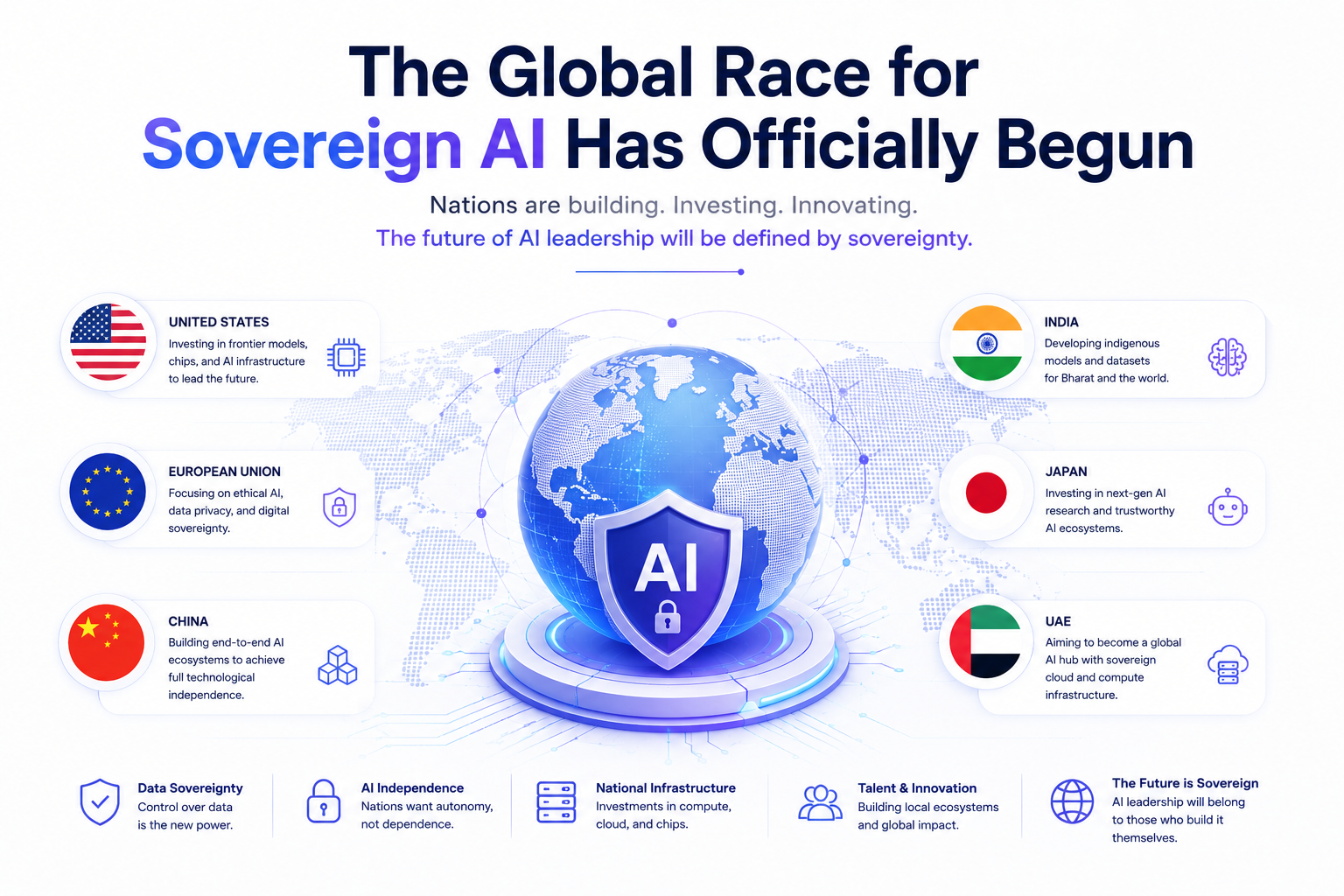
The race for digital self-reliance is fracturing into distinct ideological blocs, each operating under a different playbook:
United States (Strategic Acceleration): Driving aggressive private-sector innovation while using strict semiconductor export controls to maintain a generational lead over global competitors.
European Union (Regulatory-First): Championing the landmark EU AI Act to enforce strict compliance, data privacy, and ethical frameworks while funding regional sovereign clouds.
Middle East (Capital Infrastructure): Pouring billions of oil-revenue capital directly into massive domestic GPU supercomputers and state-backed frontier models (like Abu Dhabi’s Falcon).
Asia-Pacific (Centralized Localization): Developing localized large language models tailored to regional languages and cultural nuances while securing domestic supply chains against Western tech monopolies.
⚠️ The Reality Check: While nations talk about absolute self-reliance, true isolation is nearly impossible. The vast majority of these "sovereign" projects still rely fundamentally on U.S.-designed hardware and underlying open-source foundations.
The Takeaway
AI has officially graduated from a commercial software trend to a fundamental pillar of national infrastructure, right alongside electricity, telecommunications, and defense.
The future will not be dominated by one single, omnipresent global AI. Instead, the global tech landscape is fracturing into a multipolar network of local "AI factories."
For tech leaders, policymakers, and builders, the message is clear: if you don’t control your own AI stack, you don't control your future.
Tags
#AI #ArtificialIntelligence #SovereignAI #AILeadership #NationalAI #GlobalAIRace #AIInfrastructure #AIGovernance #DigitalSovereignty #AIInnovation #FutureOfAI #EnterpriseAI #GenerativeAI #AIPolicy #TechnologyStrategy #AIEconomy #DataSovereignty #CloudComputing #AITransformation #DigitalTransformation #AIInvestment #AIRegulation #TechLeadership #NationalSecurity #AIChips #ComputeInfrastructure #EmergingTechnology #Innovation #FutureTech #GlobalTechnology #AIRevolution #StrategicTechnology #AIEcosystem #DigitalIndependence #TechTrends #Geopolitics #AICompetition #NextGenTechnology #MachineLearning #DeepLearning