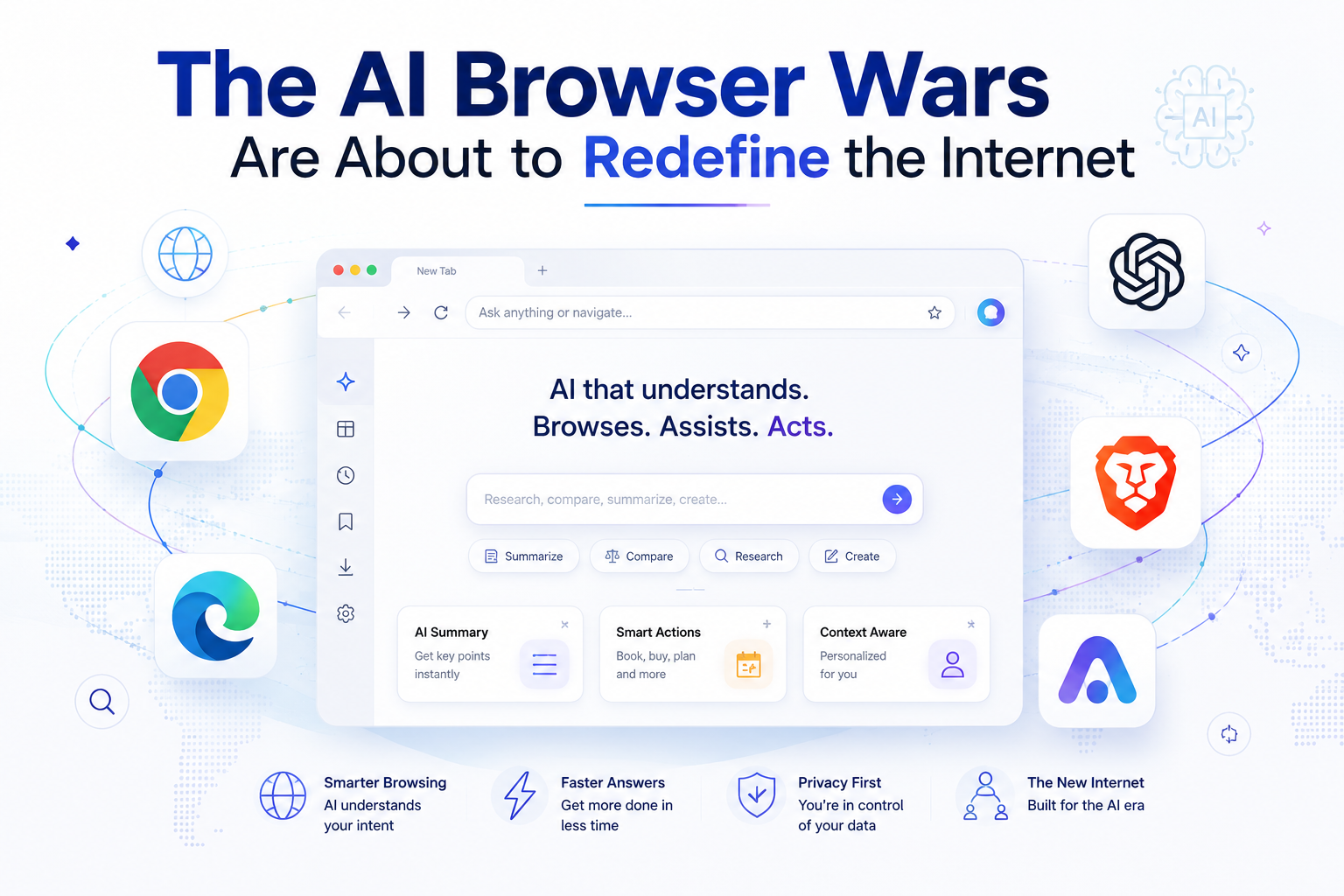
The AI Browser Wars Are About to Redefine the Internet
Remember when choosing a browser was simple?
You picked Chrome because it was fast. Firefox because it was open. Safari because it came with your Mac. Edge because... well, it was already installed.
For years, browsers competed on speed, security, extensions, and user experience. But something much bigger is happening now.
The next browser war isn't about tabs.
It's not about bookmarks.
And it's definitely not about which browser loads a website a few milliseconds faster.
It's about Artificial Intelligence.
A new generation of AI-powered browsers is emerging, and they have the potential to fundamentally change how we interact with the internet. Instead of searching, clicking, comparing, and navigating through dozens of websites, AI browsers promise something entirely different:
You ask. The browser thinks. The browser acts.
And that could redefine the internet as we know it.
From Browsing the Web to Delegating Tasks
For nearly three decades, the web has operated on a simple model.
You search for information.
You click links.
You open tabs.
You compare results.
You make decisions.
The browser was simply a window into the internet.
But AI is transforming that relationship.
Imagine opening your browser and typing:
"Find the best project management platform for a 500-person engineering organization, compare pricing, summarize the pros and cons, and recommend the best option."
Instead of sending you to ten different websites, the browser performs the research for you.
In seconds.
That's not search.
That's delegation.
And it's the direction the entire industry is heading.
Why Everyone Suddenly Wants to Own the Browser
The browser has always been one of the most valuable pieces of software in the world.
Why?
Because it's where people spend a significant portion of their digital lives.
Every search.
Every purchase.
Every article.
Every SaaS application.
Every workflow.
The browser sits in the middle of it all.
Now imagine adding AI directly into that experience.
Suddenly, the browser isn't just a gateway to information.
It's an intelligent layer sitting between users and the entire internet.
That's why technology giants, AI startups, and software companies are racing to build the next generation of browsers.
Whoever wins may control the primary interface of the AI era.
The End of Search As We Know It?
Search engines have dominated the web for more than twenty years.
Need information?
Search.
Need a product?
Search.
Need an answer?
Search.
But AI changes user expectations.
People no longer want a list of links.
They want answers.
They want recommendations.
They want actions.
Instead of spending twenty minutes researching, users increasingly expect AI to do the heavy lifting.
This shift may be one of the biggest disruptions to online behavior since the launch of Google itself.
The Rise of Agentic Browsing
Here's where things become truly interesting.
Future browsers won't just answer questions.
They'll complete tasks.
Imagine saying:
"Book me a flight to Berlin next Thursday, compare airlines, choose the best value option, and prepare everything for checkout."
The browser could:
Search flights
Compare prices
Analyze reviews
Check baggage policies
Fill booking forms
Prepare payment details
All without manually opening a single website.
This is known as Agentic AI, and many experts believe it will become one of the defining technologies of the next decade.
The browser evolves from a tool into a digital assistant.
What This Means for Content Creators
If AI browsers start delivering answers directly, what happens to websites?
That's the billion-dollar question.
Publishers, bloggers, media companies, and businesses depend on visitors.
But if AI summarizes content before users visit a page, traffic patterns could change dramatically.
This doesn't mean content becomes less important.
In fact, it becomes more important.
AI systems still need high-quality information to learn from, reference, and recommend.
The difference is that future content strategies may focus less on rankings and more on becoming the trusted source AI systems choose to cite and summarize.
SEO Is Entering a New Era
For years, SEO was largely about ranking pages.
The future may be about something much bigger:
Becoming the answer.
As AI browsers become more sophisticated, they'll prioritize:
Original insights
Authoritative expertise
Structured information
Clear context
Trustworthy sources
The winners won't necessarily be the websites with the most traffic.
They'll be the ones AI trusts enough to include in its answers.
Privacy Will Define the Winners
AI browsers require context.
Lots of it.
To provide meaningful assistance, they need to understand:
Your preferences
Your browsing habits
Your work patterns
Your interests
Your goals
That creates an enormous opportunity—but also enormous responsibility.
Users are becoming increasingly aware of how their data is collected and used.
The companies that balance intelligence with privacy may gain the strongest competitive advantage.
In the AI era, trust could become the ultimate feature.
The Browser Is Becoming an Operating System
The most fascinating part of this transformation is that browsers are starting to look less like browsers and more like operating systems.
Think about it.
Most modern work already happens inside a browser:
Email
Documents
Meetings
Messaging
Development tools
Project management
Research
Now add AI capable of understanding, connecting, and automating all of those activities.
The browser becomes the command center of digital life.
The Bigger Battle Behind the Browser Wars
At first glance, this may look like a competition between software products.
It's not.
It's a battle to determine how humans interact with information in the AI age.
The companies building AI browsers are competing to become the primary interface between people and the internet.
That position comes with extraordinary influence.
Because whoever controls the interface often controls the future.
What's the Takeaway?
We're witnessing the beginning of one of the most important technology shifts since the rise of smartphones.
The next generation of browsers won't simply help us navigate the web.
They'll help us think, decide, create, research, and act.
The future internet may involve fewer clicks, fewer searches, and fewer tabs—but far more intelligence.
The browser is no longer just a window to the internet.
It's becoming the AI-powered operating system of the digital world.
And the browser wars of the next few years could determine what that future looks like.
Tags
#AI #ArtificialIntelligence #AIBrowser #BrowserWars #GenerativeAI #AIAgents #AgenticAI #FutureOfAI #FutureOfInternet #TechnologyTrends #DigitalTransformation #AIInnovation #SearchEvolution #AIAutomation #Productivity #WebTechnology #TechNews #Innovation #AIRevolution #TechFuture #MachineLearning #LLM #EnterpriseAI #DigitalInnovation #NextGenTech #InternetFuture #SmartBrowsing #AITrends #TechLeadership #EmergingTechnology