Why Most Agentic AI Projects Fail, What Successful Companies Do Differently
The business world is experiencing what industry insiders call the Agentic Reckoning.
Recent market data reveals a stark truth for enterprise leadership: a significant portion of agentic AI projects are expected to be abandoned or canceled due to integration failures and unmanaged errors.
The enterprise rush to move past basic chatbots and deploy autonomous digital workers has hit a wall. Millions of dollars are pouring into proofs-of-concept (PoCs) that look spectacular in a controlled demo environment but completely collapse the moment they are exposed to the messy chaos of real-world operations.
The failure point is rarely the "brain" (the underlying language model). Instead, it is the implementation strategy. Here is why most autonomous AI projects fail, and the exact architectural blueprints successful companies use to cross the production finish line.
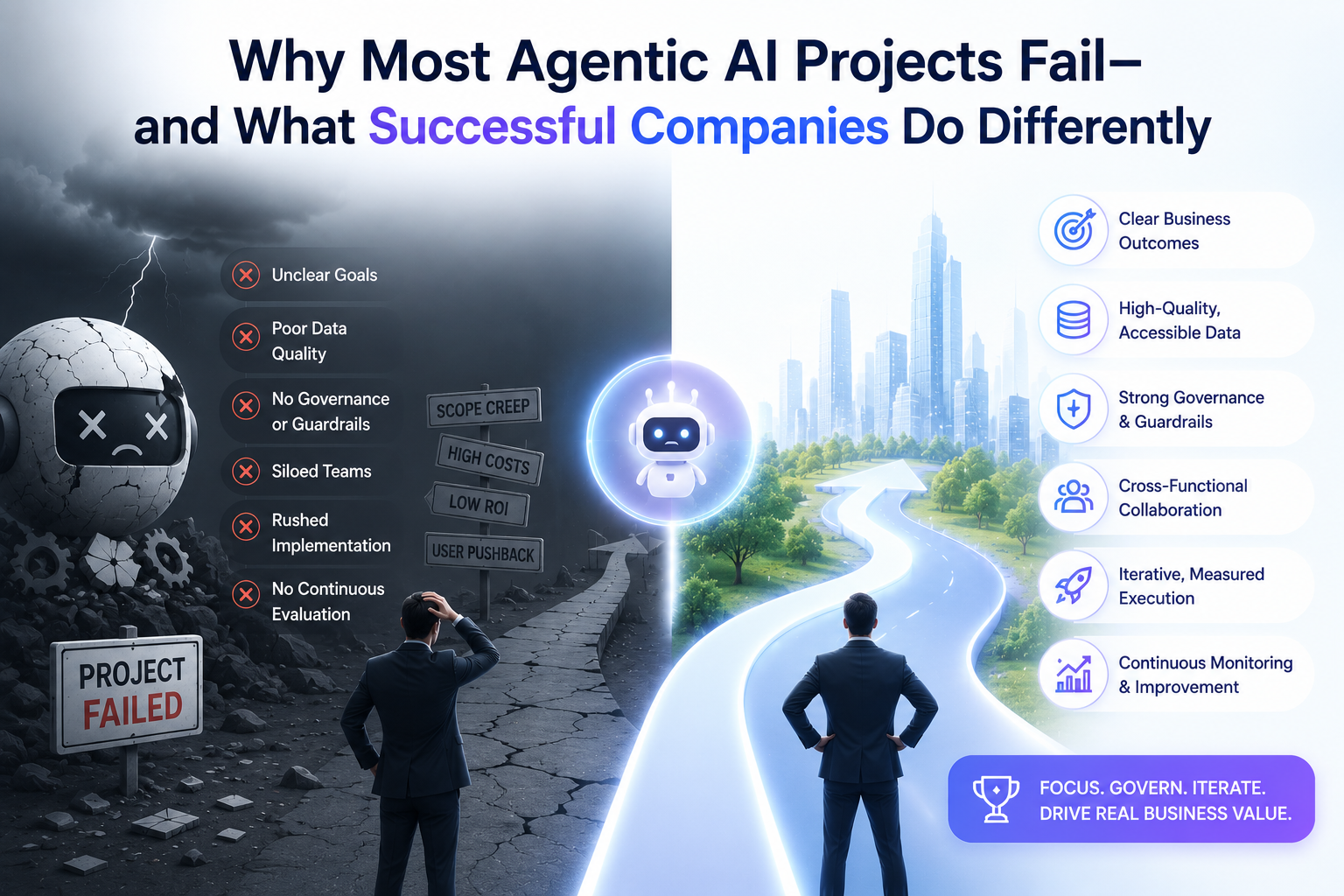
1. The "Black Box" Autonomy Trap vs. Process-Aware Design
The Mistake:
Many companies approach agentic AI with a "hands-off" philosophy. They give an advanced model a vague, high-level goal—such as "resolve this billing dispute"—and expect the agent to autonomously figure out the steps.
When a model acts as an unguided black box, it struggles to navigate the strict boundaries required by enterprise operations. If the agent makes a minor error or misinterprets a data field in Step 2 of a 10-step reasoning process, that mistake compounds silently. By Step 10, it transforms into a catastrophic failure—like executing an unauthorized financial transaction or sending a client data that violates compliance rules.
What Successful Companies Do Differently:
Winners design agents around structured, Process-Aware Architecture. Instead of letting an agent wander aimlessly, they build clear guardrails. They map out complex workflows into explicit sub-tasks, anchoring the agent’s reasoning using knowledge graphs or GraphRAG (Graph Retrieval-Augmented Generation). This ensures the AI understands the real-world relationships between data points and adheres to strict business logic at every turn.
2. Fragile Infrastructure vs. Resilient Runtime Spines
The Mistake:
A significant portion of failed enterprise AI pilots trace back to fragile plumbing. Teams often build agents using stateless scripts or simple developer frameworks designed for quick experiments.
In a production environment, business software encounters real-world hiccups: APIs timeout, networks flicker, or data schemas shift unexpectedly. When a stateless agent experiences a transient glitch, it suffers from state loss. It loses its place in the middle of a complex, multi-hour workflow, hangs silently without error codes, and completely derails the automation pipeline.
What Successful Companies Do Differently:
Top-tier engineering teams treat the agentic runtime—the infrastructure spine of the operation—as a first-class priority. They build on durable execution frameworks that can pause, save state, survive network disconnects, and pick up exactly where they left off. If a downstream system drops out for 10 seconds, the agent doesn't crash; it gracefully waits, handles the exception, and continues executing its task reliably.
3. The "Set It and Forget It" Bias vs. The Human Employee Analogy
The Mistake:
Leadership teams frequently treat agentic AI like traditional workflow automation or Robotic Process Automation (RPA). The prevailing mindset is: build the bot, connect the APIs, deploy it, and watch the headcount drop.
This approach completely misses the mark. AI agents are inherently probabilistic, meaning they deal with percentages of certainty, not absolute certainties. When an agent runs into a novel customer edge case that it hasn't seen before, it either stalls or makes an inaccurate guess, immediately eroding team trust.
What Successful Companies Do Differently:
Successful organizations approach deploying an AI agent the exact same way they approach onboarding a new human employee. They don't expect perfection on day one.
They assign human managers to supervise agent performance.
They design clean, intuitive human-in-the-loop (HITL) interfaces, ensuring the agent can easily escalate complex exceptions to a human specialist.
They allocate roughly 40% of their project budget specifically for post-launch optimization, continuous tuning, and behavior refinement.
4. "Agent Washing" vs. Relentless ROI Focusing
The Mistake:
The current software market is flooded with software vendors rebranding basic dashboards, standard chatbots, or rigid if/then logic flows as "agentic AI." Driven by fear of missing out, businesses buy into these overpriced packages without defining clear success metrics, resulting in skyrocketing API token costs that quickly outpace any real business value.
What Successful Companies Do Differently:
Successful executives ruthlessly avoid the hype cycle. Before writing a single line of code or signing a vendor contract, they audit their processes to ensure they have clean, searchable data lineage.
They pick narrow, highly specific targets where autonomy provides undeniable leverage. They don't aim for vague goals like "improving productivity." Instead, they target measurable KPIs, such as reducing invoice reconciliation from 5 business days to under 4 hours while maintaining a 99.5% accuracy rate.
Moving Forward In Your Agentic Journey
Autonomy is the future of enterprise software, but scaling it successfully requires shifting your focus away from how "smart" the underlying AI model is, and turning your attention to the infrastructure, governance, and human guardrails supporting it.
If you build a robust, resilient runtime spine and treat your digital workers as collaborative assets that require ongoing guidance, you position your enterprise to join the top tier of projects that successfully transition from a proof-of-concept into a highly profitable operational powerhouse.
Tags
#AI #AgenticAI #AIFailure #AISuccess #EnterpriseAI #AIAgents #AIImplementation #DigitalTransformation #BusinessStrategy #AIProjects #AIAutomation #ArtificialIntelligence #AILeadership #InnovationManagement #EnterpriseTechnology #AIBestPractices #FutureOfWork #BusinessInnovation #AIAdoption #TechnologyStrategy #IntelligentAutomation #AITransformation #SuccessFactors