15 AI Best Practices Every Professional Should Follow in 2026
Artificial intelligence has evolved past the phase of basic chat prompts. In 2026, the corporate landscape is powered by agentic AI—autonomous systems and persistent digital teammates that can navigate complex workflows and execute multi-step tasks across enterprise software independently.
As the lines between human labor and autonomous software continue to blur, professionals must upgrade their daily operating habits. Relying on outdated methods can expose your organization to critical vulnerabilities or leave your career stuck in the past.
These 15 foundational best practices will help you safely, productively, and ethically navigate your work day.
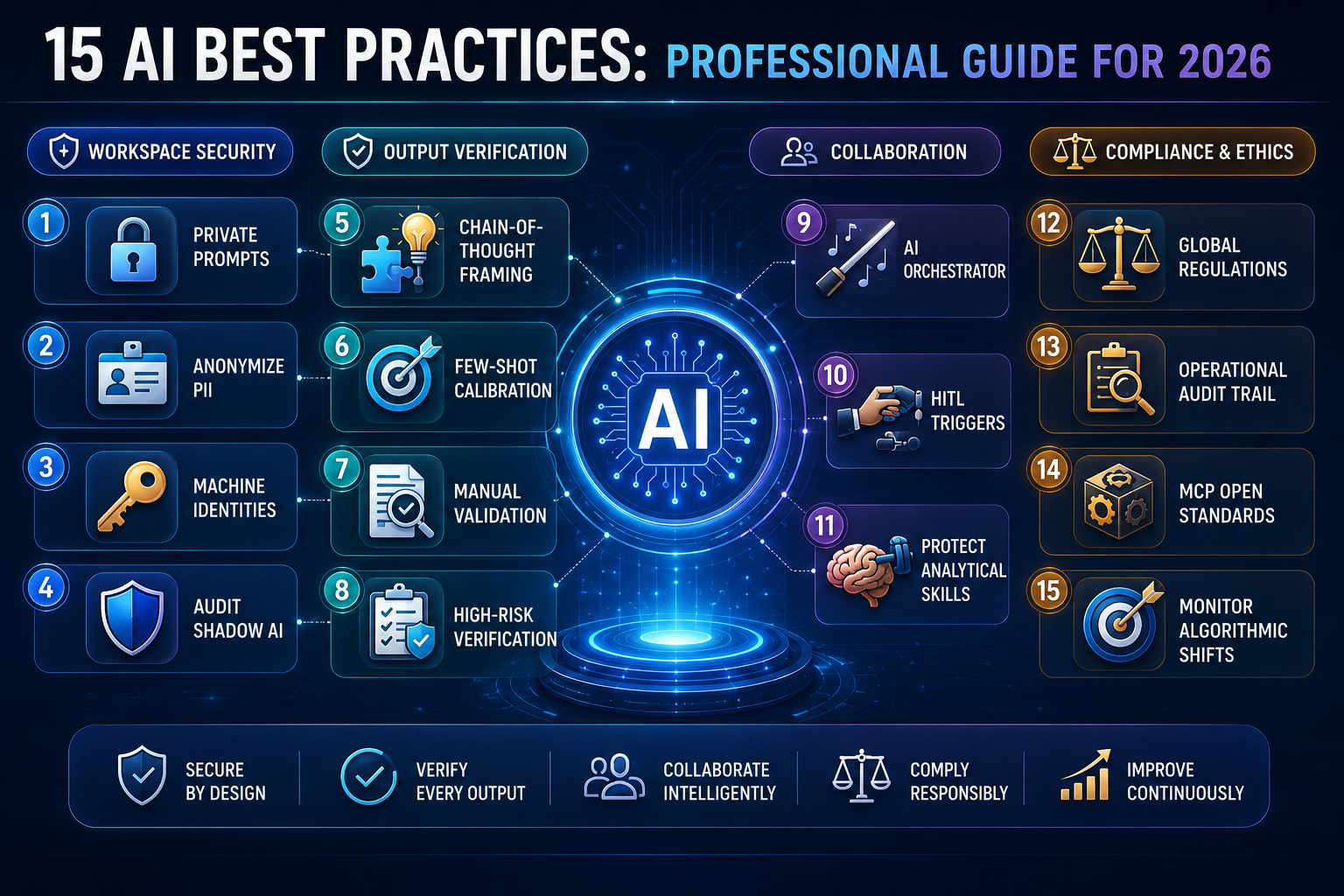
Workspace Security and Data Integrity
1. Treat Every Prompt as a Public Disclosure
Never paste proprietary source code, unreleased financial data, or client metrics into a public or third-party AI interface. Unless you are using a strictly verified, enterprise-grade instance with zero-data-retention policies, your data can be absorbed into vendor training cycles or accidentally leaked.
2. Strip Out All Personally Identifiable Information (PII)
Before feeding data arrays or case studies into an AI, manually strip or anonymize sensitive customer info (like emails, phone numbers, and IDs). Leading-edge setups now enforce server-side input filtering to catch these, but doing it yourself remains your best personal defense against compliance failures.
3. Establish Explicit Non-Human Machine Identities
If you deploy autonomous agents to handle data routing or monitor apps, treat them like a new hire. Do not let agents run under your personal login credentials. Work with IT to provision distinct machine identities with limited access rights, ensuring their actions can be isolated and audited.
4. Audit Your Tooling for Shadow AI
With more than half of knowledge workers admitting to using unsanctioned browser extensions or free AI apps, "Shadow AI" is a massive corporate risk. Only use tools vetted by your organization’s governance council to protect your internal network from malicious data exfiltration.
Logic Engineering and Output Verification
5. Transition from Basic Prompting to Chain-of-Thought (CoT) Framing
Simple, one-line requests result in generic, low-quality outputs. When configuring tasks, force the model to explicitly break down its reasoning step-by-step. For example: "First list your underlying assumptions, then outline the execution plan, and finally generate the solution." This structural approach slashes hallucination rates.
6. Practice "Few-Shot" Calibration
Do not ask an AI to write a report, build a script, or construct an analysis from a blank canvas. Always provide 1 to 3 high-quality examples of your previous work within the context window. This sets a definitive benchmark for tone, formatting, and structural constraints.
7. Never Passively Sign Off on Probabilistic Output
AI systems operate on probabilities, not fixed certainties. Never copy and paste AI-generated deliverables directly to a client, manager, or production pipeline without conducting a complete manual validation. Treat the AI's output as a rough first draft, not a finished product.
8. Run Verification Checklists on High-Risk Tasks
If you use AI to assist with hiring screenings, software code deployment, or financial analysis, implement strict, mandatory validation checks. Ensure the logic holds up against edge cases and complies with regional anti-bias rules before finalizing anything.
Human-AI Team Collaboration
9. Act as an "AI Orchestrator" Rather Than a Content Writer
Shift your self-image away from a manual content creator and step into a managerial mindset. Your primary value is now defining high-level strategic boundaries, evaluating automated logic paths, and setting operational goals for your digital assistants.
10. Establish Clean Human-in-the-Loop (HITL) Triggers
When managing automated workflows, build in clear escalation points. Define the exact thresholds where an autonomous agent must pause and wait for a human signature—such as issuing financial transactions over a certain dollar amount or publishing public-facing copy.
11. Protect and Train Your Core Analytical Skills
Relying entirely on AI to summarize lengthy documents or write code can cause your own critical thinking skills to fade over time. Balance your workflow: use AI to construct structural outlines or handle repetitive tasks, but write core strategic ideas yourself to keep your skills sharp.
Regulatory Compliance and Professional Ethics
12. Align Your Workflows with Global Regulatory Changes
Global AI regulations are tightening quickly. With the strict enforcement phases of the European Union AI Act officially active as of August 2, 2026, any professional processing data linked to EU markets must maintain clear, auditable documentation detailing how their AI tools make decisions.
13. Maintain a Running Audit Trail of AI Operations
Keep a structured record of how and when AI was used for major project deliverables. Log the data sources used, the models involved, and the oversight steps you took. This clear data lineage protects your professional credibility if an automated process is audited down the road.
14. Vet Vendors for Explanatory Open Standards
When evaluating new B2B tools, avoid vendors who offer completely hidden, "black box" algorithms. Favor platforms that integrate open communication standards like the Model Context Protocol (MCP), which provide clear visibility into exactly how the AI accesses and moves your data.
15. Proactively Identify and Call Out Algorithmic Shifts
Models are not static; their performance can degrade over time as real-world data distributions change. Continually check your long-running automations to catch logic errors or slipping accuracy before they impact your clients.
Tags
#AI #AIBestPractices #ArtificialIntelligence #AIProductivity #ProfessionalDevelopment #FutureOfWork #AISkills #DigitalTransformation #AILiteracy #GenerativeAI #AIAutomation #CareerGrowth #WorkplaceInnovation #ProfessionalSuccess #AITraining #TechSkills #BusinessProductivity #AIAdoption #KnowledgeWork #AITrends2026 #SmartWorking #DigitalSkills #ProfessionalExcellence