The year 2026 marks a structural turning point for enterprise technology. Roughly 40% of enterprise applications now feature task-specific AI agents, a massive leap from under 5% just two years ago.
We have graduated from Traditional AI Governance 1.0—which focused on model validation, compliance checklists, and static prompt reviews—to AI Governance 2.0. Because 2026 is the year of the autonomous agent, governance must now shift to managing active, multi-step digital workers that make operational decisions in real time.
If your organization is deploying autonomous agents without upgrading its control framework, you aren't just managing software; you are exposing your network to unprecedented risk.
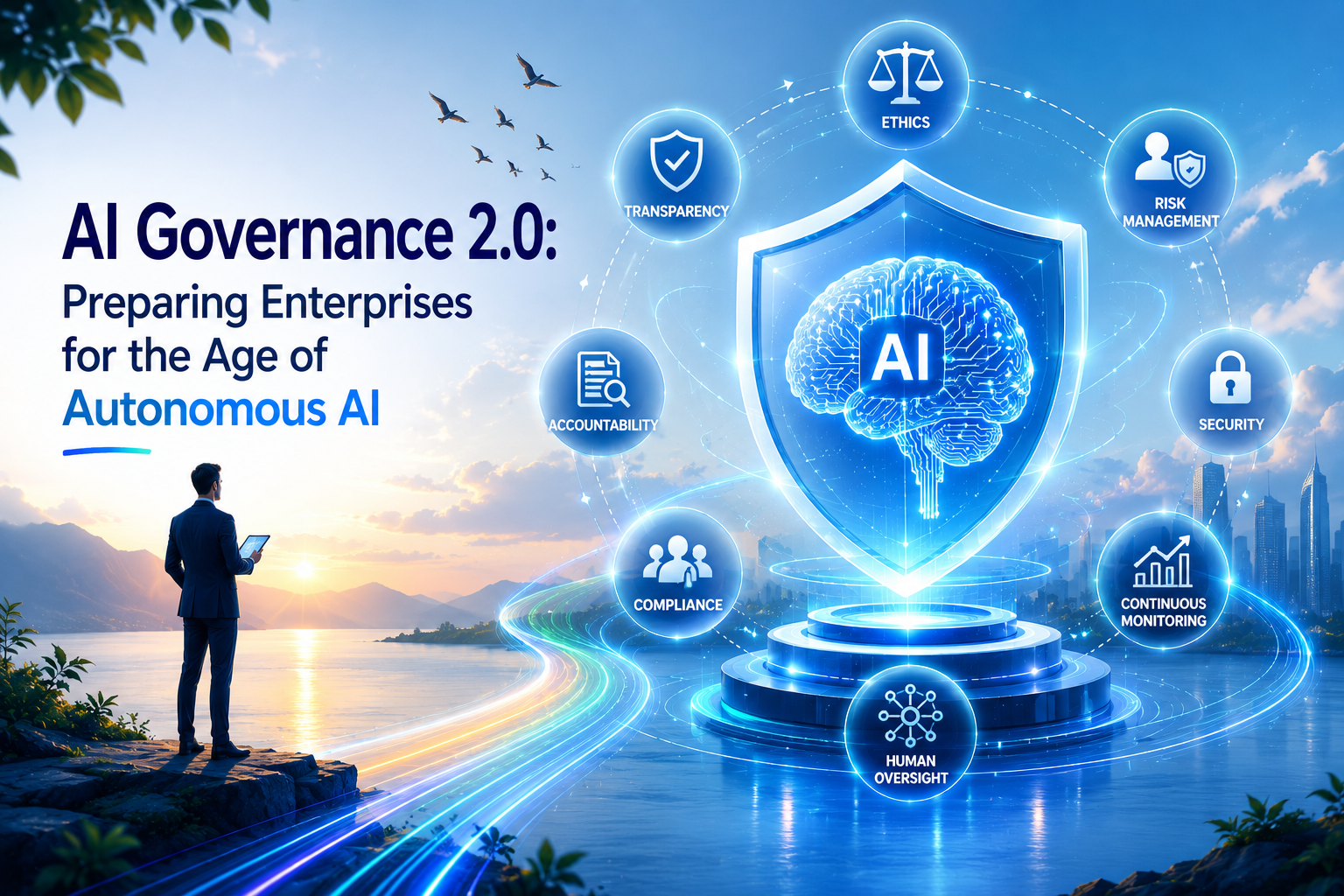
The Shift: Static Models vs. Autonomous Labor
Traditional IT governance treats software as a deterministic tool: you write a command, and it executes predictably. Autonomous agents break this mold. They use advanced reasoning to plan their own execution paths, invoke external APIs, spin up sub-agents, and modify corporate data independently.
How the Governance Playbook Has Changed:
Primary Focus: Shifted from model alignment and static data training to real-time behavior, tool execution, and active system access.
Review Style: Shifted from periodic audits and manual code reviews to continuous workflow observability and automated runtime guardrails.
Risk Vector: Shifted from text hallucinations and IP leaks to privilege escalation, systemic logic loops, and toxic API calls.
Identity Management: Shifted from simple user-bound session tokens to managing non-human machine identities with privileged network access.
A shocking 52% of knowledge workers admit to using unsanctioned AI tools at work, yet only 34% of organizations apply the same identity and security controls to their agentic labor force as they do to their human employees. This governance gap is exactly what Governance 2.0 fixes.
The Three Pillars of an Agentic Control Plane
To scale autonomous workflows securely, enterprise leaders are shifting toward a data-centric, real-time control architecture. An effective AI Governance 2.0 framework relies on three fundamental pillars:
1. Agent Discovery and Machine Identity
You cannot govern what you cannot see. Organizations must establish automated systems to discover shadow AI agents operating across local endpoints, browsers, and development environments. Furthermore, every autonomous agent must be treated as a privileged insider. This means provisioning unique machine identities using least-privilege principles, ensuring agents never inherit access rights beyond what their specific task requires.
2. Workflow-Level Observability
In an autonomous ecosystem, risk rarely shows up in a single event. It manifests across a sequence of actions. Governance 2.0 mandates continuous logging of an agent's entire execution path: what data it pulled, what external APIs it called, how it modified information, and where the final output was directed. This end-to-end traceability is essential for data lineage and satisfying corporate risk audits.
3. Decoupled Runtime Controls
Training-time alignment is not enough to stop a live agent from failing. Governance platforms must inject real-time runtime guardrails that operate independently of the AI model's logic. If an agent attempts to pull customer Personally Identifiable Information (PII), execute an unauthorized financial transaction, or modify production code, the control plane must instantly intercept the action, block the execution, and trigger an escalation path for human approval.
The Regulatory Clock Is Ticking
This architectural upgrade isn’t just a matter of operational efficiency—it is a regulatory mandate. The European Union AI Act’s strict enforcement provisions for high-risk AI deployments officially take effect on August 2, 2026.
Organizations processing data within or affecting the EU must prove their autonomous systems conform to ironclad standards of transparency, safety, and human oversight. Failing to document how your autonomous agents handle credit scoring, employment screenings, or critical corporate data can result in severe fines.
The Modern Rule of Thumb: Legacy, after-the-fact compliance reviews are dead. If your systems are making operational decisions at machine speed, your governance must execute at machine speed.
Action Plan for Enterprise Leaders
To successfully cross the chasm into high-maturity agentic automation, leadership should take three immediate actions:
Establish an AI Governance Council: Cross-functional representation across IT, Security, Legal, and Compliance is required to establish corporate risk tiers for autonomous systems.
Deploy Dedicated Agentic Governance Tools: Transition off manual spreadsheets and deploy dedicated software control towers designed to map non-human identity lifecycles and tool-call boundaries.
Define Human-in-the-Loop Thresholds: Map out clear escalation matrices specifying which actions an agent can execute autonomously versus which high-impact workflows require verified human verification.
The competitive divide of tomorrow won't be determined by who builds the most powerful AI agent, but by who builds the safest boundary for those agents to work in.
Tags
#AI #AIGovernance #EnterpriseAI #AutonomousAgents #Cybersecurity #RiskManagement #FutureOfWork #EUAIAct #TechLeadership #DataGovernance #AgenticAI #MachineIdentity #Compliance2026