Weather is one of the most practical frontiers for applied AI. It affects travel, logistics, agriculture, construction, renewable energy, insurance, retail demand, and emergency planning. With WeatherNext 3, Google is pushing AI weather forecasting from research demo into product infrastructure.
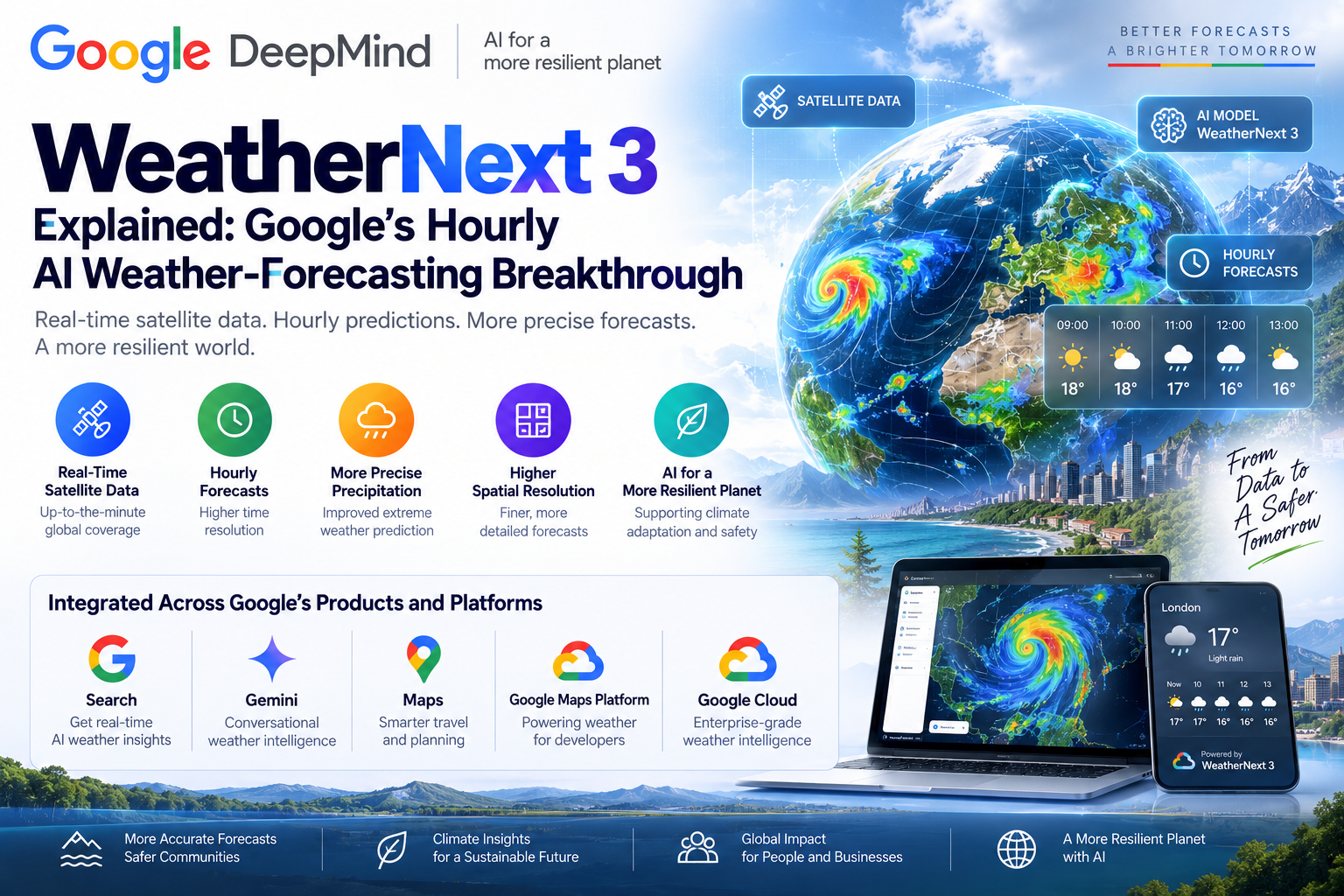
Google announced WeatherNext 3 on September 3, presenting it as its most advanced global weather AI model so far. The key upgrades are real-time satellite ingestion, hourly forecast refreshes, sharper spatial resolution, improved precipitation prediction, and deployment across Google Search, Gemini, Maps, Google Maps Platform, Earth Engine, BigQuery, Google Cloud Storage, and Google Cloud workflows.
Quick Take
- WeatherNext 3 is Google's new flagship AI weather model, built to produce global forecasts every hour instead of waiting for slower update cycles.
- The big technical shift is fresher data: the model uses live geostationary satellite information along with weather observations and historical analysis.
- The resolution is much sharper: Google describes surface temperature and humidity forecasts at 5 km, other surface variables around 10 km, and atmospheric variables around 25 km.
- Precipitation is the headline business value: Google says WeatherNext 3 improves rain and snow forecasts, especially for planning at least a day ahead.
- The enterprise story is distribution: WeatherNext 3 data is being made available through BigQuery, Earth Engine, Google Cloud Storage, Google Maps Platform, and Cloud-based workflows.
WeatherNext 3 matters because it turns weather AI from a research achievement into operational data that businesses can actually plug into decisions.
What Is WeatherNext 3?
WeatherNext 3 is an AI forecasting system from Google DeepMind and Google Research. Instead of relying only on traditional numerical weather prediction outputs, it learns from more direct and frequently refreshed observations, including satellite data and station-level measurements.
In simple terms, WeatherNext 3 tries to answer a practical question: can AI make useful weather forecasts faster, more locally, and with better precipitation detail than earlier global AI models?
Google says the system produces forecasts every hour, uses a higher-resolution representation of surface weather, and supports probabilistic forecasting across multiple ensemble members. For business readers, that last point matters because probabilistic forecasts are more useful for risk decisions than a single "yes or no" prediction. A logistics team, for example, does not only need to know whether rain is possible. It needs to know how likely, where, when, and how confident the forecast is.
Why It Matters Now
AI weather forecasting has become one of the clearest examples of AI moving beyond chatbots. The value is not conversational novelty. It is faster decision intelligence for the physical world.
Weather conditions affect fuel usage, delivery time, field service routes, crop protection, retail footfall, event staffing, renewable energy output, aviation planning, construction schedules, and insurance exposure. For large companies, these decisions are already data-driven. For SMEs, the challenge has been access: weather intelligence has often required specialist systems, expensive data pipelines, or manual interpretation.
WeatherNext 3 changes the adoption story because Google is placing forecast data into platforms many technical teams already understand: BigQuery for analytics, Earth Engine for geospatial workflows, Google Cloud Storage for file-based pipelines, and Google Maps Platform for location-aware applications.
How WeatherNext 3 Works At A High Level
The important idea is not that AI "replaces physics." The better framing is that AI can learn useful weather patterns from huge historical and real-time datasets, then generate fast forecasts that complement traditional meteorological systems.
Google says WeatherNext 3 uses a mosaic of global geostationary satellite data. This is important because fast-moving rain, snow, storm boundaries, and local temperature changes can evolve between traditional update windows. Hourly refreshes make the model more relevant for same-day operational decisions.
WeatherNext 3 vs Traditional Forecasting
Traditional numerical weather prediction remains essential, especially for official forecasts and warnings. But AI models like WeatherNext 3 are changing the speed, access, and cost structure of forecasting. The best practical view is not "AI versus meteorologists." It is AI forecasts plus expert meteorology plus operational decision systems.
| Area | Traditional forecasting strength | WeatherNext 3 direction | Business meaning |
|---|---|---|---|
| Physics grounding | Numerical models are based on atmospheric equations and decades of scientific validation. | AI learns patterns from historical analysis, observations, satellite data, and station measurements. | Use AI forecasts as decision support, while keeping official weather agencies as the authority for warnings. |
| Update speed | Many operational pipelines have slower update cycles because physics simulations are complex. | Google says WeatherNext 3 can generate forecasts every hour. | Useful for field operations, delivery routes, outdoor work, energy scheduling, and fast-changing local conditions. |
| Spatial detail | Global models may smooth local terrain, coastlines, valleys, and urban microclimates. | WeatherNext 3 provides higher-resolution surface forecasts, including selected variables at 5 km. | Better local planning for sites, depots, farms, retail locations, and infrastructure assets. |
| Precipitation | Rain and snow are difficult because small-scale cloud processes change quickly. | Google emphasizes improved precipitation prediction using satellite-based precipitation sources and reanalysis data. | Higher value for outdoor operations, event planning, agriculture, insurance, and transport disruption planning. |
| Enterprise access | Specialist weather datasets can be hard for small teams to integrate. | Google exposes WeatherNext workflows through Cloud surfaces such as BigQuery, Earth Engine, and Cloud Storage. | AI weather intelligence becomes easier to combine with business data, dashboards, and automation workflows. |
Where WeatherNext 3 Will Appear
WeatherNext 3 is not limited to a single research interface. Google says it is being integrated into consumer and developer surfaces. That is what makes the announcement strategically important.
| Surface | Likely user | What it enables |
|---|---|---|
| Google Search | Consumers and general business users | More localized weather answers when people search for conditions, rain, snow, temperature, and planning questions. |
| Gemini | AI assistant users | Weather-aware planning prompts, travel questions, and daily decision support inside a conversational interface. |
| Google Maps | Travelers, commuters, logistics planners | Weather context inside route planning, local discovery, outdoor activities, and location-aware decisions. |
| Google Maps Platform | Developers and product teams | Weather layers and forecast signals for apps that depend on routes, locations, assets, and customer movement. |
| Earth Engine | Researchers, climate teams, geospatial analysts | Large-scale spatial analysis, raster overlays, environmental monitoring, and satellite-data workflows. |
| BigQuery and Google Cloud Storage | Enterprise data teams | Joining forecast data with store, fleet, asset, crop, grid, insurance, and supply-chain datasets. |
Business Use Cases For SMEs
For MaGeN-AI readers, the most useful question is not whether WeatherNext 3 is technically impressive. The better question is: where does better weather prediction create measurable business value?
| Sector | Use case | Possible value | Implementation caution |
|---|---|---|---|
| Logistics | Route risk scoring, delay alerts, depot planning, driver communication. | Better ETAs, fewer missed slots, smarter rerouting, lower disruption cost. | Do not automate safety decisions without human dispatch oversight and official warnings. |
| Construction | Rain, wind, temperature, and storm risk planning for outdoor work. | Better crew scheduling, equipment protection, and material handling. | Follow local safety rules and site manager judgement for stop-work decisions. |
| Renewable energy | Wind-speed, cloud-cover, solar-radiation, and generation planning. | Improved forecast-based balancing and maintenance timing. | Validate against local grid requirements and existing energy forecasting tools. |
| Agriculture | Precipitation windows, irrigation planning, frost risk, harvest timing. | Reduced waste, improved crop protection, better labor scheduling. | Keep local agronomy expertise in the loop because field conditions vary sharply. |
| Retail and events | Demand forecasting for outdoor locations, staffing, promotions, and stock planning. | More responsive staffing and inventory decisions. | Avoid overreacting to single forecasts; combine weather with historical demand patterns. |
| Insurance and risk | Claims triage, weather exposure mapping, pre-event communication. | Better preparation and more targeted customer communication. | Keep transparent records; avoid automated decisions that affect customer rights without review. |
Why Precipitation Prediction Is The Big Deal
Rain and snow forecasting is hard because precipitation is local, dynamic, and tied to small-scale atmospheric processes. A forecast that is correct at the regional level may still be wrong for a specific road, depot, farm, event site, or city district.
Google says WeatherNext 3 improves precipitation forecasting by training with sources such as NASA's IMERG satellite precipitation data and Google's own precipitation reanalysis. Google also reports evaluation improvements against multiple precipitation baselines, and says users may see up to 50% more accurate precipitation forecasts when planning at least a day ahead.
The safe interpretation is this: WeatherNext 3 could make rain and snow planning more useful for ordinary users and businesses, but it should still be validated locally before being used in high-consequence workflows.
Weather Forecasting vs Climate Forecasting
The keyword AI climate forecasting is important for SEO, but the distinction matters. Weather forecasts predict atmospheric conditions over hours, days, and sometimes a couple of weeks. Climate analysis studies long-term patterns, risks, averages, extremes, and changes across seasons or decades.
WeatherNext 3 is primarily a weather forecasting model. However, better high-resolution weather data can support climate-adjacent work such as renewable energy planning, extreme-weather exposure analysis, infrastructure resilience, and agricultural adaptation. That is why climate teams may still care about WeatherNext 3, even if it is not a complete climate-risk model by itself.
Production Readiness Checklist
Before a business connects WeatherNext 3 into operations, the team should treat it like any other external AI-powered data source: useful, powerful, but not magic. The goal is to make better decisions without creating invisible dependency or accountability gaps.
| Checklist item | Why it matters | Practical action |
|---|---|---|
| Define decision boundaries | Not every weather-related decision has the same risk. | Separate informational dashboards from route changes, shutdown decisions, claims actions, or safety alerts. |
| Keep official warning sources | Google itself points users to local meteorological agencies for severe weather warnings. | Use national weather services and emergency authorities as the source of truth for safety-critical alerts. |
| Validate locally | Forecast value depends on terrain, season, location, and business process. | Compare WeatherNext 3 data against historical outcomes for the specific regions and sites you operate in. |
| Log data versions | Forecasts change over time, and decisions need traceability. | Store forecast timestamp, model version if available, source surface, user action, and final decision. |
| Use human review | Weather data can affect people, assets, and safety. | Keep dispatchers, site managers, operators, or analysts in the approval loop for high-impact actions. |
| Plan for outages | Cloud data and APIs can be delayed or unavailable. | Maintain fallback data sources, cached forecasts, manual procedures, and local authority alerts. |
EU AI Act And Responsible AI Considerations
WeatherNext 3 is not a general-purpose chatbot. But when AI weather output is used inside business processes, the downstream use case matters. A low-risk use case might be helping a cafe plan outdoor seating. A higher-impact use case might involve transport safety, workplace safety, critical infrastructure, insurance decisions, or emergency response.
For European SMEs, the practical EU AI Act lesson is simple: classify the workflow, not only the model. If weather AI is used only for internal planning, transparency and documentation may be enough. If it influences safety, access to services, insurance outcomes, worker scheduling, or public-facing warnings, stronger governance is needed.
| Responsible AI area | What to document | Why it matters |
|---|---|---|
| Transparency | Where the forecast came from, how often it updates, and whether it is official or experimental. | Users should not mistake AI-generated forecast support for official emergency guidance. |
| Human oversight | Who approves actions triggered by weather risk signals. | Important when the decision affects safety, employees, customers, routes, or operations. |
| Data governance | Forecast timestamp, location precision, source, license, retention period, and business datasets joined with it. | Weather data may become sensitive when combined with customer, worker, asset, or location data. |
| Accuracy monitoring | Forecast performance by region, season, lead time, and business decision type. | A model can be strong globally while still underperforming for a specific local use case. |
| Fallback procedure | What the business does when AI forecasts are unavailable, delayed, or contradicted by official warnings. | Reduces operational dependency and supports safer continuity planning. |
Best Fit Recommendation
WeatherNext 3 is best suited for businesses that already make weather-sensitive decisions but lack a modern, automated weather-data pipeline. The strongest early adopters will be teams in logistics, field service, renewable energy, agriculture, travel, outdoor retail, insurance, and geospatial analytics.
For SMEs, the smartest first project is not a fully autonomous weather agent. Start with a dashboard or alerting workflow that joins WeatherNext 3 forecasts with your own operational data. For example: forecasted rainfall plus delivery routes, wind risk plus construction sites, cloud cover plus solar assets, or temperature changes plus perishable inventory.
The winning pattern is practical: use WeatherNext 3 to improve planning, keep official weather services for safety-critical warnings, and document where human review is required.
FAQ
What is WeatherNext 3?
WeatherNext 3 is Google's AI weather forecasting model from Google DeepMind and Google Research. It is designed to generate more timely, higher-resolution global forecasts using live satellite data, weather observations, and AI-based prediction methods.
Why is WeatherNext 3 important?
It brings hourly AI weather forecasts into widely used Google surfaces and developer platforms. That makes advanced weather intelligence easier to use in business workflows such as logistics, energy planning, agriculture, retail, insurance, and geospatial analytics.
Does WeatherNext 3 replace official weather warnings?
No. WeatherNext 3 can support planning and analysis, but severe weather warnings and public safety guidance should still come from local meteorological agencies, national weather services, and emergency authorities.
How can developers access WeatherNext 3?
Google says WeatherNext 3 forecast data is available through developer surfaces such as Google Cloud Storage, Earth Engine, and BigQuery, with access handled through Google's WeatherNext developer process.
Is WeatherNext 3 useful for AI climate forecasting?
WeatherNext 3 is mainly a weather forecasting model, not a full climate model. However, better high-resolution weather forecasts can support climate-related planning in areas such as renewable energy, agriculture, infrastructure resilience, and extreme-weather risk analysis.