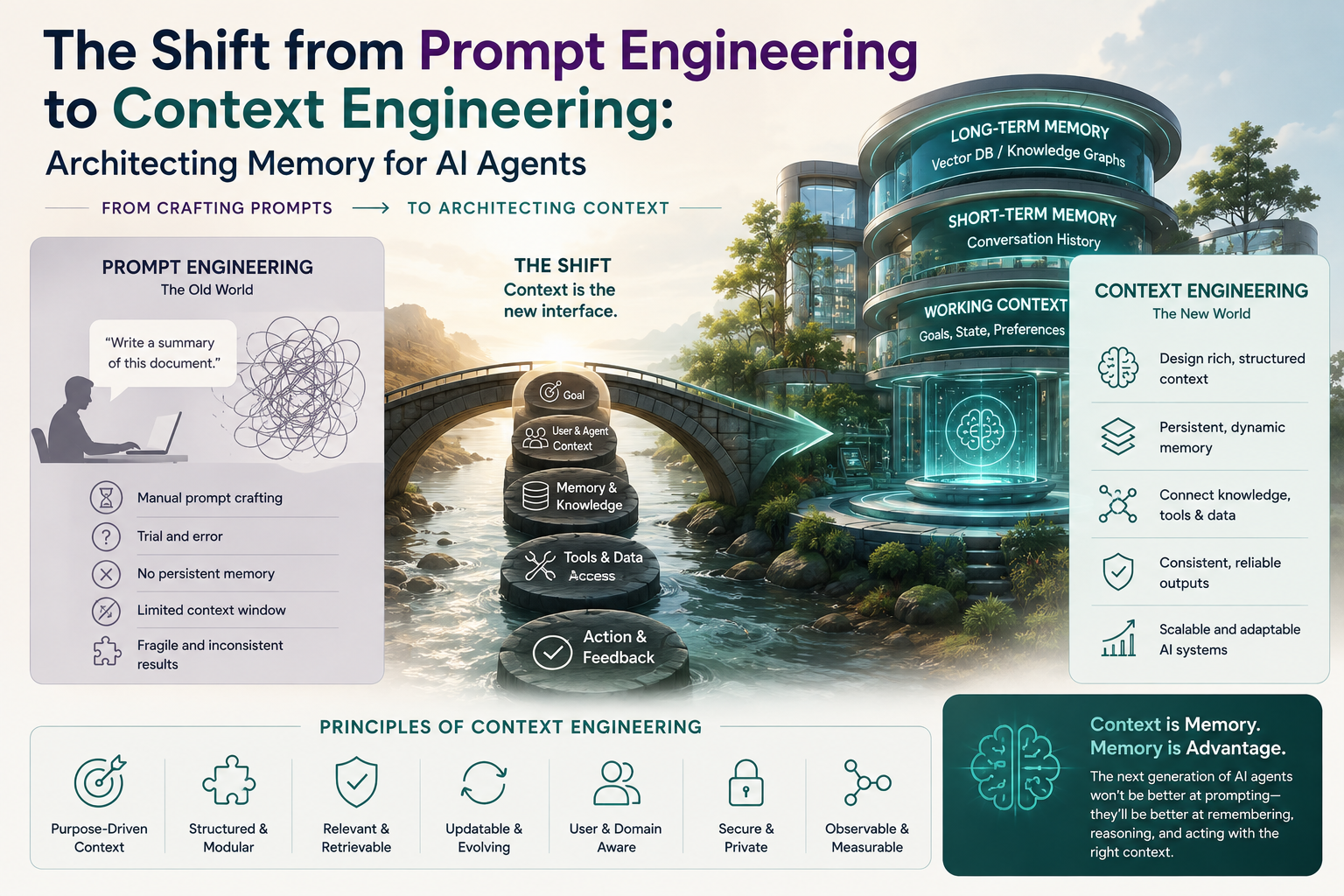
Prompt engineering helped the first wave of generative AI users get better answers from chatbots. But AI agents need more than a well-written instruction. They need the right memory, the right tools, the right documents, the right permissions, and the right decision history at exactly the right moment.
That is why the industry is shifting from prompt engineering to context engineering. The prompt is still important, but it is no longer the whole system. For production agents, the real architecture is the context layer: what the model sees, what it remembers, what it can retrieve, what it can do, and what evidence it leaves behind.
Quick Take
- Prompt engineering is mainly about writing better instructions for a model.
- Context engineering is about designing the full information environment around an AI agent.
- Reliable agents need memory architecture: runtime context, short-term state, long-term memory, retrieval, tool context, and lifecycle controls.
- More context is not automatically better. Bad, stale, private, or excessive context can make an agent slower, less accurate, or less safe.
- For European organizations, agent memory must be governed with transparency, access control, retention rules, human oversight, logging, and risk classification.
The future of AI agents will be won less by clever one-line prompts and more by well-designed memory, retrieval, permissions, and governance.
What Changed?
Prompt engineering became popular because it gave users an immediate way to improve model output. You could ask for a role, specify a format, add examples, define constraints, and get a better response. That still works for many one-off tasks.
But agents are different. An agent may run across multiple steps, call tools, read files, search databases, update records, summarize conversations, ask clarifying questions, and continue a task after the first model call. In that environment, the prompt is only one input among many.
The harder question becomes: what should the agent know right now? The answer may depend on user identity, permissions, recent conversation state, retrieved documents, long-term memory, tool results, business policy, previous decisions, and current risk level.
| Area | Prompt Engineering | Context Engineering |
|---|---|---|
| Main Goal | Improve the wording of the instruction sent to the model. | Design what information, tools, state, and memory the agent receives at each step. |
| Typical Scope | One chat message, one task, one output format. | Multi-step workflows, retrieval, tool calls, memory writes, evaluation, and audit trails. |
| Success Question | "Did the model answer this prompt well?" | "Did the agent receive the right context, take the right action, and leave the right evidence?" |
| Memory | Usually limited to text pasted into the prompt or the visible conversation. | Structured into short-term state, long-term memory, retrieved knowledge, and system configuration. |
| Risk | Ambiguous instructions or weak output formatting. | Stale memory, wrong permissions, data leakage, context overload, unsafe tool use, and poor logging. |
| Best Use | Content drafting, summarization, brainstorming, and one-time analysis. | Production agents, enterprise search, copilots, workflow automation, customer operations, and regulated AI use. |
Why Agents Need Context Engineering
Agent systems usually fail for one of two reasons: the model is not capable enough, or the wrong context was provided. In real enterprise use, the second reason is often the bigger problem. A capable model can still fail if it sees outdated customer data, misses an important policy, retrieves the wrong document, loses task state, or has access to tools it should not use.
Anthropic describes a useful distinction between workflows and agents. Workflows follow predefined code paths, while agents dynamically decide their own process and tool usage. The more autonomy an AI system has, the more important context architecture becomes.
For example, a support agent cannot only rely on a prompt that says "be helpful." It needs customer entitlements, product version, open tickets, known incidents, warranty status, approved troubleshooting steps, language preference, escalation rules, and a clear boundary for what it may never promise.
An agent without context architecture is just a chatbot with access to more ways to make mistakes.
The Memory Stack for AI Agents
Memory architecture should be separated into layers. This prevents every piece of information from being treated the same way. A temporary tool result, a user's long-term preference, a customer contract, and a compliance rule should not live in the same uncontrolled bucket.
| Memory Layer | Purpose | Control Needed |
|---|---|---|
| Runtime Context | Static or session-level information such as user ID, role, tenant, app mode, permissions, and environment. | Strict access control, least privilege, tenant separation, and no unnecessary exposure to the model. |
| Short-Term State | Conversation history, uploaded files, current workflow status, pending actions, and recent tool results. | Summarization, compaction, freshness checks, and protection against accidental cross-task carryover. |
| Long-Term Memory | User preferences, project decisions, relationship context, repeated instructions, and stable business facts. | Consent, source, timestamp, confidence, edit/delete ability, and review before durable memory writes. |
| Retrieved Knowledge | External documents, policies, tickets, code, CRM records, product manuals, and database results. | Permission-aware retrieval, source citations, ranking quality, data minimization, and stale document detection. |
| Tool Context | Information that tools can read or write, including APIs, files, records, actions, and execution results. | Tool allowlists, action approval, sandboxing, rate limits, output validation, and audit logs. |
| Lifecycle Context | What happens between model calls, such as summarization, policy checks, guardrails, routing, logging, and evaluation. | Monitoring, failure handling, incident response, testing, version history, and governance records. |
What Context Engineering Actually Does
Context engineering is not dumping every available document into the model. It is a selection system. A good context layer decides what to include, what to exclude, what to summarize, what to retrieve, what to verify, and what to store for later.
Select
Goal: Choose only the information needed for the current task.
Example: A finance assistant retrieves the relevant invoice and payment policy, not the entire finance archive.
Shape
Goal: Present context in a clear structure the model can use.
Example: Convert messy ticket history into timeline, facts, open questions, and recommended next action.
Store
Goal: Save durable facts only when they are useful, accurate, permitted, and reviewable.
Example: Remember a customer's preferred report format, but do not store sensitive personal notes without a reason.
Govern
Goal: Make context use visible, controlled, and auditable.
Example: Record which sources were retrieved before an agent created a customer-facing answer.
MCP and the Context Layer
The Model Context Protocol is important because it shows where agent architecture is heading. Instead of every AI app building custom integrations, MCP provides a standardized way for applications to share contextual information, expose tools, and connect AI systems with external capabilities.
In simple terms, MCP gives teams a cleaner way to connect agents to resources, prompts, and tools. That matters because the context layer can become messy very quickly. Without a standard interface, each integration becomes a custom security and maintenance problem.
| MCP Feature | Plain Meaning | Why It Matters for Context Engineering |
|---|---|---|
| Resources | Context and data the user or AI model can use. | Helps agents access relevant documents, records, files, or knowledge without hardcoding every connection. |
| Prompts | Reusable templated messages and workflows. | Turns prompt engineering into a managed component rather than one-off text copied between teams. |
| Tools | Functions the AI model can execute. | Creates a boundary where permissions, approvals, logging, and action safety can be designed explicitly. |
| Consent and Control | User approval over what data is shared and what actions are taken. | Supports privacy, trust, and governance when agents interact with business systems. |
Enterprise Use Cases
Context engineering becomes valuable when the agent must understand the business, not only the sentence typed by the user. These are the patterns most European SMEs and enterprise teams should watch.
| Agent Type | Context Needed | Memory Risk |
|---|---|---|
| Customer Support Agent | Customer profile, product version, ticket history, support policy, entitlements, known incidents, and escalation rules. | Wrong customer context, privacy leakage, overpromising, or stale product information. |
| Engineering Copilot | Repository structure, coding standards, open issues, architecture decisions, test results, dependencies, and release rules. | Insecure code suggestions, license issues, secret exposure, or outdated architectural assumptions. |
| Sales Operations Agent | CRM data, approved messaging, pricing rules, customer segment, meeting notes, and contract boundaries. | Incorrect pricing, unauthorized commitments, personal data exposure, or poor source tracking. |
| Compliance Assistant | Policy library, regulatory obligations, audit history, control evidence, responsible owner, and review dates. | Confident but wrong compliance guidance, missing legal review, or weak audit trail. |
| Internal Knowledge Agent | Documents, wikis, SharePoint folders, project notes, people directories, and decision records. | Permission bypass, old files ranking above current files, and lack of citation to source material. |
Common Failure Modes
Bad context engineering can make an agent look smart while quietly increasing risk. The failure modes are often boring, which is exactly why they matter.
| Failure Mode | What Happens | How To Reduce Risk |
|---|---|---|
| Context Overload | The model receives too much information and misses the few facts that matter. | Rank, summarize, chunk, and limit context to the current task. |
| Stale Memory | The agent uses an old preference, old policy, or outdated customer fact as if it were current. | Add timestamps, expiry rules, source links, and memory review workflows. |
| Wrong Tenant Context | Data from one customer, business unit, or user appears in another user's workflow. | Enforce tenant isolation, permission-aware retrieval, and automated tests for access boundaries. |
| Hidden Sensitive Data | Personal data, confidential documents, source code, or credentials enter context without a valid reason. | Classify data, redact secrets, minimize retrieval, and log sensitive context access. |
| Unsafe Tool Use | The model takes an action such as sending, deleting, purchasing, or updating records without enough control. | Use least privilege, human approval, action previews, reversibility, and strict tool schemas. |
| Missing Evidence | The agent produces an answer but nobody can tell which sources, memories, or tool outputs shaped it. | Record source IDs, tool calls, memory reads, memory writes, model version, and final approval. |
Implementation Checklist
A practical context engineering program starts small. Do not begin with a grand memory platform. Begin by mapping what context one important agent needs and what it must never see.
- Define the task boundary: write down what the agent is allowed to do, what it can recommend, and what requires human approval.
- Create a context map: list runtime context, short-term state, long-term memory, retrieval sources, tools, and governance logs.
- Separate memory types: do not mix user preferences, customer facts, legal policy, tool output, and temporary chat state.
- Add source and timestamp: every durable memory should have origin, date, owner, and confidence level.
- Make retrieval permission-aware: the agent should only retrieve documents the user is allowed to access.
- Summarize carefully: preserve decisions, constraints, open questions, and source references when compressing long conversations.
- Review memory writes: ask for human approval before storing sensitive or long-term personal information.
- Test failure cases: check stale documents, misleading retrieved text, prompt injection in documents, tool errors, and cross-user data leakage.
- Log agent context: record what memory and sources were used before important outputs or actions.
- Measure quality: track accuracy, latency, token cost, correction rate, user trust, escalation rate, and policy violations.
EU AI Act and Responsible AI Considerations
Context engineering has direct governance implications. Agent memory can include personal data, confidential business information, customer history, workplace data, or policy documents. That means organizations need clear rules for consent, access, retention, deletion, transparency, and human oversight.
Under the EU AI Act, high-risk systems are expected to consider areas such as human oversight, accuracy, robustness, cybersecurity, and lifecycle performance. Even when an agent is not high-risk, the same design habits are useful: document the intended purpose, screen the use case, control data access, keep audit logs, and avoid overreliance on AI outputs for consequential decisions.
| Governance Area | What It Means for Agent Memory | Evidence To Keep |
|---|---|---|
| Risk Classification | Check whether the agent supports lower-risk productivity, regulated advice, employment decisions, credit, healthcare, education, or public services. | Use-case register, intended purpose, affected users, data types, and risk review notes. |
| Transparency | Tell users when AI is using memory, retrieval, or tools to shape an answer or action. | User notices, memory settings, data source list, and explanation of limitations. |
| Human Oversight | Require human review before the agent makes or triggers consequential decisions. | Approval workflow, role matrix, override path, and escalation records. |
| Data Governance | Control what the agent can store, retrieve, summarize, transmit, or delete. | Retention policy, access control records, source metadata, deletion process, and vendor documentation. |
| Cybersecurity | Protect the context layer from prompt injection, data poisoning, unauthorized tool access, and cross-tenant leakage. | Security tests, incident logs, monitoring dashboards, vendor reviews, and model/version history. |
In agentic AI, memory is not just a product feature. It is a data governance, security, and accountability surface.
Best Fit Recommendation
Use prompt engineering when the task is simple, isolated, low-risk, and does not require tools, business data, or durable memory. This is still useful for drafts, summaries, brainstorming, translation, and formatting.
Use context engineering when the AI system needs to work across time, documents, tools, people, permissions, and business processes. This is the right approach for agents, enterprise search, customer workflows, coding copilots, compliance assistants, and internal automation.
The best first step is a memory design review. Pick one agent use case, map the context it needs, remove what it should not see, define who can approve actions, and log what context shaped the outcome.
FAQ
What is context engineering?
Context engineering is the design of the information environment around an AI system. It decides what instructions, memories, documents, tools, formats, and policies the model receives at each step.
How is context engineering different from prompt engineering?
Prompt engineering focuses on the wording of instructions. Context engineering focuses on the system around the prompt, including memory, retrieval, tool access, state, governance, and evaluation.
What is memory in an AI agent?
Agent memory is information the system can use across steps or conversations. It can include short-term conversation state, long-term preferences, project facts, retrieved documents, tool results, and summarized decisions.
Is long-term AI memory safe?
It can be useful, but it needs controls. Long-term memory should have consent, source, timestamp, access rules, review options, deletion paths, and protection against storing sensitive information unnecessarily.
Why does MCP matter for context engineering?
The Model Context Protocol matters because it gives AI applications a standardized way to connect to external context, resources, prompts, and tools, making integrations easier to govern and reuse.