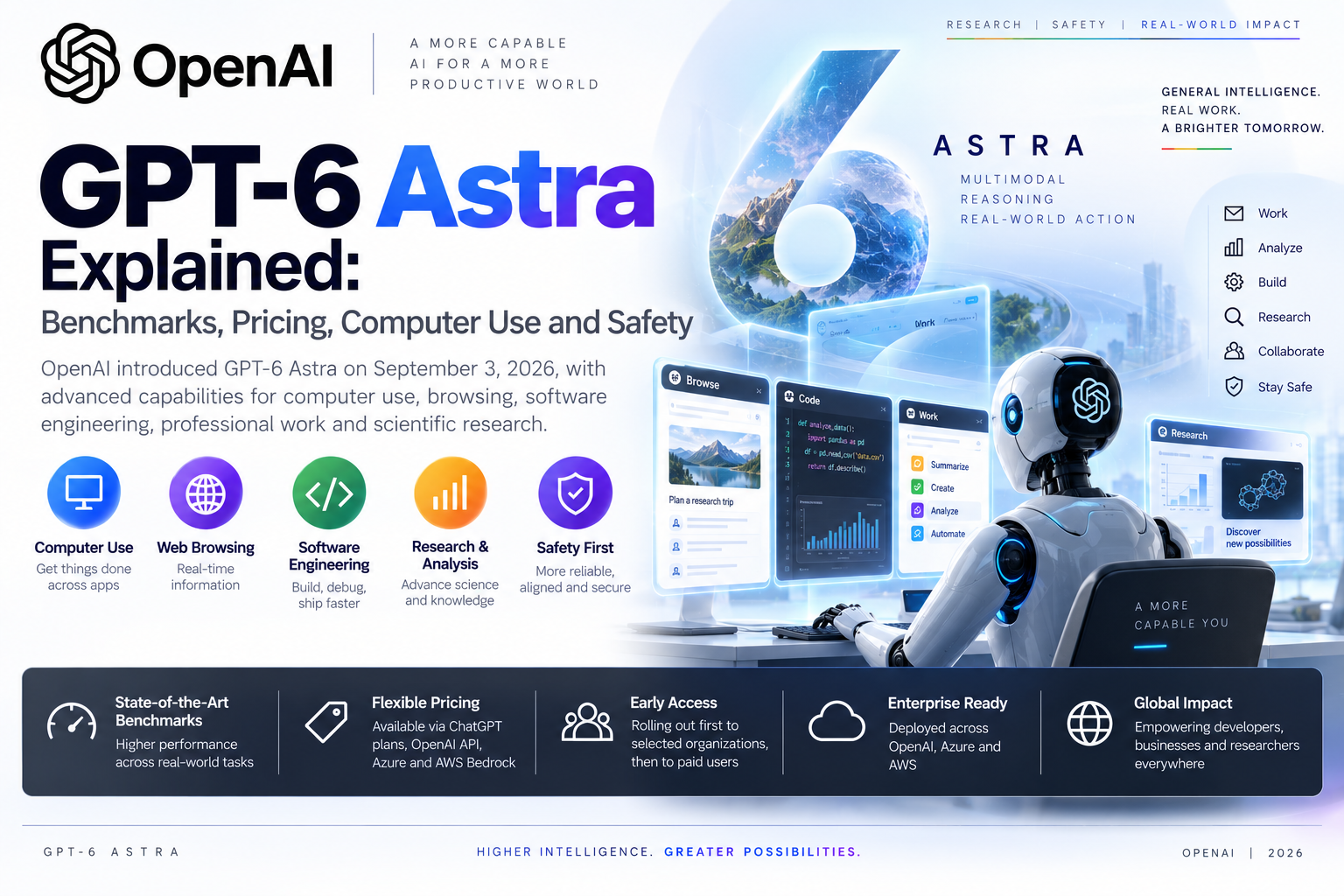
GPT-6 Astra Explained: Benchmarks, Pricing, Computer Use and Safety
OpenAI's GPT-6 Astra launch is one of the biggest model announcements of 2026 because it is not only about better chat. It is about AI systems that can browse, operate software, write code, reason over long context, use tools, and complete professional workflows with stronger safety controls.
OpenAI introduced GPT-6 Astra on September 3, 2026 and is rolling it out first to selected organizations, followed by ChatGPT Plus, Pro, Business, and Enterprise users, the OpenAI API, Microsoft Azure, and AWS Bedrock. For enterprise leaders and developers, the practical question is simple: where does Astra create real value, and where does it need careful governance?
Quick Take
- GPT-6 Astra is OpenAI's new frontier model for hard end-to-end work across coding, computer use, research, cybersecurity, and professional documents.
- The model is built for tool-heavy workflows, including web search, file search, code interpreter, hosted shell, apply patch, skills, computer use, MCP, and tool search through the Responses API.
- Pricing starts at $10 per 1M input tokens and $50 per 1M output tokens for standard API text usage, with separate cached input, cache write, long-context, Batch, Flex, and Fast mode pricing.
- The benchmark story is strongest in computer use, coding, long context, and cybersecurity, but readers should treat published scores as official launch data, not universal proof for every production environment.
- Safety is central to Astra's rollout because stronger computer-use and cyber capabilities require tighter permissions, monitoring, red teaming, human review, and EU AI Act-aware governance.
GPT-6 Astra is best understood as a model for delegated professional work, not just a smarter chatbot.
What Is GPT-6 Astra?
GPT-6 Astra is OpenAI's newest flagship model for complex reasoning and agentic workflows. OpenAI positions it for software engineering, computer use, research, document creation, browsing, and professional tasks that require multiple steps rather than single-turn answers.
The model supports text input and output, image input, reasoning tokens, and large context. OpenAI's model page lists a 1,050,000-token context window, 128,000 max output tokens, and a knowledge cutoff of April 30, 2026. The same page lists reasoning effort levels of low, medium, high, xhigh, and max.
For business users, the important shift is that Astra is designed to work across tools. It can inspect files, use web search, execute code, operate browser or desktop interfaces, and preserve task state across complex sessions when deployed inside the right environment.
Why GPT-6 Astra Matters Now
The AI market is moving from response generation to delegated execution. Earlier models could draft, summarize, and code with supervision. Astra is aimed at more complete workflows: testing an interface, producing a polished document, researching across sources, debugging software, navigating business systems, and coordinating tool calls.
That matters for SMEs because the value of AI increasingly comes from saved workflow time, not only better text. A model that can combine reasoning, tool use, long context, and computer operation can help teams turn messy work into repeatable processes.
Examples include customer-support triage, sales research, policy review, software QA, compliance documentation, spreadsheet analysis, procurement comparisons, internal knowledge search, and field-service planning. The opportunity is real, but only if businesses pair the model with permissions, logs, review points, and data controls.
GPT-6 Astra Key Specs
| Area | GPT-6 Astra detail | Why it matters |
|---|---|---|
| Availability | Limited organizations first, then ChatGPT Plus, Pro, Business, Enterprise, OpenAI API, Microsoft Azure, and AWS Bedrock. | Enterprises can plan pilots while smaller teams wait for broader access. |
| Context | 1,050,000-token context window. | Useful for large codebases, legal packs, research collections, enterprise documentation, and multi-file projects. |
| Output | 128,000 max output tokens. | Supports long reports, technical plans, migration documents, and structured deliverables. |
| Reasoning control | Reasoning effort supports low, medium, high, xhigh, and max. | Teams can trade speed and cost against deeper work where the task deserves it. |
| Modalities | Text input/output and image input; audio and video are not listed as supported on the model page. | Best for professional text, code, documents, screenshots, and visual inspection rather than audio/video generation. |
| Tools | Web search, file search, image generation, code interpreter, hosted shell, apply patch, skills, computer use, MCP, and tool search are listed for Responses API usage. | Astra is designed for agentic workflows where the model must interact with software and data. |
GPT-6 Astra Pricing
OpenAI's pricing page lists GPT-6 Astra under flagship models with prices per 1M tokens. The article below uses official pricing available at source-check time; API pricing can change, so teams should verify before procurement or production budgeting.
| API usage type | Short context price | Long context price | Planning note |
|---|---|---|---|
| Input | $10.00 per 1M tokens | $20.00 per 1M tokens | Large research and codebase tasks can become expensive if prompts are not scoped. |
| Cached input | $1.00 per 1M tokens | $2.00 per 1M tokens | Prompt caching is important for repeated workflows with stable instructions or documents. |
| Cache writes | $12.50 per 1M tokens | $25.00 per 1M tokens | Cache write cost matters when building reusable agent workflows. |
| Output | $50.00 per 1M tokens | $75.00 per 1M tokens | Verbose reports and long generated files should be controlled with output budgets. |
| Batch and Flex | 50% of Standard rates | 50% of Standard rates | Useful for offline analysis, bulk processing, and non-urgent document tasks. |
| Fast mode | 2x applicable rates | 2x applicable rates | Best for time-sensitive work where latency is worth the premium. |
Benchmark Signals: GPT-6 Astra vs GPT-5.6
OpenAI published a wide benchmark table covering computer use, professional work, coding, academic tasks, science and health, cybersecurity, alignment, long context, and abstract reasoning. These are official launch results and should be read as directional signals. Production performance can differ depending on system prompts, tools, safety policies, data quality, latency mode, and human review.
| Benchmark area | GPT-6 Astra | GPT-5.6 Sol | What to infer carefully |
|---|---|---|---|
| OSWorld 2.0 computer use | 72.6% | 65.7% | Astra appears stronger at operating UI-driven tasks, especially when paired with the right harness. |
| ScreenSpot-Pro | 92.7% | 76.9% | Visual interface understanding is a major part of the computer-use story. |
| AutomationBench | 41.4% | 18.1% | Better automation performance is relevant for real workflow delegation. |
| Terminal-Bench 4.0 | 57.9% | 37.3% | Astra shows a stronger coding-agent profile for terminal-heavy software tasks. |
| DeepSWE v1.1 | 74.1% | 72.7% | Improvement is smaller here, so teams should test on their own repositories. |
| OpenAI MRCR 512K-1M | 96.3% | 73.8% | Long-context retrieval looks like a meaningful upgrade for large documents and codebases. |
Computer Use: The Biggest Practical Shift
Computer use means a model can operate browser and desktop interfaces through screenshots, tools, code execution, or structured UI actions. OpenAI's computer-use guide says GPT-6 Astra is recommended with code execution, while the computer tool remains supported as an alternative.
This matters because many business processes still live inside interfaces: CRMs, ERP tools, HR portals, spreadsheets, web dashboards, internal admin pages, cloud consoles, and browser-based SaaS apps. APIs are cleaner when available, but computer use helps with legacy workflows where no good API exists.
The safest production pattern is controlled delegation. Let Astra handle low-risk steps such as form preparation, data extraction, interface checking, draft creation, or test execution. Require approval for external sending, purchases, customer updates, financial actions, production changes, access changes, and legally sensitive decisions.
Where GPT-6 Astra Fits Best
| Use case | Why Astra fits | Control needed |
|---|---|---|
| Software engineering | Long context, coding benchmarks, shell/code tools, patching, and UI testing support. | Repository permissions, CI checks, code review, test requirements, and rollback plan. |
| Professional documents | Large context and structured output help with reports, proposals, policies, presentations, and spreadsheets. | Template controls, citation checks, factual review, and stakeholder approval. |
| Research workflows | Browsing, file search, long context, and analysis tools support evidence gathering and synthesis. | Source quality checks, citation discipline, and separation of evidence from interpretation. |
| Customer operations | Can combine CRM context, policy documents, and workflow automation. | Human approval before customer-facing commitments, refunds, contract changes, or escalations. |
| Cyber defense | OpenAI reports major cyber benchmark gains and positions access for defensive workflows. | Strict scope, authorization, audit logs, red-team rules, and refusal boundaries for exploit creation. |
Safety: Why Astra Needs Stronger Governance
Astra's capability profile creates a double-edged adoption story. A stronger model can help defenders review code, analyze systems, and patch weaknesses faster. The same class of capability can also increase misuse risk if access, prompts, tools, and permissions are poorly controlled.
OpenAI's launch material says Astra includes stronger safeguards, monitoring, and refusal behavior for more advanced cybersecurity tasks. OpenAI's general API safety guidance also recommends moderation, adversarial testing, human review, input/output constraints, and user accountability measures.
For SMEs, the rule is simple: the more autonomy you give the model, the more governance you need around it.
| Risk area | What can go wrong | Practical safeguard |
|---|---|---|
| Computer use | The model may click, type, submit, or alter information in a live system. | Use sandboxed environments, confirmation gates, read-only access where possible, and clear stop rules. |
| Cybersecurity | Defensive analysis can become risky if the model is asked for unauthorized exploit work. | Restrict tasks to owned systems, approved tests, vulnerability validation rules, and logged security workflows. |
| Hallucination | The model may overstate capability, cite weak evidence, or fill gaps incorrectly. | Require source links, retrieval checks, evaluator prompts, and human review for important outputs. |
| Data exposure | Large-context work may include sensitive customer, employee, source-code, or contract data. | Use data classification, access control, minimum necessary context, retention settings, and vendor review. |
| Cost overrun | Long context and high reasoning effort can increase API spend quickly. | Route tasks by complexity, use caching, monitor token usage, and reserve Astra for high-value workflows. |
EU AI Act And Responsible AI Considerations
For European SMEs, GPT-6 Astra should be governed based on the use case. A low-risk writing assistant is very different from a workflow that affects employment, credit, insurance, education, healthcare, public services, cybersecurity, or critical infrastructure.
The practical EU AI Act approach is to classify the workflow, document the vendor and model settings, keep human oversight for consequential decisions, log automated actions, and clearly disclose AI-generated or AI-assisted content where users may reasonably expect it.
| Governance area | What to capture | Why it matters |
|---|---|---|
| Use-case classification | Whether Astra is used for low-risk productivity, customer workflows, safety-related work, or regulated decisions. | The risk category depends on deployment context, not only model name. |
| Human oversight | Which actions require approval before execution. | Critical for customer impact, code deployment, security, finance, HR, and legal workflows. |
| Traceability | Prompt, model, tool calls, file inputs, source links, reviewer, and final action. | Supports audits, incident review, and quality improvement. |
| Data governance | What data is sent, why it is necessary, retention settings, and access rights. | Large-context systems make data minimization more important, not less. |
| Transparency | Where AI assistance is disclosed to employees, customers, or readers. | Helps avoid misleading synthetic content and supports trust. |
Best Fit Recommendation
GPT-6 Astra is best for high-value workflows where reasoning, context, tools, and execution all matter. It is likely too expensive for every simple task, especially when a faster or smaller model can handle routing, summarization, tagging, or basic drafting.
The recommended enterprise pattern is tiered model routing: use smaller or faster models for routine tasks, then route complex work to Astra when the task needs long context, code execution, computer use, multi-step planning, or high reliability. This keeps cost under control while preserving Astra for the work where it can justify its premium.
For MaGeN-AI readers, a strong first pilot would be a supervised workflow such as software QA, internal research synthesis, compliance document drafting, customer support escalation analysis, or field-service planning. Start with human review, track accuracy and time saved, then expand autonomy gradually.
FAQ
What is GPT-6 Astra?
GPT-6 Astra is OpenAI's frontier model for complex reasoning, coding, computer use, research, browsing, document creation, and professional workflows.
How much does GPT-6 Astra cost?
OpenAI's API pricing lists GPT-6 Astra standard text pricing at $10 per 1M input tokens and $50 per 1M output tokens, with separate cached input, cache write, long-context, Batch, Flex, and Fast mode pricing.
How is GPT-6 Astra different from GPT-5.6?
OpenAI's published results show Astra ahead of GPT-5.6 Sol across several computer-use, coding, long-context, cybersecurity, and alignment benchmarks. Teams should still evaluate it on their own workflows before production rollout.
Does GPT-6 Astra support computer use?
Yes. OpenAI lists computer use as supported for GPT-6 Astra through the Responses API, and OpenAI's computer-use guide recommends code execution for Astra-based computer-use integrations.
Is GPT-6 Astra safe for enterprise use?
GPT-6 Astra includes OpenAI safety safeguards and is positioned for enterprise workflows, but safe deployment still depends on human oversight, permissions, logging, red teaming, data governance, and use-case risk classification.