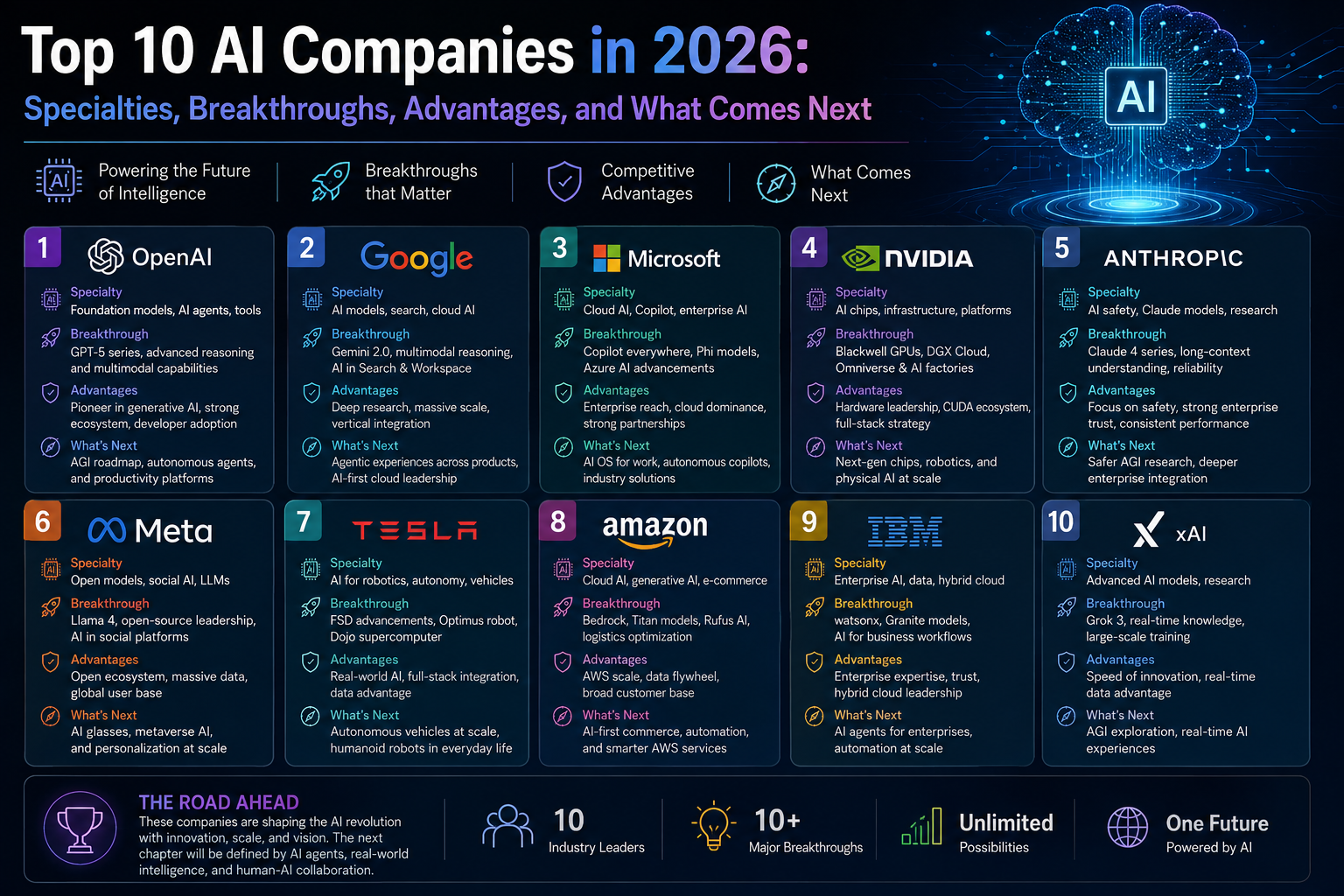
The phrase "best AI company" is too broad for 2026. AI leadership now depends on the job you need done. The company that leads in data center chips may not lead in workplace copilots. The company strongest in frontier reasoning may not be the best fit for on-device privacy, robotics, sovereign AI, or enterprise cloud deployment.
This ranking is therefore organized by specialty. It looks at ten companies that are shaping the AI market through models, infrastructure, cloud platforms, devices, developer tools, enterprise adoption, and governance readiness.
Quick Take
- NVIDIA remains the infrastructure king because modern AI runs on accelerated compute, networking, software, and full AI factory design.
- OpenAI, Google DeepMind, and Anthropic lead the frontier model conversation from different angles: general intelligence, multimodal systems, agentic work, and safety-focused enterprise AI.
- Microsoft and AWS are essential because enterprises often buy AI through productivity suites, cloud platforms, identity systems, governance controls, and developer ecosystems.
- Meta, Apple, Qualcomm, and Mistral AI matter because the next phase is not only cloud chatbots. It is open models, on-device intelligence, edge AI, mobile AI, sovereign AI, and domain-specific deployment.
- The smartest AI strategy in 2026 is not choosing one vendor forever. It is building a governed model portfolio that can route work to the best model, chip, or platform for each risk level and workflow.
The best AI company in 2026 depends on the use case: frontier reasoning, enterprise workflow, AI infrastructure, on-device AI, robotics, coding, sovereign deployment, or regulated automation.
How This List Was Chosen
This is not a stock ranking, revenue ranking, or market-cap table. It is an editorial shortlist for technology and business readers who want to understand which AI companies are most strategically important in 2026 and why.
| Selection Factor | What It Means | Why It Matters in 2026 |
|---|---|---|
| AI Specialty | The company's strongest role in the AI stack. | AI is no longer one market. It now spans models, chips, cloud, agents, robotics, cybersecurity, devices, and governance. |
| Technology Breakthrough | A recent model, chip, platform, deployment method, or enterprise feature that changes capability or economics. | Buyers need proof that a vendor is moving the state of the art, not only marketing existing AI features. |
| Enterprise Advantage | Distribution, security controls, developer ecosystem, integration depth, pricing leverage, or regulatory fit. | Most AI value comes when models connect to real workflows, data, permissions, and business systems. |
| Expected Direction | Where the company appears to be heading based on public product direction. | AI roadmaps are volatile, so leaders should watch direction of travel rather than bet only on today's benchmark results. |
| Governance Readiness | Support for safety, security, logging, deployment control, privacy, documentation, and human oversight. | In Europe especially, adoption must be paired with EU AI Act-aware risk classification and operational controls. |
Top 10 AI Companies in 2026
The table below gives the fast view. The ranking reflects strategic importance by specialty, not a claim that one company is superior for every AI project.
| Rank | Company | Specialty | Main Advantage | Breakthrough Signal | What To Expect Next |
|---|---|---|---|---|---|
| 1 | NVIDIA | AI infrastructure, GPUs, networking, software, and full-stack AI factories. | It owns much of the accelerated compute conversation, from chips to systems to developer tooling. | Vera Rubin moving toward production reinforces NVIDIA's role in next-generation agentic AI factories. | More rack-scale AI systems, stronger inference economics, sovereign AI infrastructure, robotics simulation, and enterprise AI factory deployments. |
| 2 | OpenAI | Frontier models, agentic reasoning, multimodal knowledge work, coding, and user-facing AI products. | Deep product adoption through ChatGPT, API tooling, agents, enterprise workflows, and developer ecosystems. | GPT-5.6 emphasizes stronger performance per dollar, coding agents, long-horizon work, and more capable tool use. | More persistent agents, richer multimodal workflows, stronger enterprise controls, and deeper automation across business software. |
| 3 | Google DeepMind | Multimodal AI, science AI, robotics, Gemini models, TPUs, search, and cloud AI. | It combines world-class AI research with Google's distribution, data infrastructure, developer tools, and cloud ecosystem. | Gemini Robotics 2 shows how Gemini-class models are moving from screens into embodied and robot control tasks. | More robotics progress, tighter Gemini integration across Google products, stronger Vertex AI tooling, and more multimodal enterprise workflows. |
| 4 | Microsoft | Enterprise AI operating layer: Microsoft 365 Copilot, Azure AI Foundry, GitHub, Windows, identity, and governance. | Microsoft sits where enterprise work already happens: documents, email, meetings, code, cloud, identity, and security. | Microsoft Foundry updates show continued investment in agents, app building, model choice, evaluation, and enterprise orchestration. | More Copilot-native business processes, model routing, agent orchestration, developer automation, and governance across Microsoft clouds. |
| 5 | Anthropic | Safety-oriented frontier models, enterprise assistants, coding, long-document reasoning, and governed AI adoption. | Claude is strongly positioned for teams that need high-quality reasoning with a safety and enterprise-control narrative. | Claude Enterprise self-serve expands access to enterprise-grade AI with administration, security, and team deployment patterns. | More governed workplace agents, deeper developer tools, stronger policy controls, and continued competition in coding and knowledge work. |
| 6 | Meta | Open model ecosystem, consumer AI, social AI, assistants, smart glasses, and creator workflows. | Meta has enormous consumer reach and a strategic role in open and widely distributed AI models. | The Meta AI app, built with Llama 4, points toward more personalized AI across apps, social platforms, and devices. | More AI-native social features, open-model adoption, creator tools, ads automation, smart-glasses use cases, and consumer assistants. |
| 7 | Amazon Web Services | Cloud AI platform, Bedrock, model marketplace, enterprise infrastructure, agents, and custom AI silicon. | AWS is often the default cloud environment for companies that want model choice, deployment control, and scalable infrastructure. | Recent AWS announcements around Bedrock and agent infrastructure reinforce its role as a deployment platform for production AI. | More governed agent services, better model marketplaces, custom silicon adoption, private enterprise AI deployments, and cloud cost controls. |
| 8 | Apple | On-device AI, private personal intelligence, M-Series chips, Neural Engine, developer frameworks, and consumer devices. | Apple controls the device, silicon, operating system, privacy layer, and user experience in a way few competitors can match. | Apple's third-generation foundation models and M-Series AI compute direction show a growing local and private AI strategy. | More local AI features, private cloud expansion, app-level AI APIs, personal context experiences, and stronger AI workflows on Mac, iPhone, and iPad. |
| 9 | Qualcomm | Edge AI, mobile AI, AI PCs, Snapdragon X, NPUs, connected devices, automotive, and embedded AI. | Qualcomm brings AI inference close to users through power-efficient chips for phones, PCs, vehicles, and edge devices. | Snapdragon X2 Elite platforms highlight high-NPU Windows AI PCs and continued movement toward local AI workloads. | More AI PCs, edge agents, local multimodal features, automotive AI, industrial devices, and private on-device inference. |
| 10 | Mistral AI | European AI, efficient frontier models, enterprise assistants, open model strategy, coding, and sovereign deployment. | Mistral is strategically important for organizations that need European AI options, deployment flexibility, and less vendor lock-in. | Mistral Medium 3, Le Chat Enterprise, and the coding stack point toward cost-efficient enterprise AI with hybrid and self-hosted options. | More European sovereign AI adoption, stronger coding products, in-region inference, enterprise customization, and regulated-sector deployments. |
1. NVIDIA: The AI Factory Company
1NVIDIA deserves the first position because most advanced AI still depends on compute. Models need GPUs, high-speed networking, inference optimization, memory systems, software libraries, and data center design. NVIDIA's advantage is not only the chip. It is the full stack that surrounds the chip.
The company has turned AI infrastructure into a platform category. CUDA, accelerated libraries, networking, server systems, enterprise software, simulation tooling, and reference architectures make NVIDIA hard to replace at scale.
Specialty
Accelerated compute and AI factory infrastructure for training, inference, robotics, simulation, and enterprise AI workloads.
Advantage
The strongest combination of hardware, software, ecosystem, developer trust, and deployment partners in AI infrastructure.
Breakthrough
Vera Rubin signals the next wave of large-scale AI compute for agentic AI factories and high-performance inference.
Expected
Enterprises will care more about total AI factory economics: utilization, inference cost, networking, energy, availability, and sovereign cloud options.
2. OpenAI: Frontier AI and Agentic Work
2OpenAI remains one of the defining AI companies because it combines frontier models with product distribution. The strategic advantage is the loop between research, ChatGPT usage, developer APIs, enterprise deployments, coding tools, and agentic workflows.
For businesses, OpenAI is strongest when the task requires advanced reasoning, multimodal work, coding, natural language interfaces, rapid prototyping, and cross-functional knowledge work. The risk is concentration: depending too heavily on one model provider can create cost, resilience, governance, and procurement challenges.
Best fit: teams building high-value AI assistants, coding agents, analysis workflows, customer-facing copilots, and internal productivity systems where frontier capability matters.
3. Google DeepMind: Multimodal Intelligence and Robotics
3Google DeepMind has a uniquely broad AI position. It works across Gemini models, robotics, science, search, cloud, mobile, developer tools, and TPUs. That makes Google especially important when AI moves beyond text into multimodal reasoning, video, vision, physical tasks, and scientific discovery.
The Gemini Robotics direction is important because it shows how model capability can move into embodied systems. Robotics is still difficult, expensive, and slower to commercialize than software agents, but the direction is clear: AI is leaving the chat window and entering tools, machines, labs, warehouses, and industrial workflows.
Best fit: organizations already using Google Cloud, Workspace, Android, data platforms, search-heavy workflows, or multimodal AI systems.
4. Microsoft: The Enterprise AI Distribution Layer
4Microsoft's advantage is distribution. AI becomes much easier to adopt when it appears inside the tools where employees already work: Word, Excel, Teams, Outlook, GitHub, Windows, Dynamics, Power Platform, and Azure.
Azure AI Foundry and Microsoft Foundry-style tooling matter because enterprises do not only need a model. They need identity, permissions, evaluation, monitoring, deployment pipelines, governance, and integration with existing business systems.
Microsoft's future advantage will depend on whether it can make agents feel like reliable workflow infrastructure rather than extra chat windows pasted onto existing software.
5. Anthropic: Safety-First Enterprise AI
5Anthropic has built a strong position around Claude, especially for long-document reasoning, coding, complex writing, enterprise analysis, and safety-focused AI adoption. The company is important because buyers increasingly want capability and governance together.
For regulated teams, Claude's value is not only model quality. It is the perception of careful system behavior, enterprise controls, and a product direction that emphasizes safer AI deployment. That does not remove the need for internal governance, but it gives risk-sensitive buyers a clearer starting point.
Best fit: teams that prioritize high-quality written analysis, code assistance, legal or policy-heavy workflows, enterprise controls, and cautious assistant behavior.
6. Meta: Open Models and Consumer AI at Scale
6Meta matters because it connects AI to billions of users and has pushed an open-model strategy that shaped the broader ecosystem. Open models help developers inspect, adapt, host, fine-tune, and deploy AI in ways that closed APIs may not allow.
Meta's consumer AI strategy also matters. AI inside social platforms, messaging, creator workflows, advertising, and wearable devices could make assistants less like separate apps and more like ambient features inside daily communication.
The key watchout is trust. Consumer AI that remembers preferences, understands images, and operates inside social environments must be handled with clear privacy controls, user choice, and transparent data practices.
7. AWS: The Model-Choice Cloud Platform
7AWS is critical because many companies want AI inside their existing cloud architecture. Amazon Bedrock, agent services, model choice, managed infrastructure, private deployment options, and custom silicon give AWS a strong role in production AI.
AWS is not always the flashiest name in consumer AI, but it is one of the most important enterprise platforms. It serves buyers who care about procurement, networking, security, region control, workload scaling, observability, and integration with existing cloud services.
Best fit: companies already standardized on AWS that need governed model access, private data integration, agents, scalable inference, and infrastructure flexibility.
8. Apple: Private AI on the Device
8Apple's AI strength is different from the cloud labs. Apple controls the chip, device, operating system, app ecosystem, privacy story, and developer frameworks. That makes it powerful in on-device AI, personal context, mobile assistants, and low-latency local experiences.
The company's foundation model and M-Series direction points to a future where many useful AI tasks happen locally, while heavier requests use private cloud infrastructure. For users and SMEs, that could mean faster, more private AI features in everyday devices.
The challenge is openness. Apple can deliver elegant integrated experiences, but developers and enterprises will watch how much control, observability, and model flexibility they get.
9. Qualcomm: Edge AI and AI PCs
9Qualcomm is important because AI is moving onto devices. Phones, laptops, vehicles, cameras, sensors, and industrial systems need efficient local inference. Snapdragon X2 Elite and Qualcomm's NPU strategy show how the company is turning edge AI into a mainstream buying criterion.
This matters for privacy, latency, battery life, and cost. If a task can run locally, it may avoid cloud round trips, reduce API cost, preserve responsiveness, and keep sensitive data closer to the user. That is useful for AI PCs, field work, regulated environments, and mobile-first teams.
Best fit: device makers, AI PC buyers, edge AI developers, automotive teams, and businesses that need local intelligence without constant cloud dependence.
10. Mistral AI: European and Sovereign AI
10Mistral AI earns a place because Europe needs strong AI companies, not only imported AI services. Mistral's advantage is a combination of efficient models, enterprise products, open-model direction, European positioning, hybrid deployment options, and customization.
Le Chat Enterprise and Mistral Medium 3 show the direction clearly: private enterprise AI, secure data connections, agent builders, model customization, hybrid deployment, and lower-cost performance for professional workflows.
Mistral may not always beat the largest US labs on every frontier benchmark, but it can be strategically valuable for organizations that care about data residency, sovereignty, vendor flexibility, and regulated deployment.
Best Company by Use Case
For most businesses, the useful question is not "which company is number one?" It is "which company fits this workflow, risk level, and deployment environment?"
| Use Case | Best-Fit Companies | Why |
|---|---|---|
| Frontier reasoning and general AI assistants | OpenAI, Google DeepMind, Anthropic | Strong model capability, fast product cycles, enterprise offerings, and broad developer adoption. |
| Enterprise productivity and workflow automation | Microsoft, OpenAI, Anthropic, Google | These vendors sit close to documents, email, meetings, code, collaboration, and identity systems. |
| AI infrastructure and scale-out compute | NVIDIA, AWS, Microsoft, Google | AI at scale depends on GPUs, networking, cloud regions, orchestration, monitoring, and cost controls. |
| On-device AI and private personal intelligence | Apple, Qualcomm, Microsoft | The value comes from local inference, NPUs, OS integration, privacy posture, and device distribution. |
| Open and sovereign AI strategies | Mistral AI, Meta, NVIDIA, AWS | Organizations can use open models, regional infrastructure, hybrid deployments, and vendor-diverse stacks. |
| Robotics and physical AI | Google DeepMind, NVIDIA, Qualcomm, Apple | Physical AI needs multimodal models, simulation, edge chips, sensors, and low-latency local inference. |
| Coding agents and software engineering | OpenAI, Anthropic, Microsoft, Mistral AI | Competitive coding models, IDE integration, agentic workflows, code search, and enterprise controls drive adoption. |
What To Expect in 2026
AI competition in 2026 will not be a simple model leaderboard. The market is moving toward complete systems: models plus tools, memory, retrieval, chips, cloud, devices, governance, and user experience.
Agentic AI Becomes the Default
Companies will move from single-turn chatbots toward agents that plan, use tools, retrieve documents, write code, monitor tasks, and hand work back to humans for approval.
Model Portfolios Replace One-Model Bets
Enterprises will use multiple models for different tasks: fast models for routine work, frontier models for complex reasoning, local models for privacy, and domain models for regulated workflows.
AI Moves Closer to the Device
Apple and Qualcomm show why local AI matters. Many assistants, summaries, translations, and media features will run partly on-device to improve latency and data control.
Infrastructure Becomes Strategy
NVIDIA, AWS, Microsoft, and Google will compete not only on model quality but on cost per task, inference speed, power efficiency, region availability, and deployment control.
Governance Becomes a Buying Criterion
Legal, security, and compliance teams will ask for audit logs, model documentation, risk classification, access controls, data retention rules, and human oversight.
Physical AI Gets Serious
Robotics, simulation, autonomous systems, warehouse automation, and edge AI will become more visible as multimodal and vision-language-action models mature.
EU AI Act and Responsible AI Considerations
For European companies, vendor selection cannot stop at model quality. Under the EU AI Act, organizations need to understand whether their AI system is prohibited, high-risk, limited-risk, or lower-risk, and then apply the right controls. General-purpose AI providers also face transparency and documentation expectations, while deployers remain responsible for how AI is used in real workflows.
Before adopting any of the companies above, build a small governance checklist. It does not need to slow innovation, but it should prevent blind deployment.
| Control Area | What To Check | Why It Matters |
|---|---|---|
| Use-Case Classification | Decide whether the AI system affects employment, education, credit, healthcare, public services, biometric processing, law enforcement, or other sensitive areas. | High-risk use cases require stronger documentation, human oversight, quality management, and monitoring. |
| Data Governance | Map what data enters the model, where it is stored, how long it is retained, and whether personal or sensitive data is processed. | AI governance and GDPR obligations overlap when systems process personal data or confidential business information. |
| Human Oversight | Define where humans review, approve, override, or pause AI-assisted decisions. | Autonomous AI should not silently make consequential decisions without appropriate accountability. |
| Transparency | Tell users when they are interacting with AI where required, and label AI-generated or AI-edited content when appropriate. | Transparency builds trust and supports legal expectations around AI-assisted outputs. |
| Security | Test prompt injection, data exfiltration, jailbreak attempts, supply-chain risk, tool misuse, and agent permissions. | AI systems can become new attack surfaces, especially when agents connect to email, files, code, tickets, or customer systems. |
| Auditability | Keep logs of model versions, prompts, retrieved sources, tool calls, human approvals, and post-deployment incidents. | Without evidence, it is difficult to debug, prove compliance, measure quality, or respond to failures. |
Practical rule: choose AI vendors for capability, but deploy AI systems with governance, documentation, security testing, and human accountability.
Recommendation for SMEs
Small and medium-sized businesses should avoid copying the buying behavior of the largest technology companies. You do not need a giant AI stack on day one. You need a clear workflow, a controlled pilot, measurable success criteria, and a vendor choice that matches your data sensitivity.
For a simple first move, many SMEs should start with Microsoft, Google, OpenAI, Anthropic, or AWS because these vendors already fit common workplace and cloud environments. For local privacy, watch Apple and Qualcomm. For European sovereignty and deployment flexibility, evaluate Mistral AI. For infrastructure-heavy AI products, NVIDIA remains difficult to ignore.
FAQ
What is the best AI company in 2026?
There is no single best AI company for every use case. NVIDIA leads AI infrastructure, OpenAI and Google DeepMind lead much of the frontier model conversation, Microsoft and AWS lead enterprise distribution, Apple and Qualcomm matter for on-device AI, and Mistral AI is important for European sovereign AI.
Which AI company is best for small businesses?
For most small businesses, the best first choice is usually the AI tool already connected to their daily work. Microsoft is strong for Microsoft 365 organizations, Google for Workspace and cloud users, OpenAI or Anthropic for advanced assistants, and AWS for cloud-native AI builders.
Which AI company is strongest for infrastructure?
NVIDIA is the clearest AI infrastructure leader because its GPUs, networking, systems, software, and ecosystem power much of the AI training and inference market. Cloud platforms such as AWS, Microsoft Azure, and Google Cloud are also essential for deployment.
Which company is best for on-device AI?
Apple and Qualcomm are two of the most important on-device AI companies. Apple has tight control over silicon, operating systems, and devices, while Qualcomm is central to mobile AI, AI PCs, edge devices, and efficient NPUs.
Why include Mistral AI in the top 10?
Mistral AI is important because it gives the market a serious European AI company with efficient models, enterprise products, deployment flexibility, open-model strategy, and strong relevance for sovereignty-conscious organizations.
Is this ranking investment advice?
No. This is an editorial technology analysis for AI strategy and enterprise planning. It is not financial advice, stock advice, or a prediction of market performance.