For the past few years, one skill dominated conversations about building applications with large language models: prompt engineering.
Developers experimented with system prompts, few-shot examples, role instructions, chain-of-thought-style prompting strategies, and carefully structured templates to improve model outputs.
But as AI systems evolve from simple chatbots into autonomous AI agents, the challenge is changing.
The question is no longer simply:
“What should we ask the model?”
Increasingly, it is:
“What information should the model have available when it makes this decision?”
This transition represents the rise of context engineering.
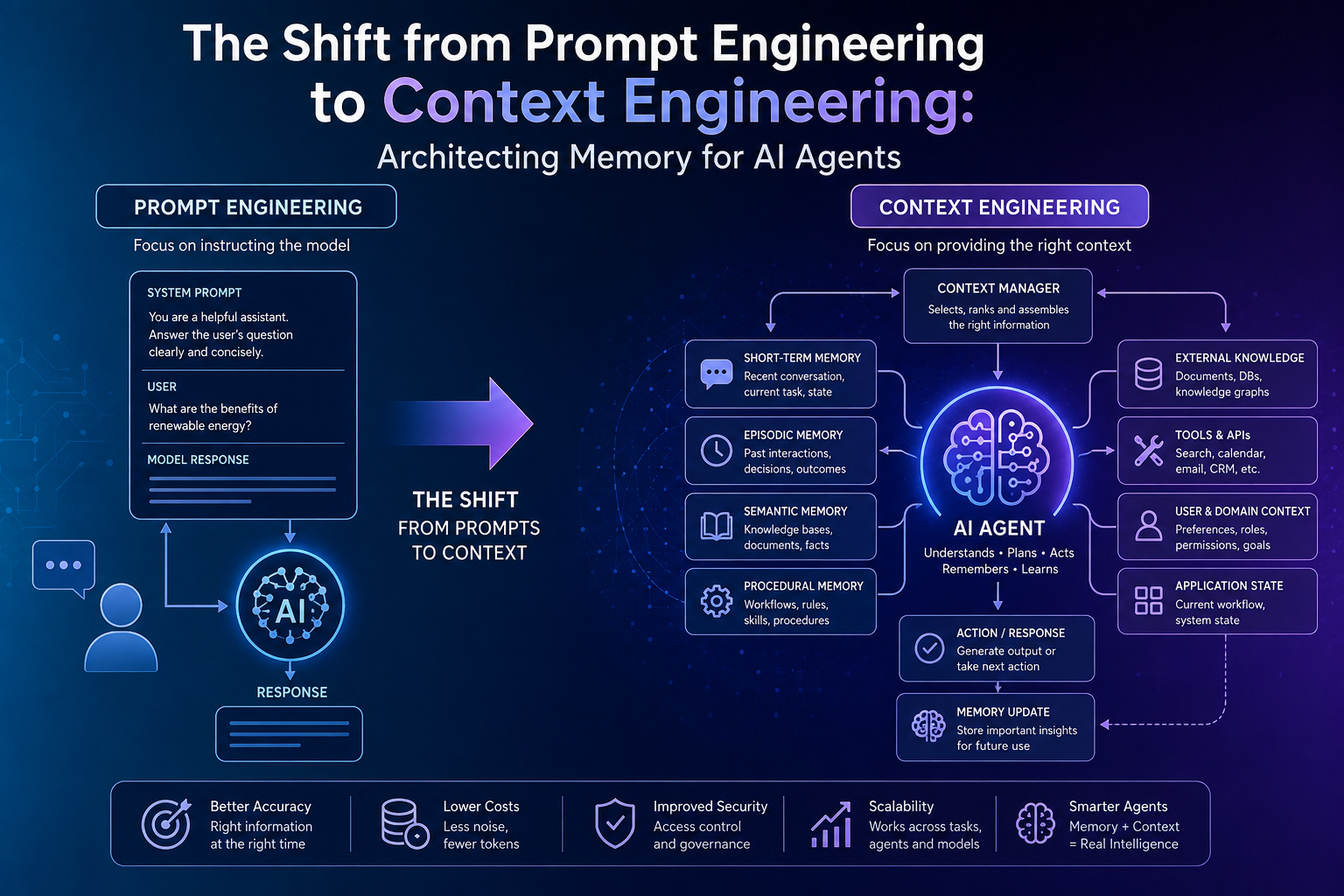
Instead of optimizing individual prompts, context engineering focuses on designing the complete information environment surrounding an AI model—including memory, retrieved knowledge, conversation history, tools, user preferences, application state, and previous agent actions.
For modern agentic systems, this context layer may become just as important as the model itself.
What Is Context Engineering?
Context engineering is the process of designing, selecting, organizing, and delivering the right information to an AI model at the right moment.
A modern AI agent rarely operates using only a user's latest message.
Its effective context might include:
System instructions
Current user request
Conversation history
Previous agent actions
User preferences
Retrieved documents
Database records
API responses
Tool descriptions
Workflow state
Short-term memory
Long-term memory
Examples of previous successful tasks
The objective is not to provide the model with everything available.
The objective is to provide the most relevant information for the current decision.
That distinction is critical.
More context does not automatically produce better AI.
Poorly designed context can introduce noise, increase token costs, slow inference, and even reduce answer quality.
Good context engineering therefore becomes an optimization problem:
Right information + right structure + right time + right model.
Prompt Engineering vs. Context Engineering
Prompt engineering and context engineering are related, but they operate at different levels.
Prompt Engineering
Prompt engineering focuses primarily on how instructions are written.
Typical questions include:
How should the task be described?
What role should the model assume?
Should examples be included?
What output format should be requested?
How can ambiguity be reduced?
For example:
Analyze this customer complaint and classify its urgency as low, medium, or high.
Improving the wording of that instruction is prompt engineering.
Context Engineering
Context engineering asks a broader question:
What does the model need to know before it can classify the complaint correctly?
The context might therefore contain:
Customer account history
Previous support tickets
Product information
Service-level agreement
Current system outages
Customer priority level
Previous escalation decisions
The prompt may remain relatively simple.
The intelligence comes from assembling the correct context around it.
Why AI Agents Make Context Engineering More Important
Traditional chatbot interactions are often short-lived.
A user asks a question, the model generates an answer, and the interaction ends.
AI agents operate differently.
An agent might receive a goal such as:
“Investigate why customer churn increased this month and recommend actions.”
Completing that goal could require the agent to:
Query analytics systems
Examine customer feedback
Compare historical churn
Identify affected segments
Search previous reports
Generate hypotheses
Test those hypotheses
Store intermediate findings
Ask another agent for analysis
Produce a final recommendation
The agent must maintain useful information across all these steps.
Without effective context management, the system can lose track of previous findings, repeat work, retrieve irrelevant information, or make decisions based on outdated data.
This is why memory architecture is becoming a core component of AI agent design.
The Memory Architecture of an AI Agent
A practical agent memory system can be thought of as several layers.
1. Working Memory
Working memory contains information needed for the agent's immediate task.
This could include:
Current instruction
Recent messages
Active tool results
Current reasoning state
Temporary calculations
Intermediate conclusions
It is similar to the information someone keeps mentally available while solving a problem.
Working memory should remain focused.
If every previous interaction is continuously inserted into the model's context window, important information can become buried inside irrelevant history.
2. Episodic Memory
Episodic memory stores information about previous events and interactions.
For an AI agent, this might include:
Tasks completed yesterday
Previous conversations
Decisions made during earlier workflows
Tool calls that succeeded or failed
User feedback on previous outputs
Imagine an AI sales assistant.
Instead of treating every interaction as new, it could remember:
Customer asked about enterprise pricing last week and requested another discussion after budget approval.
That historical event can influence what the agent does next.
Episodic memory gives AI systems something closer to operational continuity.
3. Semantic Memory
Semantic memory stores reusable knowledge rather than specific events.
Examples include:
Company policies
Product documentation
Technical specifications
Customer information
Internal knowledge bases
Industry terminology
This information may live outside the model in databases, vector stores, search indexes, knowledge graphs, or document repositories.
When needed, the agent retrieves relevant pieces and adds them to the active context.
This architecture is closely related to Retrieval-Augmented Generation (RAG).
4. Procedural Memory
AI agents also need to understand how tasks should be performed.
Procedural memory can represent workflows, rules, or reusable procedures such as:
How to approve a refund
How to analyze a sales opportunity
How to deploy an application
How to escalate a support ticket
How to review a document
How to perform a compliance check
Instead of teaching these procedures repeatedly through large prompts, agent platforms can represent them as reusable workflows, tools, policies, or skills.
This can make agent behavior more consistent and maintainable.
Context Engineering Is More Than Memory
Memory is only one part of the context engineering problem.
A sophisticated agent may have access to thousands—or millions—of possible pieces of information.
The system must decide what deserves to enter the model's limited active context.
A simplified architecture might look like this:
User Request
↓
Context Manager
↓
Retrieve Relevant Memory
↓
Retrieve External Knowledge
↓
Check Current Application State
↓
Select Available Tools
↓
Rank and Compress Information
↓
Construct Model Context
↓
AI Model
↓
Action / Response
↓
Store Important New Memory
The context manager becomes an important orchestration layer between the AI model and the surrounding system.
The Context Window Is Not the Same as Memory
Modern AI models can process increasingly large context windows.
That can create the impression that developers can simply insert everything into the prompt.
But a large context window is not equivalent to an effective memory system.
Consider an AI assistant with access to 500 previous conversations.
One approach would be to send all 500 conversations to the model.
A better architecture might:
Analyze the current request.
Search previous interactions.
Rank them by relevance.
Retrieve the most useful memories.
Summarize older information when appropriate.
Inject only the relevant information into the active context.
The second approach can reduce cost and improve signal quality.
Therefore:
Context window = what the model can currently see.
Memory = information the system can preserve and retrieve over time.
Context engineering connects the two.
Retrieval Becomes a Core AI Capability
Retrieval-Augmented Generation originally became popular as a method for allowing LLM applications to answer questions using external documents.
Agentic systems expand this concept significantly.
Agents may retrieve information from:
Vector databases
SQL databases
Enterprise search
Knowledge graphs
APIs
CRM platforms
Email
Documents
Previous conversations
Application logs
Other AI agents
The important question becomes:
What information should be retrieved for this specific task?
That requires more than semantic similarity.
Future context systems may increasingly consider factors such as:
Relevance: Does this information relate to the current goal?
Recency: Is the information still current?
Authority: Is the source trustworthy?
Priority: Is this information important enough to consume context space?
Permissions: Is the agent allowed to access it?
Dependency: Does another task depend on this information?
Context retrieval therefore becomes a form of intelligent information routing.
Memory Requires Forgetting
One of the most overlooked parts of AI memory architecture is forgetting.
An AI agent that remembers everything indefinitely may become inefficient.
Information can become:
Outdated
Duplicated
Contradictory
Irrelevant
Expensive to retrieve
Inappropriate to retain
Effective memory systems therefore need lifecycle policies.
For example:
Temporary memory
Delete after the task ends.
Session memory
Retain during the current conversation.
Operational memory
Keep for a defined workflow or project.
Long-term memory
Store information likely to remain useful.
Archived memory
Keep outside active retrieval but make searchable when required.
Memory management may eventually resemble database management more than traditional prompt design.
Context Compression Will Become Increasingly Important
As agents perform longer workflows, their histories can grow rapidly.
Imagine an autonomous research agent performing hundreds of actions.
Sending every previous action back to the model would quickly become inefficient.
Instead, systems can compress older context.
For example:
Raw history
47 web searches
19 documents analyzed
12 hypotheses generated
8 rejected
4 calculations performed
3 datasets compared
could become:
Compressed context
Analysis indicates that three factors explain most of the observed change. Five alternative explanations were investigated and rejected due to insufficient evidence.
The original information can remain available in storage while the model receives a compact representation.
This creates a useful distinction between:
Stored context — everything the system retains.
and
Active context — what the model needs right now.
Context Engineering for Multi-Agent Systems
The challenge becomes even more interesting with multi-agent AI systems.
Imagine a workflow containing:
Research Agent
Data Analysis Agent
Coding Agent
Compliance Agent
Planning Agent
Review Agent
Each agent may require different context.
The coding agent probably does not need the entire market research history.
The compliance agent may only need regulations, proposed actions, and relevant company policies.
The context layer therefore needs to determine:
Which agent needs which information?
This leads toward role-specific context architectures.
Instead of maintaining one enormous shared memory, systems can create specialized context views for different agents.
That can improve both efficiency and security.
Context Engineering Can Reduce AI Costs
Context design also has significant economic implications.
Large prompts consume tokens.
Repeatedly sending unnecessary conversation history, documents, and tool descriptions can increase inference costs.
A better context pipeline can reduce unnecessary tokens by:
Retrieving only relevant documents
Summarizing historical conversations
Removing duplicate information
Caching reusable context
Selecting only relevant tools
Compressing completed workflow states
For AI applications operating millions of requests, context optimization can become an important infrastructure cost consideration.
Security and Privacy Become Context Problems
Giving AI agents memory introduces another challenge:
What should the agent be allowed to remember?
Organizations will need policies controlling:
Personal information
Confidential company data
Customer records
Authentication credentials
Financial information
Proprietary documents
Temporary tool outputs
Context engineering therefore intersects with AI governance and cybersecurity.
A production-grade memory system should answer questions such as:
Who created this memory?
Where did the information come from?
How long should it be stored?
Which agents can retrieve it?
Can the user delete it?
Is the information still valid?
Agent memory cannot simply be a giant database containing everything the AI has ever encountered.
It needs governance.
From Prompt Templates to Context Pipelines
The architecture of AI applications is therefore changing.
An early LLM application might look like:
User → Prompt → Model → Response
A modern agentic system increasingly looks like:
User
↓
Intent / Goal Detection
↓
Memory Retrieval
↓
Knowledge Retrieval
↓
State Management
↓
Tool Selection
↓
Context Ranking
↓
Context Compression
↓
Model Reasoning
↓
Tool Execution
↓
Memory Update
↓
Response or Next Action
The prompt still exists.
But it becomes only one component of a much larger intelligence pipeline.
Will Context Engineering Replace Prompt Engineering?
Probably not.
Prompt engineering remains important because models still require clear instructions.
But its role is changing.
For simple tasks, good prompting may be enough.
For complex AI agents, however, the quality of the surrounding context can matter just as much as the wording of the instruction.
A beautifully written prompt cannot compensate for missing information.
Likewise, an AI agent with excellent memory retrieval but unclear instructions may still behave poorly.
The strongest systems combine both:
Prompt engineering defines how the model should behave.
Context engineering determines what the model should know.
What Developers Should Learn Next
Developers building AI agents may increasingly need skills beyond traditional prompting.
Important areas include:
Retrieval-Augmented Generation
Vector search
Knowledge graphs
Memory architectures
Agent orchestration
State management
Context compression
Semantic retrieval
Tool routing
Model routing
Data governance
Observability
Evaluation frameworks
In other words, building AI agents increasingly resembles systems engineering.
The model is important, but the architecture surrounding the model determines how reliably that intelligence can be used.
The Future: Context as an AI Operating Layer
The next generation of AI applications may treat context as an independent infrastructure layer.
Instead of every application building its own memory system, organizations could maintain centralized context platforms connecting:
Users + Agents + Models + Enterprise Data + Tools + Memory
An AI agent could enter a task and automatically receive the appropriate:
Identity
Permissions
Historical memory
Organizational knowledge
Available tools
Current workflow state
Relevant documents
Different models could then operate on the same context infrastructure.
This creates an important architectural possibility:
The model becomes replaceable, while the context layer becomes persistent.
Organizations could switch between faster models, reasoning models, specialized models, or future models without rebuilding their entire knowledge and memory architecture.
That may make context infrastructure one of the most strategically valuable layers in enterprise AI.
Final Thoughts
Prompt engineering helped unlock the first generation of generative AI applications.
Context engineering may help define the next.
As AI evolves from answering isolated questions to operating as persistent agents, developers must solve a larger problem than writing better instructions.
They must design systems capable of deciding:
What should the AI know?
What should it remember?
What should it retrieve?
What should it forget?
And what information should be available at this exact moment?
The future of AI agents will not depend only on larger models or larger context windows.
It will depend on how intelligently we architect the information surrounding those models.
That is the shift from prompt engineering to context engineering—and memory sits at the center of it.
Tags
#ContextEngineering #PromptEngineering #AIAgents #AgenticAI #AIMemory #LLM #GenerativeAI #ArtificialIntelligence
#RAG #RetrievalAugmentedGeneration #LLMMemory #AIArchitecture #AgentArchitecture #StatefulAI #MultiAgentSystems #VectorDatabase #AIEngineering #ContextManagement #AIInfrastructure #EnterpriseAI #AIOrchestration #AIDevelopment #FutureOfAI #AI2026