The Year of Agentic AI: 10 Biggest AI Breakthroughs of H1 - 2026
The first half of 2026 has officially marked the "Year of Truth" for Artificial Intelligence. The industry has dramatically evolved away from the simple prompt-and-response chatbots of the past. As traditional scaling laws hit data and data center walls, the finest minds in tech pivoted from making models bigger to making them smarter.
In the first six months of 2026, breakthroughs in post-training, autonomous architecture, physical computing, and biological mapping transformed AI from an analytical tool into an active, self-correcting partner.
Here are the 10 biggest AI breakthroughs that defined first half of 2026.
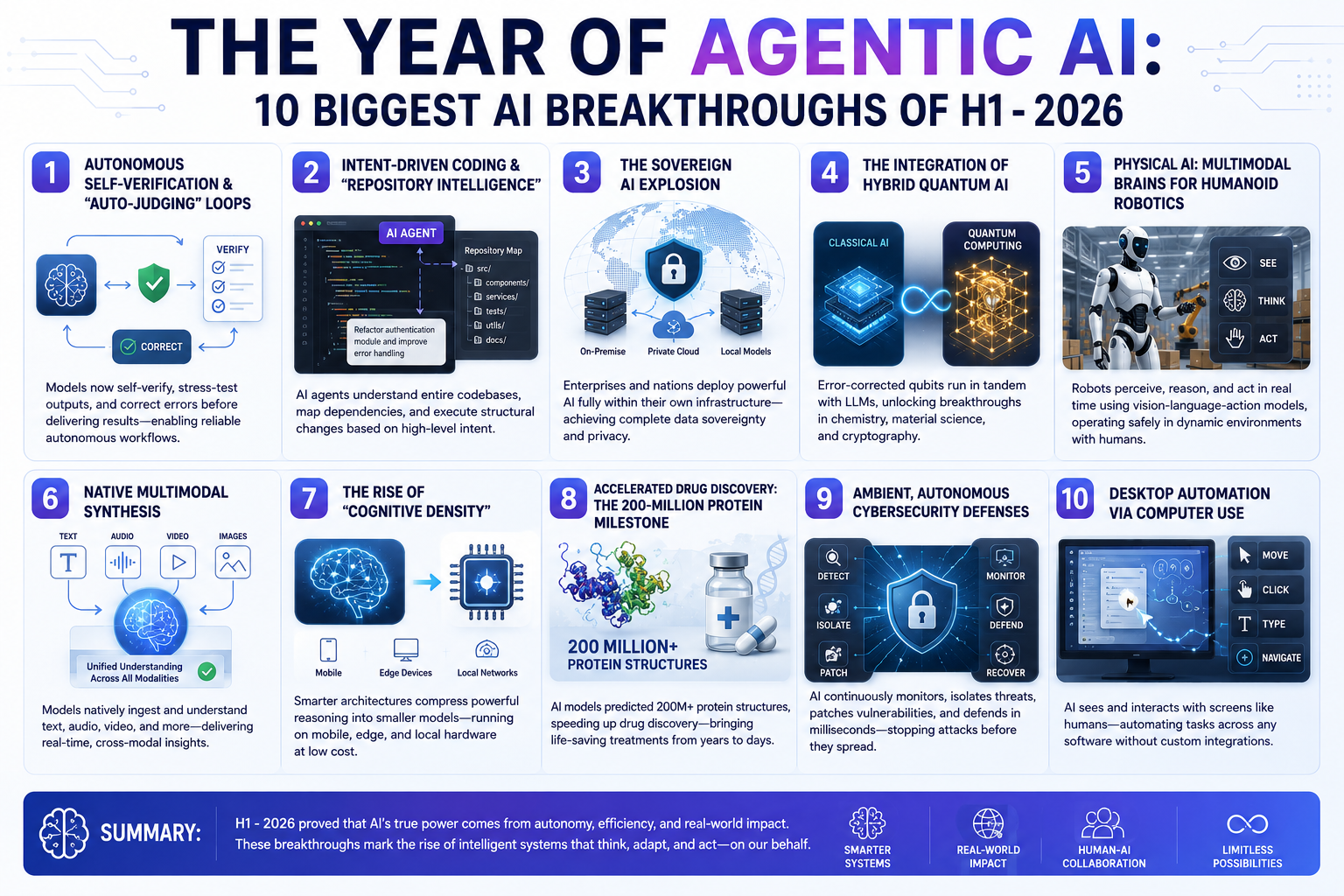
1. Autonomous Self-Verification & "Auto-Judging" Loops
The single biggest obstacle to deploying multi-agent AI workflows has always been the compounding error rate—if an agent makes a mistake on step two, the entire 10-step process collapses. In early 2026, labs cracked autonomous self-verification.
The Breakthrough: Models are now engineered with internal feedback loops that allow them to pause, stress-test their own outputs against deterministic verification systems, and self-correct errors before delivering a final result.
The Impact: This shift has made autonomous multi-hop enterprise workflows (like automated financial auditing and multi-step coding deployments) scalable and reliable without constant human hand-holding.
2. Intent-Driven Coding & "Repository Intelligence"
Software engineering underwent its most radical paradigm shift yet. We have officially moved from text-based "copilots" to total code orchestration.
The Breakthrough: Leading developer platforms rolled out "Repository Intelligence." Instead of suggesting a single line of code, AI agents now analyze an entire, multi-million-line enterprise repository, map out systemic dependencies, and execute structural modifications based on simple English intent.
The Impact: The primary developer bottleneck has shifted from syntax tracking to orchestration, allowing small three-person engineering teams to build, deploy, and maintain hyper-scaled products.
3. The Sovereign AI Explosion
Data privacy regulations and geopolitics triggered a massive migration toward hyper-localized, closed-loop systems.
The Breakthrough: Both nation-states and global enterprises completely bypassed third-party public API dependencies. Through advanced open-weights foundational models like Meta's Llama 4, organizations successfully deployed top-tier reasoning capabilities entirely within localized, private hardware stacks.
The Impact: Complete corporate and national tech sovereignty with zero risk of proprietary data leakage to external tech giants.
4. The Integration of Hybrid Quantum AI
Quantum computing has transitioned from theoretical physics into production-grade enterprise data centers.
The Breakthrough: Microsoft’s Majorana 1 and IBM’s latest topological quantum architectures achieved a historic milestone: reliable error-corrected qubits running in tandem with LLMs.
The Impact: Supercomputers simulate data, AI identifies patterns, and the quantum layer handles molecular and material modeling with flawless precision. This hybrid architecture has broken decades-old barriers in chemistry and cryptography.
5. Physical AI: Multimodal Brains for Humanoid Robotics
Robots have finally stepped out of safety cages and entered dynamic human environments.
The Breakthrough: "Physical AI" unified vision-language-action (VLA) models natively with advanced robotic reinforcement learning. Robots are no longer locked into rigid, pre-programmed paths; they can "see," interpret chaotic spatial surroundings, and adjust their physical mechanics in real time.
The Impact: Autonomous humanoid systems are now safely operating alongside humans in fulfillment centers, agricultural fields, and manufacturing lines without structural re-engineering of the facility.
6. Native Multimodal Synthesis
The industry has eliminated the old method of "stitching" together text, audio, and video models via separate pipelines.
The Breakthrough: Current front-runner architectures are natively multimodal from day one. Systems ingest hours of high-definition video, raw cross-referenced audio streams, and thousands of pages of text simultaneously, understanding the spatial and temporal links across all mediums instantly.
The Impact: Medical systems can simultaneously cross-examine a patient's historical text charts with live radiological video streams, generating comprehensive diagnostic maps in seconds.
7. The Rise of "Cognitive Density"
As the capital expenditure of running massive frontier models became unsustainably expensive, engineers shifted focus to efficiency.
The Breakthrough: Breakthroughs in sparse expert routing and specialized distillation compressed high-level reasoning capabilities into incredibly small parameter counts.
The Impact: These highly dense, cost-effective models can run natively on mobile hardware, low-power edge devices, and local networks, democratizing advanced AI without crushing corporate cloud budgets.
8. Accelerated Drug Discovery: The 200-Million Protein Milestone
Artificial intelligence has rewritten the timeline for biological and chemical synthesis.
The Breakthrough: Advanced biological models successfully predicted the three-dimensional structures of over 200 million proteins, accelerating drug discovery pipelines from a matter of years to mere days.
The Impact: In H1-2026, clinical trials began for multiple highly targeted oncology treatments, custom vaccines, and synthetic antibiotics specifically engineered by AI to defeat highly resistant superbugs.
9. Ambient, Autonomous Cybersecurity Defenses
With AI scaling the sophistication of cyber threats, defensive security models have adapted by becoming completely autonomous.
The Breakthrough: Security architectures moved to an "ambient" model. Defensive AI monitors network behavior, automatically isolates infected nodes, re-writes compromised source code on the fly to patch vulnerabilities, and defends infrastructure without human intervention.
The Impact: The window to neutralize zero-day exploits has dropped from days to milliseconds, fundamentally reshaping modern enterprise cyber resilience.
10. Desktop Automation via Computer Use
Instead of waiting for apps to build custom API hooks, AI models learned how to use computers exactly like humans do.
The Breakthrough: Frontier models gained the ability to interpret desktop interfaces visually, move cursors, click buttons, type text, and navigate across independent third-party software programs to execute multi-step operations.
The Impact: The total elimination of manual data entry, manual cross-app workflows, and complex software-to-software copy-pasting.
Summary: A Mature Era of Intelligence
The first half of 2026 proved that the true value of artificial intelligence lies not in its raw scale, but in its ability to autonomously execute logic inside the physical and digital frameworks we already use. As these ten breakthroughs continue to mature, the remainder of 2026 will undoubtedly push the boundaries of human-AI collaboration even further.
Tags
#AgenticAI #AIAgents #AutonomousAI #AIBreakthroughs #AI2026 #H12026 #ArtificialIntelligence #GenerativeAI #FutureOfAI #TechTrends2026 #AIInnovation #LLMs #LargeLanguageModels #MachineLearning #MultiAgentSystems #AIResearch #EnterpriseAI #BusinessAI #AIAutomation #WorkflowAutomation #DigitalTransformation #OpenAI #GoogleAI #Anthropic #ClaudeAI #MetaAI #Llama #xAI #Grok #MicrosoftAI #NVIDIA #AmazonAWS #AIInfrastructure #CloudAI #MultimodalAI #ReasoningAI #AICoding #AIProductivity #Technology #Innovation #FutureTech #EmergingTech #TechIndustry #BusinessTechnology #AIStartups #Automation #EnterpriseTechnology #AITrends #NextGenAI #IntelligentAutomation