AI Chips 2026: NVIDIA, AMD, Intel, Google TPU and AWS Trainium Compared
The gold rush for Artificial Intelligence has officially moved into its second phase. In July 2026, the conversation has shifted away from a simple shortage of hardware toward an intense architectural war.
As frontier models require massive training clusters and enterprise applications demand lightning-fast, cost-effective inference for agentic workflows, the underlying silicon matters more than ever.
NVIDIA is no longer the only game in town. Tech giants are fighting back with monster graphics processors and hyper-efficient Custom ASICs (Application-Specific Integrated Circuits) to break free from vendor lock-in.
This technical guide breaks down the flagship AI silicon of 2026: NVIDIA Blackwell Ultra (B300), AMD Instinct (MI350/MI400), Intel Gaudi 3, Google TPU v6 (Trillium), and AWS Trainium 3.
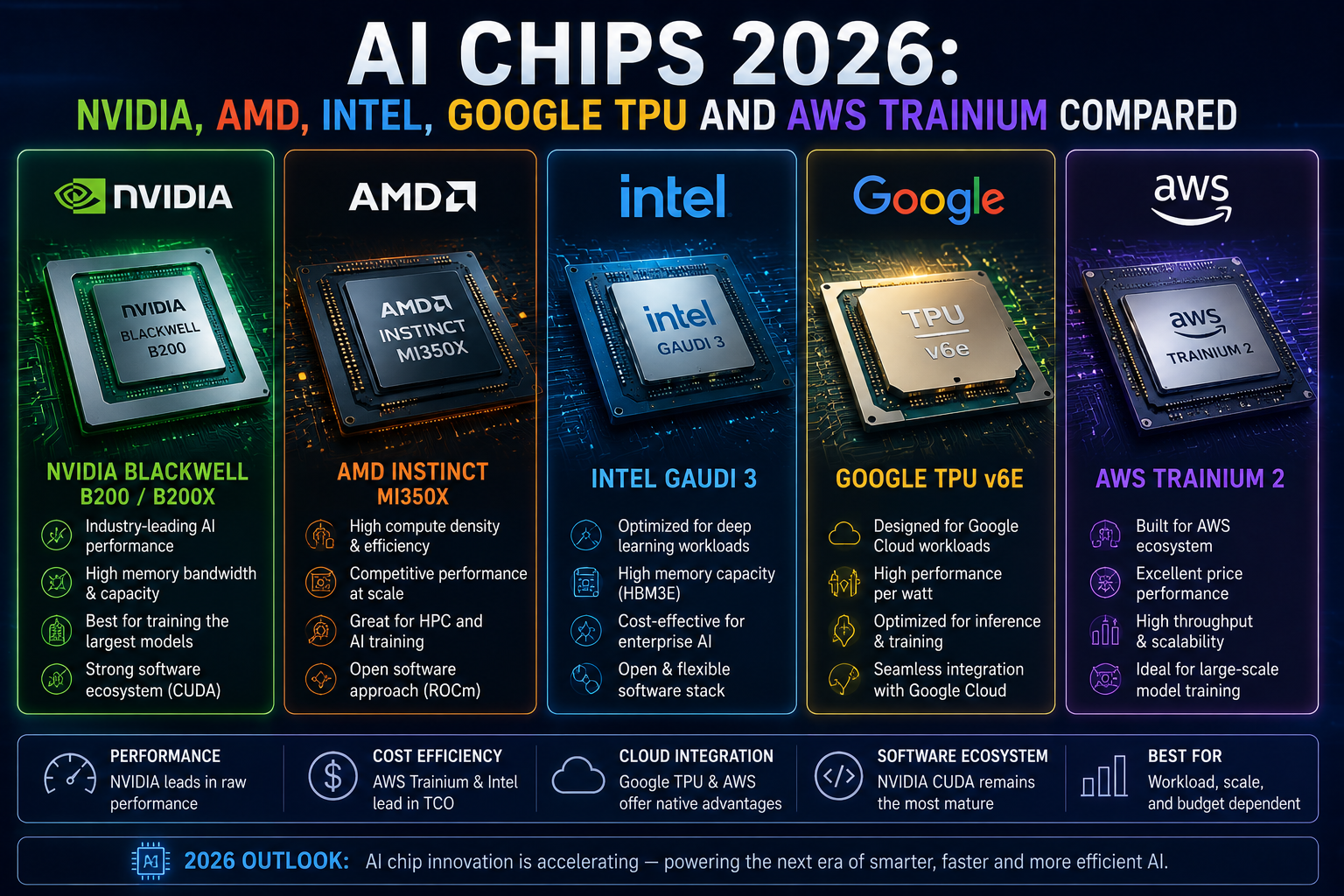
1. NVIDIA Blackwell Ultra (B300): The Unrivaled Super-Chip
NVIDIA’s mid-generation refresh, the Blackwell Ultra B300, is the heavyweight champion of 2026. Rather than completely overhauling the architecture, NVIDIA focused heavily on destroying the "memory wall" that slows down large language models.
The Edge: The B300 features a staggering 288GB of HBM3e memory pushing 8 TB/s of bandwidth. This means an engineering team can host a 100B+ parameter model natively on a single GPU without complex sharding or quantization-induced accuracy loss.
The Killer App: Its refined FP4 (4-bit floating point) tensor engine delivers up to 15 petaFLOPS of dense compute. For high-volume reasoning models (like OpenAI's o-series or DeepSeek R1) that spin up massive chain-of-thought KV caches, the B300 is unmatched.
Verdict: If you are training frontier-class models or running heavy, ultra-low-latency enterprise reasoning pipelines, NVIDIA’s B300 ecosystem (backed by the unstoppable CUDA software platform) remains the gold standard.
2. AMD Instinct (MI350 & MI400): The Validation Era
AMD has officially broken NVIDIA’s monopoly. Supported by massive multi-gigawatt infrastructure commitments from tier-1 labs like OpenAI, AMD’s MI350 series is shipping at massive scale, with the next-gen MI400 series ramping up for the second half of 2026.
The Edge: AMD wins on raw capacity and open economics. The current MI350X matches NVIDIA's 288GB of memory, while the incoming MI400 pushes onto next-gen HBM4 memory architectures with staggering bandwidth leaps up to ~19.6 TB/s.
Software Maturity: The historic knock on AMD was its software ecosystem. In 2026, their ROCm open software stack has matured completely. Frameworks like PyTorch, Hugging Face, and vLLM now run seamlessly on AMD hardware with virtually zero code modification.
Verdict: AMD is the ultimate premium alternative to NVIDIA, offering massive memory advantages that are highly optimized for scaling open-weights models like Llama 4 at a lower total cost of ownership (TCO).
3. Google TPU v6 (Trillium): The Enterprise Cloud Pioneer
Google pioneered custom AI silicon, and their TPU v6 (Trillium) represents a massive architectural leap forward. Designed specifically to work within Google Cloud's "AI Hypercomputer" architecture, Trillium is built for extreme, distributed workloads.
The Edge: Trillium delivers an astonishing 4.7x increase in peak compute performance per chip compared to the previous generation, alongside a 67% improvement in energy efficiency.
The Architecture: Google utilizes its proprietary Inter-Chip Interconnect (ICI) fabric and 3rd Generation SparseCores. This makes Trillium incredibly fast at processing "sparse" data—which is the backbone of advanced ad ranking, e-commerce recommendations, and multi-modal mixtures of experts (MoE).
Verdict: For teams running operations deeply integrated into Google Cloud or Vertex AI, migrating massive inference models to Trillium clusters has yielded up to a 65% reduction in infrastructure spend.
4. AWS Trainium 3: The Hyperscale Disrupter
Amazon Web Services completely altered the market dynamics of AI cloud procurement with Trainium 3. Built on an advanced 3nm process node (TSMC N3P), AWS has turned its custom silicon division into a multi-billion dollar annualized powerhouse.
The Edge: Trainium 3 delivers 2.52 PFLOPs of MXFP8 compute per chip, backed by an innovative Logical NeuronCore Configuration (LNC) that allows developers to fuse physical cores together into a single, highly optimized megacore.
The Zero-Margin Advantage: Because AWS builds this silicon directly, they eliminate the massive third-party hardware margins. This allows them to pass extreme cost savings directly to developers through Amazon Bedrock and EC2 instances. Major players like Anthropic run a massive portion of their production workloads on Trainium infrastructure.
Verdict: AWS Trainium 3 is the ultimate destination for businesses that care less about chasing peak GPU benchmarks and more about achieving the cheapest cost-per-token at massive production scale.
5. Intel Gaudi 3: The Practical Mid-Market Choice
While it may not command the same headlines as Blackwell or Trillium, Intel’s Gaudi 3 has carved out a vital, highly lucrative segment of the 2026 market by focusing purely on price-to-performance transparency.
The Edge: Gaudi 3 features native, on-chip integration of 24 200Gbps Ethernet ports. By avoiding proprietary networking fabrics, companies can scale out Gaudi clusters using standard, cost-effective datacenter networking equipment.
The Strategy: Intel competes aggressively on price. For standard generative AI workloads, fine-tuning, and mid-tier LLM inference, Gaudi 3 offers a fraction of the up-front capital expenditure of an enterprise NVIDIA cluster.
Verdict: Gaudi 3 is the ideal choice for mainstream enterprises that need to run custom, localized AI models on their own infrastructure without overpaying for specialized hardware features they don't actually need.
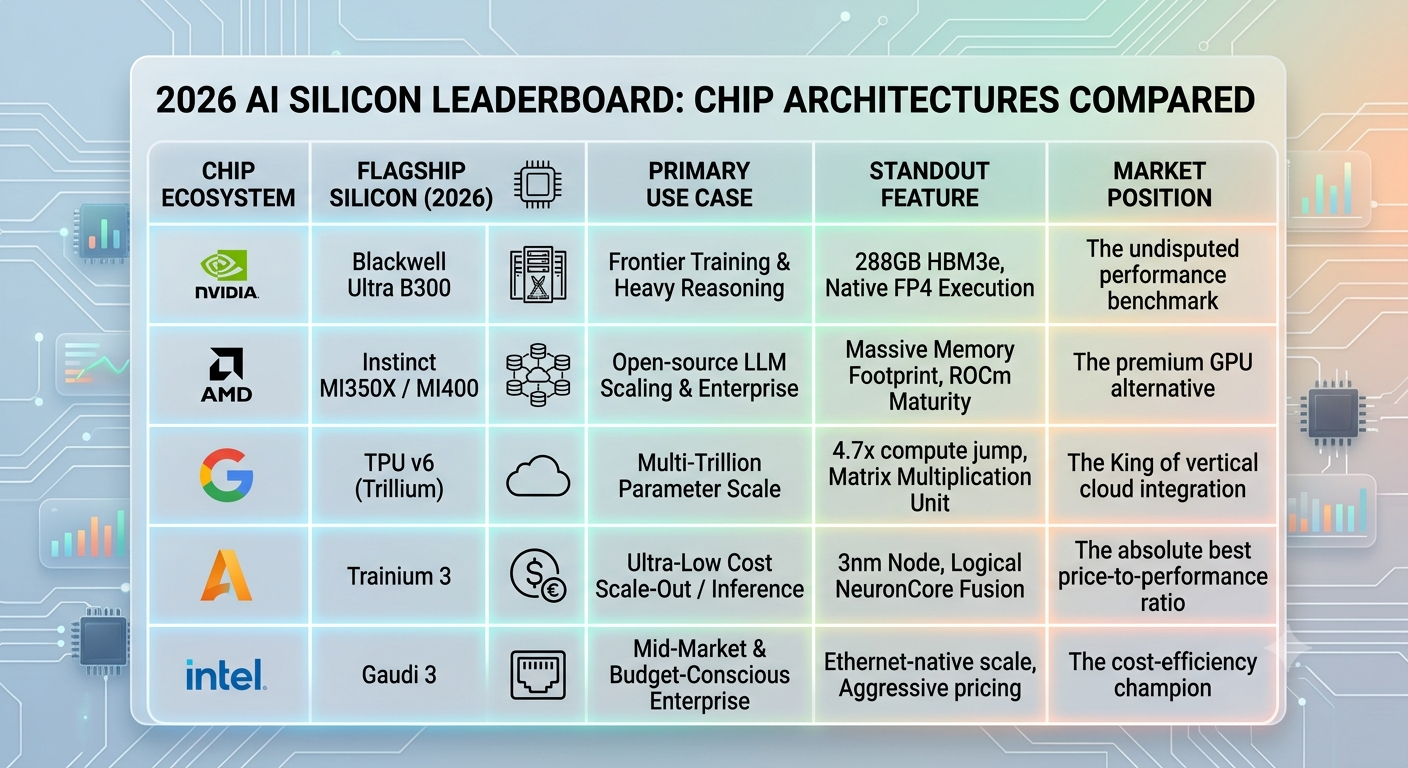
Summary: How to Choose Your 2026 Hardware Stack
The chip you build on in 2026 depends entirely on your engineering bottlenecks:
Choose NVIDIA B300 if absolute performance, cutting-edge FP4 precision, and zero-compromise developer flexibility are your top priorities.
Choose AMD Instinct if you want top-tier GPU performance paired with massive hardware memory pools and open-source software compliance.
Choose Google TPU v6 if your pipelines are heavily multimodal, data-sparse, or native to Google Cloud Vertex ecosystems.
Choose AWS Trainium 3 if you are deploying complex agentic applications at consumer scale and require the lowest possible cost-per-token.
Choose Intel Gaudi 3 if you are an enterprise building a private, cost-conscious data center utilizing standard Ethernet infrastructure.
Tags
#AIChips #NVIDIA #AMD #Intel #GoogleTPU #AWSTrainium #AmazonAWS #AIHardware #Semiconductors #GPU #TPU #AIInfrastructure #DataCenters #AcceleratedComputing #ArtificialIntelligence #GenerativeAI #MachineLearning #DeepLearning #LLMs #LargeLanguageModels #AI2026 #TechTrends2026 #CloudComputing #CloudAI #EnterpriseAI #HighPerformanceComputing #HPC #AITraining #AIInference #ChipWars #SemiconductorIndustry #Silicon #Innovation #Technology #FutureTech #TechIndustry #DataInfrastructure #EdgeAI #AIProcessors #Compute #AIInvestment #TechInvestments #DigitalTransformation #EmergingTech #HardwareComparison #AIBenchmark #NVIDIAAI #AMDInstinct #IntelGaudi #GoogleCloud