AI Energy Demand: Can the Power Grid Keep Up with AI Growth? (July 2026)
The generative AI boom is no longer limited by software design or even by the availability of raw graphics processors. In July 2026, the absolute bottleneck of the artificial intelligence revolution has boiled down to a fundamental physical constraint: electricity.
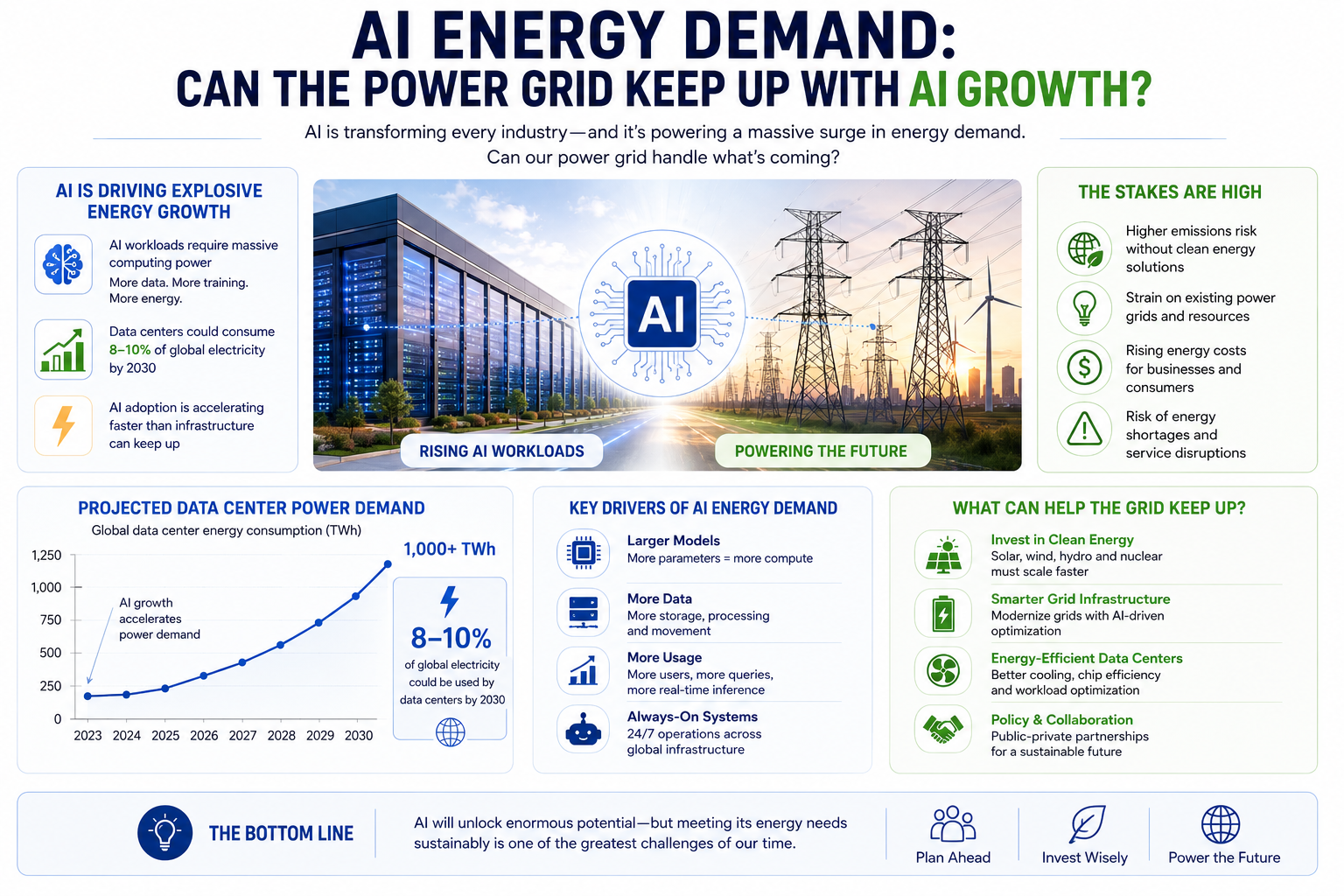
As tech giants race to deploy multi-trillion parameter models and autonomous agent networks, the global energy infrastructure is hitting a wall. According to estimates from Gartner, worldwide data center electricity demand is projected to double from its 2023 baseline, exceeding 1,000 Terawatt-hours (TWh). That is more than the annual energy consumption of the entire nation of Japan.
This deep-dive analysis explores the structural strain AI places on power grids, the physics behind why modern AI hardware is so power-hungry, and the drastic, multi-billion-dollar energy strategies tech companies are employing to keep the lights on.
1. The Physics of the Energy Crunch: Beyond the Legacy Wall
For nearly a decade, global and domestic data center power requirements grew at roughly a flat line. Hardware efficiency gains perfectly offset the expanding needs of cloud data processing.
AI changed that permanently.
Unlike standard cloud computing workloads that experience variable, spike-heavy traffic, an AI cluster operates at constant, near-maximum utilization. The introduction of state-of-the-art silicon, such as NVIDIA's Blackwell architecture, has forced a complete structural break from historical data center design assumptions.
The Rack Density Explosion
Legacy Infrastructure: A traditional enterprise cloud data center built over the last ten years handles 10 to 15 kilowatts (kW) per server rack. Air cooling is more than enough to handle this heat dissipation.
Modern AI Infrastructure: A single NVIDIA GB200 NVL72 rack draws between 120 kW and 140 kW.
An architecture requiring 10x the power density of a standard server rack cannot physically run on legacy infrastructure—the sheer heat would melt the components. As a result, 2026 has marked the absolute death of traditional air-cooling for frontier AI clusters. Operators are now required to deploy high-cost, direct-to-chip liquid cooling (DLC) systems natively.
2. Training vs. Inference: The Rise of AI Agents
A common misconception during the early days of ChatGPT was that training models was the primary source of environmental stress. While training a single frontier model does draw massive amounts of megawatt-scale power for months at a time, inference (running the models live for users) now accounts for 80% to 90% of total AI energy draw.
                                                           ┌─── Traditional Google Keyword Search
                                                           │          (Uses a fraction of a watt-hour)
SINGLE QUERY POWER DRAW ───┤
                                                           └─── Generative/Reasoning AI Query
                                                                      (Consumes ~10x the electricity)
A standard keyword search on a traditional search engine takes a fraction of a watt-hour. In contrast, a single multi-step reasoning query on a generative platform pulls roughly 10x that amount of electricity.
With the mainstream integration of autonomous AI agents that work continuously in the background—browsing the web, writing code, and automating enterprise systems—data centers must sustain an unrelenting, high-wattage base load around the clock.
3. The Interconnection Nightmare: Why the Grid is Failing
The primary issue is not always a lack of raw electricity production; it is transmission and distribution.
In the United States, which hosts roughly 45% of global data center capacity, the grid interconnection queue has swelled to over 2,600 Gigawatts (GW) of pending requests—more than double the total installed capacity of the entire U.S. power plant fleet. Data centers waiting to pull power from the main grid face backlog delays stretching anywhere from five to ten years.
Because of these utility delays, Bloom Energy projects a massive 35 GW energy gap by 2030. To bypass this infrastructure ceiling, nearly 30% of upcoming AI data center sites are planning to deploy on-site power generation as their primary energy source, working independently of public utilities.
4. The Tech Strategy: Moving Beyond Renewables to Nuclear
While major tech companies remain committed to aggressive decarbonization goals, intermittent clean energy sources like solar and wind cannot maintain the 24/7, high-uptime loads required by an AI factory. If the wind stops blowing or the sun goes down, an active frontier training cluster cannot simply pause.
This reality has triggered a historic Nuclear Power Renaissance across the technology sector.
                                                               ┌─── 1. Core-Side Co-Location (Behind-the-Meter)
                                                               │            (Data center plugs directly into existing large nuclear reactors)
                                                               │
AI NUCLEAR RECOVERY IN 2026 ───┼─── 2. Small Modular Reactors (SMRs)
                                                               │           (50-acre compact, passive-safety reactors deployed on-site)
                                                               │
                                                               └─── 3. Microreactors
                                                                              (Portable, modular units for hyper-targeted off-grid facilities)
Behind-the-Meter Co-location
Instead of drawing from municipal power, hyperscalers are building massive data center campuses directly adjacent to active nuclear facilities. Major cloud providers have locked down multi-decade Power Purchase Agreements (PPAs) with major nuclear-tied utilities, pulling clean baseline energy straight from the source.
The Rise of Small Modular Reactors (SMRs)
Small Modular Reactors represent the most significant infrastructure shift of the decade. Unlike massive, multi-billion-dollar traditional nuclear plants that take a decade to build, SMRs are compact, scalable, factory-assembled reactors occupying roughly 50 acres.
The Footprint: While a solar farm requires thousands of acres to generate equivalent power, an SMR can generate 15 to 50 MW per module right on the data center campus.
Passive Safety: Modern 2026 SMR designs utilize passive cooling loops that automatically shut down the reactor using natural convection and gravity during a utility failure, completely removing the threat of human-error meltdown.
The Jevons Paradox: Will AI Ever Become Energy-Efficient?
As software engineers optimize algorithms, the energy cost per individual AI query is dropping rapidly. However, efficiency gains are triggering Jevons Paradox: as an item or service becomes cheaper and more efficient to produce, the human consumption of that resource scales exponentially.
Because AI tokens are cheaper, faster, and more accessible than ever before, the absolute volume of usage is skyrocketing. Efficiency is not reducing energy demand; it is unlocking entirely new agentic use cases that draw even more aggregate power from the world's infrastructure.
Final Thoughts: Energy is the Ultimate Currency of Intelligence
The internet is moving away from an economy measured in clicks and impressions toward a physical economy measured in tokens-per-watt.
The tech companies that dominate the next decade will not necessarily be the ones with the slickest consumer user interfaces or the largest software ecosystems. The crown will go to the platforms that secure long-term, clean, independent baseload power. Until the grid catches up to the software, the growth of artificial intelligence remains at the mercy of the physical wire.
Tags
#AIEnergy #AIInfrastructure #PowerGrid #EnergyDemand #Electricity #DataCenters #AIDataCenters #ArtificialIntelligence #AI2026 #GenerativeAI #NVIDIA #AIChips #CloudComputing #CloudAI #Semiconductors #HighPerformanceComputing #HPC #SustainableAI #GreenAI #CleanEnergy #RenewableEnergy #NuclearEnergy #EnergyTransition #GridModernization #PowerGeneration #EnergyStorage #ElectricUtilities #ElectricGrid #Technology #TechTrends2026 #FutureTech #DigitalInfrastructure #AIInvestment #TechInvestments #EnterpriseAI #Innovation #ClimateTech #CarbonEmissions #NetZero #DataInfrastructure #Compute #MachineLearning #LLMs #BusinessTechnology #EmergingTech #Infrastructure #EnergySecurity #SmartGrid #UtilityIndustry #FutureOfAI