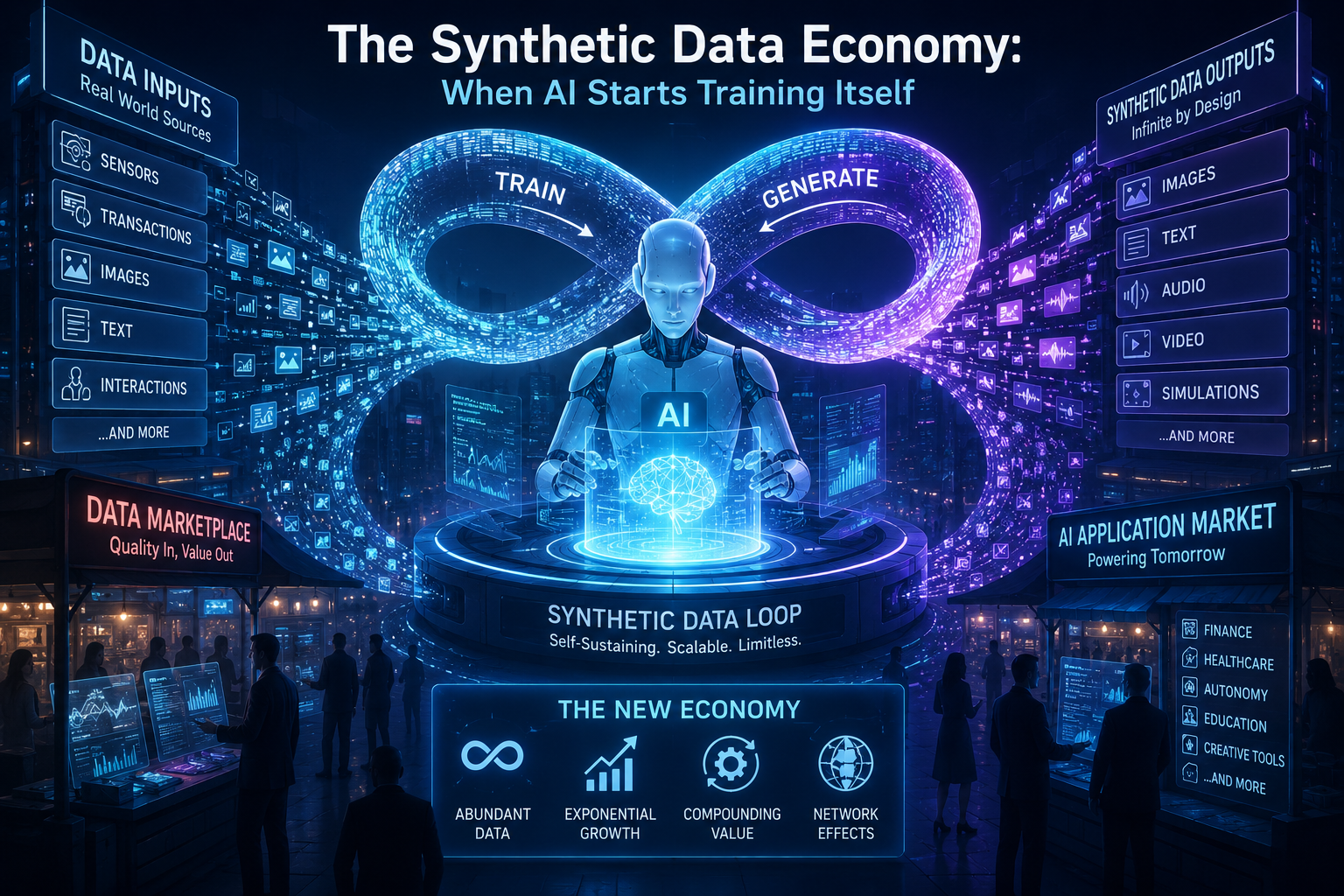
The Synthetic Data Economy: When AI Starts Training Itself
Imagine a world where the rarest, most valuable resource on the planet isn’t oil, gold, or lithium—but data. For the past decade, tech giants have been mining the internet like a digital gold rush, scooping up every blog post, tweet, video, and Reddit thread to feed the insatiable appetite of Artificial Intelligence.
But we are running into a massive problem: the internet is running out of data.
Experts predict that tech companies could exhaust the supply of high-quality public text data within the next few years. So, what happens when the digital well runs dry?
Welcome to the Synthetic Data Economy, a shifting frontier where AI stops relying on human footprints and starts training itself.
What is Synthetic Data?
Simply put, synthetic data is information that is artificially generated by computer algorithms rather than created by real-world human activity.
Instead of scraping a million medical records or tracking real-world driving habits, engineers use advanced AI models to generate simulated medical records or virtual driving scenarios. This data mirrors the statistical properties of the real world, but it contains zero real-world identity or footprint.
The Concept: It is AI creating the textbooks for the next generation of AI.
Why the Shift to an Artificial Economy?
The pivot toward synthetic data isn’t just a desperate backup plan; it’s quickly becoming a preferred strategy. Here is why the synthetic data market is booming:
1. Breaking the Data Bottleneck
Human data is messy, disorganized, and limited. If you want to train an autonomous vehicle to navigate a rare, dangerous blizzard at night, waiting for that exact real-world scenario to happen is inefficient and dangerous. Synthetic data allows developers to "photoshop" reality, creating millions of variations of rare scenarios (known as edge cases) in seconds.
2. Solving the Privacy and Copyright Crisis
The current AI landscape is a legal minefield. Publishers, artists, and everyday users are rightfully demanding protection over their intellectual property and personal data. Synthetic data completely bypasses this. Because it’s mathematically generated from scratch, there is no real person to track down, no copyright to violate, and no privacy policy to breach.
3. Cleaning the Mirror
Human data is inherently biased because human history is biased. When AI trains on the internet, it learns our worst habits, prejudices, and factual errors. By utilizing synthetic data, scientists can curate perfectly balanced datasets—deliberately removing societal biases and ensuring a fairer AI output.
The Dark Side: The "Model Collapse" Risk
While a self-training AI sounds like a perfect feedback loop, it comes with a glaring psychological and mathematical risk known as Model Collapse (or autophagous loop syndrome).
When an AI trains on data generated by another AI, it begins to forget the nuances of reality. Think of it like making a photocopy of a photocopy. The first copy looks great. By the tenth copy, the text is blurry. By the hundredth copy, it's just meaningless smudges.
If AI models completely cut off human input, they risk amplifying their own minor errors over generations, eventually degrading into gibberish. Maintaining a baseline of genuine human creativity and chaotic real-world data will always be the "secret sauce" that keeps AI grounded.
Who Profits in the Synthetic Data Economy?
This shift is creating an entirely new B2B ecosystem. We are seeing the rise of specialized "Data Factories"—companies whose sole purpose is to manufacture premium, hyper-realistic data for specific industries.
Healthcare: Generating virtual patient cohorts to test new life-saving drugs without risking patient privacy.
Finance: Simulating millions of sophisticated, never-before-seen fraud attempts to train banking security systems.
Robotics: Creating hyper-realistic physics engines where robots can "practice" walking or sorting items a billion times before they are ever built in the physical world.
The Way Forward: A Hybrid Future
The Synthetic Data Economy isn't about replacing humanity; it's about scaling human capability. The most powerful AI models of tomorrow won't just be trained on the messy, chaotic wild-west of the public internet, nor will they live entirely in an artificial simulation.
The future belongs to a hybrid model: human ingenuity providing the spark, and synthetic data providing the scale. As AI starts training itself, the human role will shift from data creators to data curators—the directors of a vast, digital simulation.
What are your thoughts on AI training itself? Does it pave the way for safer, more private technology, or does a world of "artificial reality" worry you? Let’s discuss in the comments below!
Tags
#SyntheticData #ArtificialIntelligence #FutureOfAI #MachineLearning #TechTrends #GenerativeAI #DataPrivacy #AIDevelopment #TechEconomy #DeepLearning #Innovation #BigData #DigitalTransformation #AISimulation