The Rise of AI Operating Systems: Why Models Are Becoming Commodities
The Next AI Battle Won't Be About Models
For the past few years, the Artificial Intelligence industry has been obsessed with one question:
Which AI model is the smartest?
Every few months, a new benchmark appeared. Companies competed over larger context windows, faster reasoning, better coding capabilities, and more impressive demos. But as we move deeper into 2026, a major shift is taking place.
The most valuable companies in AI may no longer be the ones building the best models. Instead, the winners could be those building the best AI Operating Systems.
The AI industry is beginning to realize something that every major technology wave eventually discovers:
Technology becomes valuable not because of the engine itself, but because of the ecosystem built around it.
Just as personal computers needed Windows and macOS, smartphones needed iOS and Android, and cloud computing needed AWS and Azure, AI is now entering its operating system era. And that changes everything.
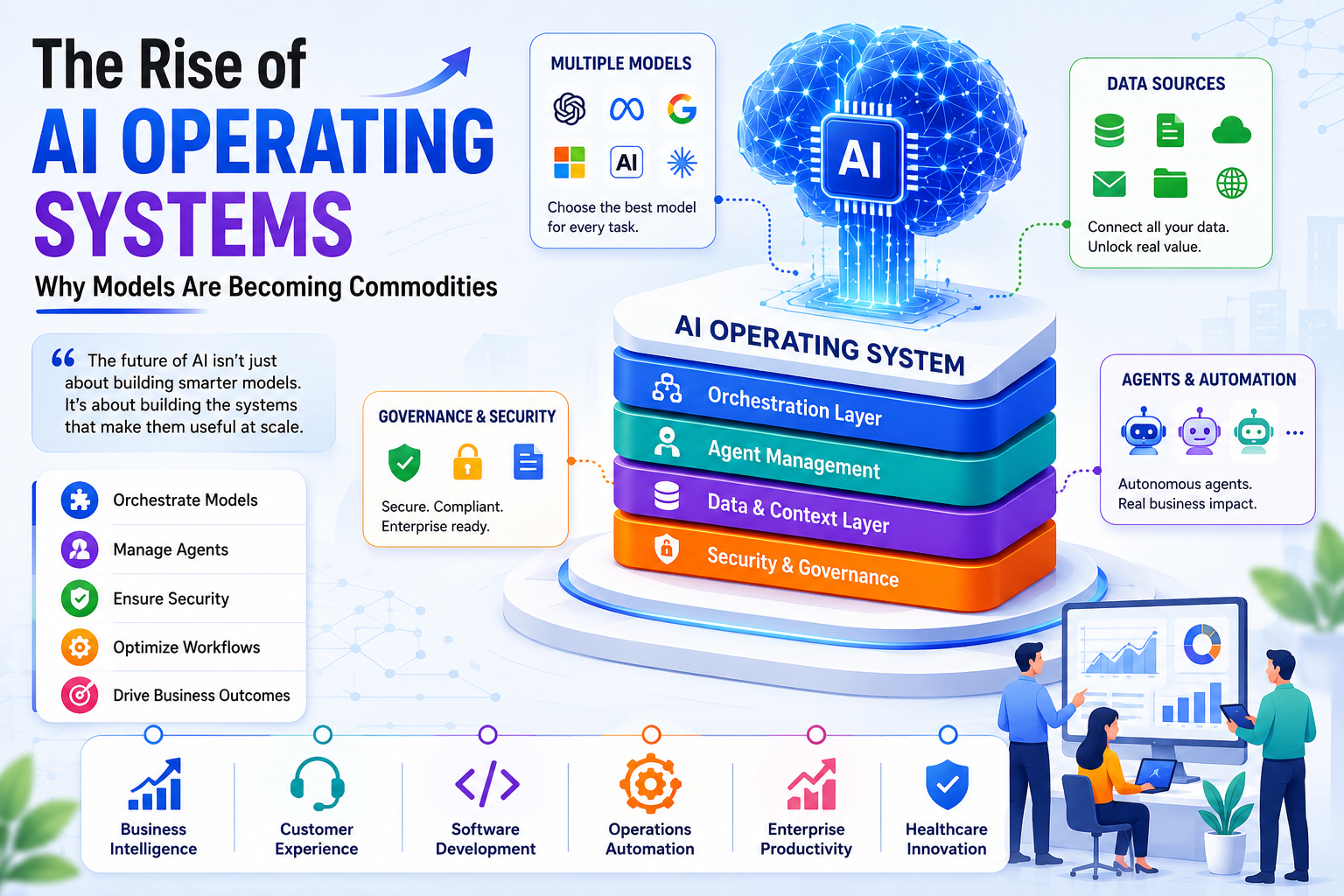
What Does "AI Operating System" Actually Mean?
When people hear the term AI Operating System, they often imagine a futuristic version of Windows or Linux.
But an AI Operating System is much broader.
An AI Operating System is the layer that connects:
AI Models
Data Sources
Applications
Agents
Security Controls
User Interfaces
Workflows
Enterprise Systems
Instead of simply answering questions, AI Operating Systems manage how intelligence flows across an organization or digital ecosystem.
Think of it as the infrastructure that enables AI to become useful at scale.
The model becomes just one component inside a much larger system.
The Commoditization of AI Models Has Already Started
In technology, every breakthrough eventually becomes accessible.
The same pattern is now emerging with AI models.
A few years ago, access to powerful Large Language Models (LLMs) was limited to a handful of organizations with enormous computing resources.
Today:
Open-source models are increasingly capable.
Smaller models achieve impressive performance.
Specialized models outperform larger general-purpose systems in specific tasks.
Cloud providers offer AI capabilities as standard services.
Enterprises can choose from multiple competitive providers.
As a result, the competitive advantage of simply having a strong model is shrinking.
Organizations now have more options than ever:
Proprietary models
Open-source models
Hybrid deployments
Domain-specific models
On-device AI models
The question is no longer:
"Which model should we use?"
The question is becoming:
"How do we orchestrate intelligence across our entire business?"
The New Competitive Moat Is Orchestration
The next generation of AI value creation lies in orchestration.
Organizations need systems that can:
Select the best model for a task
Route requests intelligently
Manage data securely
Coordinate AI agents
Monitor performance
Control costs
Ensure compliance
This orchestration layer is rapidly becoming the most strategic part of AI deployments.
Imagine a company using:
One model for coding
Another for document analysis
A third for customer service
A fourth for image generation
Users never see these differences.
The AI Operating System manages everything behind the scenes.
This approach allows organizations to adapt quickly as new models emerge.
Why Enterprises Are Demanding AI Operating Systems
Most businesses do not want dozens of disconnected AI tools.
They want:
Reliability
Governance
Security
Visibility
Cost control
An enterprise might have:
Thousands of employees
Hundreds of applications
Multiple cloud providers
Strict regulatory requirements
Managing AI across such environments requires more than a chatbot.
It requires a centralized intelligence platform.
This is where AI Operating Systems become essential.
Key enterprise requirements include:
Identity Management
Who can access what?
Security Controls
How is sensitive data protected?
Compliance Monitoring
Can AI decisions be audited?
Workflow Automation
Can AI trigger actions automatically?
Knowledge Integration
Can AI access company information securely?
These capabilities are often more important than model performance alone.
The Rise of Agentic AI Makes Operating Systems Critical
The emergence of AI Agents is accelerating demand for AI Operating Systems.
Traditional AI systems respond to requests.
Agents take action.
They can:
Plan tasks
Execute workflows
Coordinate systems
Make decisions
Interact with software
When organizations deploy hundreds or thousands of agents, coordination becomes essential.
Without a governing platform, enterprises risk:
Conflicting actions
Security vulnerabilities
Excessive costs
Poor visibility
Operational chaos
AI Operating Systems provide the framework that allows agents to operate safely and effectively.
The Lessons from Previous Technology Revolutions
History offers valuable clues.
Personal Computing
The PC revolution wasn't won by hardware alone.
Operating systems became the foundation of the ecosystem.
Smartphones
The most valuable platforms weren't individual apps.
They were iOS and Android.
Cloud Computing
Success came from cloud platforms that enabled developers to build and scale applications.
Artificial Intelligence
The same pattern is emerging.
Models are becoming infrastructure.
Platforms are becoming differentiators.
The companies controlling AI ecosystems may capture more value than those building individual models.
The Future of AI Will Be Multi-Model
Many organizations are realizing there is no single perfect AI model.
Different tasks require different strengths.
Examples include:
Coding
Specialized code-generation models.
Research
Models optimized for reasoning and retrieval.
Customer Support
Cost-efficient conversational systems.
Creative Work
Multimodal content generation models.
Manufacturing
Domain-specific industrial AI systems.
AI Operating Systems make this multi-model future practical.
Rather than committing to one provider, businesses can dynamically choose the best tool for each task.
AI Operating Systems Could Become the New Cloud Platforms
Cloud computing transformed IT by abstracting infrastructure complexity.
AI Operating Systems may do the same for intelligence.
Future AI platforms may offer:
Model marketplaces
Agent marketplaces
Workflow automation
Knowledge management
Enterprise governance
Security frameworks
AI observability
Performance analytics
Organizations would focus on outcomes rather than model management.
The AI Operating System would handle everything else.
Who Stands to Win?
Several categories of companies are positioned to benefit from this shift.
Technology Giants
Large platform providers already possess:
Infrastructure
Developer ecosystems
Enterprise relationships
Enterprise Software Vendors
Companies integrating AI into existing workflows have a natural advantage.
Cloud Providers
Cloud platforms are evolving into AI platforms.
AI-Native Startups
New companies focused on orchestration, agents, and AI management could become major industry players.
The market remains wide open.
No company has yet established dominance comparable to Windows, Android, or AWS in the AI Operating System category.
Challenges Ahead
The path forward is not without obstacles.
Key challenges include:
Security
AI systems will access increasingly sensitive information.
Standardization
The industry lacks universal AI interoperability standards.
Governance
Organizations need clear accountability frameworks.
Cost Optimization
Running multiple models and agents can become expensive.
Trust
Users must understand how AI decisions are made.
The most successful AI Operating Systems will solve these challenges while remaining easy to use.
What Happens Next?
Over the next few years, we may witness a major shift in how AI is perceived.
Today's conversation focuses on:
Models
Benchmarks
Parameters
Context windows
Tomorrow's conversation may focus on:
Ecosystems
Agents
Platforms
Workflows
Intelligence orchestration
The companies that build the connective tissue between AI models and real-world business outcomes could become the defining technology leaders of the decade.
Final Thoughts
The AI industry is moving beyond the era of model obsession.
As AI becomes more accessible and competitive, value is shifting toward orchestration, integration, governance, and ecosystem development. Models will remain important, but they are increasingly becoming components within larger intelligent platforms.
The companies that build the operating systems for AI—connecting models, agents, workflows, and enterprise systems—could define the next chapter of the technology industry.
The AI model race continues.
But the AI Operating System race has already begun.
Tags
#ArtificialIntelligence #AI #AIOperatingSystem #AgenticAI #AIAgents #GenerativeAI #EnterpriseAI #LLM #LargeLanguageModels #AIPlatforms #AIOrchestration #MultiModelAI #DigitalTransformation #CloudComputing #MachineLearning #FutureOfAI #Automation #EnterpriseTechnology #AIGovernance #Innovation #TechTrends #FutureOfWork #SoftwarePlatforms #BusinessTransformation #TechnologyLeadership #EmergingTechnology #AIEcosystem #IntelligentSystems #AIStrategy #AI2026