Inference Is the New Cloud: The Hidden Economics of AI at Scale
The golden age of SaaS was built on a beautifully simple economic model: build a software product once, host it on the cloud, and rent it out to millions with near-zero variable costs. AWS, Microsoft Azure, and Google Cloud made infrastructure so cheap and scalable that software profit margins became the envy of Wall Street. Today, that economic predictability is fracturing.
But a massive tectonic shift is happening under our feet.
As Artificial Intelligence transitions from a novelty to the backbone of global software, the traditional cloud computing model is fracturing. The new battleground isn’t about where you store your data or host your website. It’s about how much it costs you to compute a single answer.
Welcome to the era where Inference is the New Cloud.
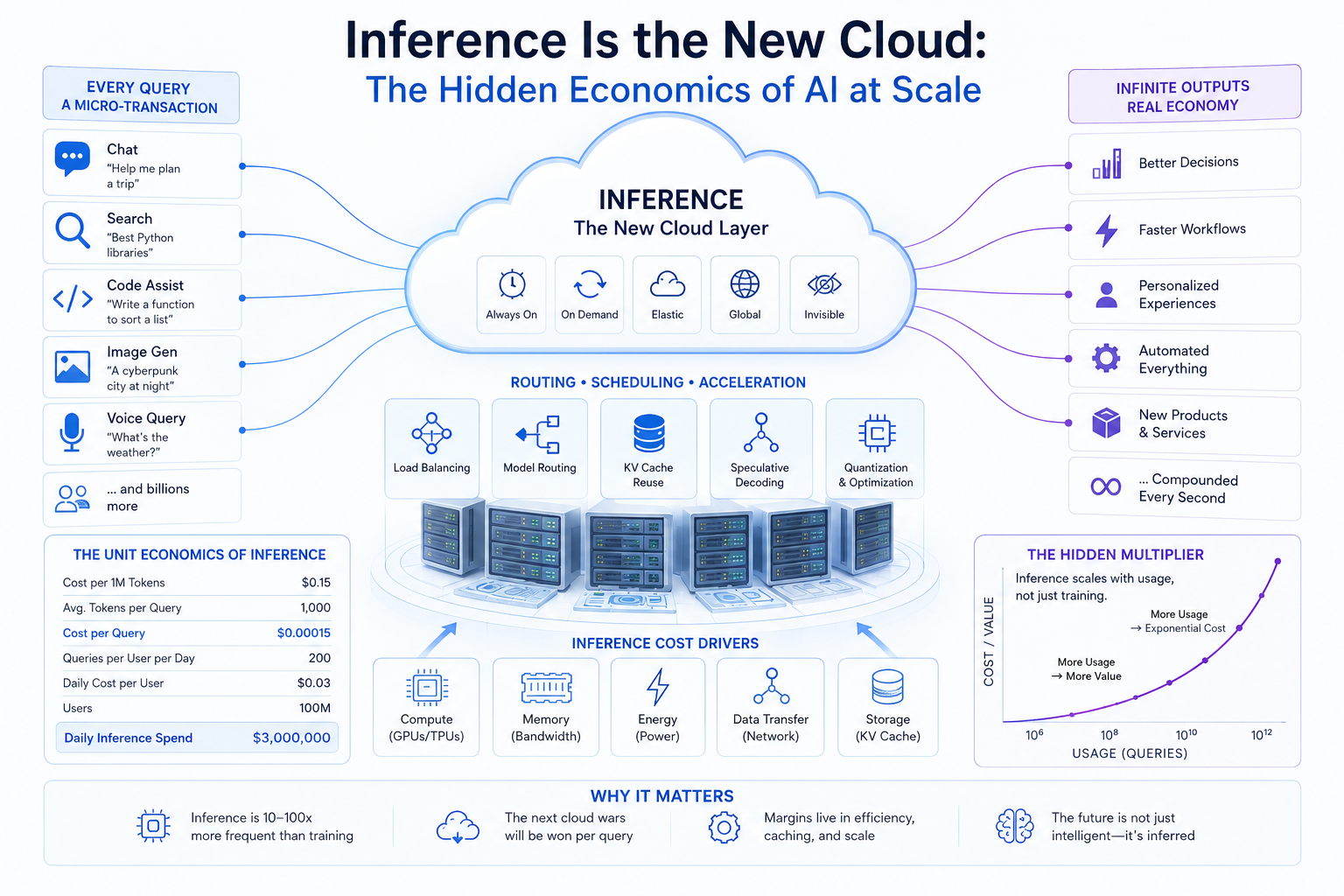
Training vs. Inference: The Cost Shift
To understand the hidden economics of AI, we have to look at the two distinct phases of an AI model's life: Training and Inference.
[ Phase 1: TRAINING ] ---> Massive upfront cost to "build" the AI's brain.
[ Phase 2: INFERENCE ] ---> Continuous, compounding cost every time a user asks it a question.
Historically, the tech industry focused entirely on the astronomical costs of training models (buying thousands of Nvidia chips, running them for months, spending millions of dollars in a single burst).
But training is a one-time fee. Inference is a forever tax. Inference is the moment the AI goes to work—when it generates a line of code, translates a document, or powers a chatbot. Every single prompt costs a fraction of a cent in compute power. When you multiply that fraction by hundreds of millions of users clicking "Enter" all day long, the math gets terrifying.
The New Reality: The long-term cost of running an AI model at scale will dwarf the cost of building it by a factor of 10-to-1.
Why Inference Changes the Rules of Business
In traditional SaaS (Software-as-a-Service), serving your 1,000th customer costs roughly the same as serving your 10,000th customer. Your profit margins get better as you scale.
AI at scale completely breaks this economic rule. Because every single interaction requires heavy GPU math, your variable costs scale linearly with your user base. If a million people suddenly start heavily using your AI app, your server bill doesn’t just rise—it skyrockets.
This creates a brand new set of challenges that tech companies are scrambling to solve:
1. The Death of "Infinite Free Trials"
We are already seeing the end of the unlimited free lunch. Companies can no longer afford to offer unthrottled, hyper-capable AI tools for free indefinitely. The hidden economics of inference are forcing the industry toward strict token limits, tiered premium subscriptions, and metered usage.
2. The Rise of the "Specialized Inference Cloud"
Because traditional cloud architectures aren't optimized for the unique, heavy workloads of AI inference, a new crop of specialized infrastructure providers is emerging. These companies don’t sell storage; they sell tokens per second. They compete ruthlessly on how cheaply and quickly they can process an AI's thought process.
3. The Edge Computing Renaissance
To bypass the staggering costs of centralized data centers, tech giants are pushing inference onto your local devices. If your smartphone, laptop, or car can run the AI model locally using its own internal chips, the tech company’s inference bill drops to zero. The future of AI economics relies heavily on making models small enough to live in your pocket.
The Winner-Take-All Efficiency War
In the old cloud era, the company with the best features won. In the inference era, the company with the most efficient math wins.
If Company A spends $0.002 to process a prompt, and Company B figures out an algorithmic trick to process the exact same prompt for $0.0002, Company B wins the market. They can price their software lower, scale ten times faster, and survive the compounding crunch of global demand.
Software engineering is shifting from building features to optimizing weights and biases to save pennies per million tokens.
The Bottom Line
Just as AWS democratized the internet by making server architecture an operational expense, the new Inference Clouds are dictating who can afford to compete in the age of AI.
We are moving past the hype phase of what AI can do. The defining question of the next decade isn't "Can AI solve this problem?" but rather "Can we afford the compute bill when a billion people ask it to?"
How do you think companies will balance the high cost of AI inference with consumer expectations for free or cheap software? Let’s talk about it in the comments!
Tags
#AIInference #CloudComputing #AIEconomics #TechInfrastructure #SaaS #ArtificialIntelligence #CloudArchitecture #TechTrends2026 #ComputeCosts #Nvidia #TechStrategy #SoftwareEngineering #GenerativeAI #EdgeComputing