The "Sovereign AI" Movement: Europe’s Plan for Independence
For years, the digital world has felt like a two-horse race between the US and China. But in 2026, a new contender has stepped onto the track: The Sovereign AI Movement. Led by the European Union, this isn't just about building "better" AI—it’s about building AI that answers to European laws, values, and borders.
The era of "digital dependency" is ending. Here is how Europe is drawing its own map in the AI landscape.
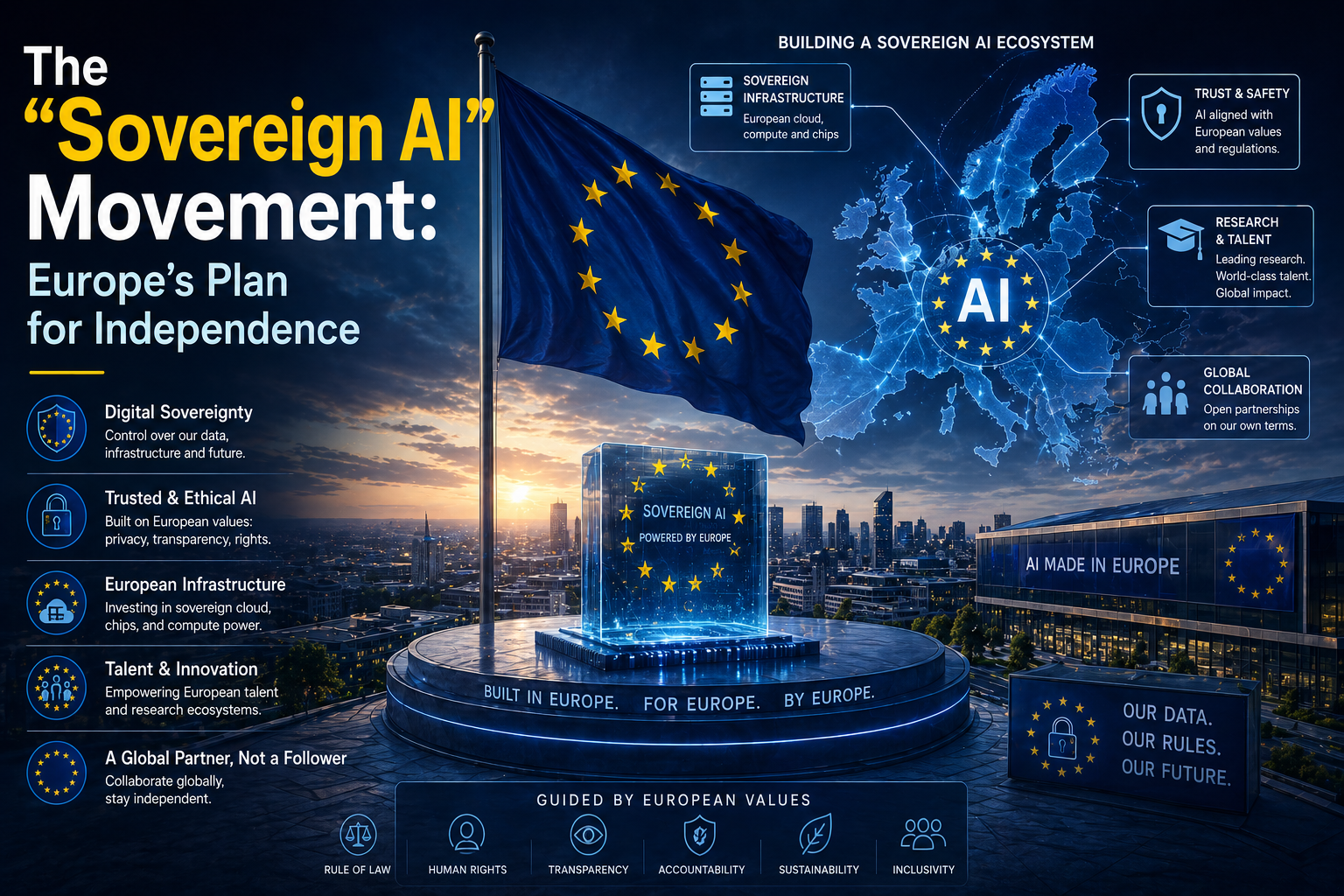
1. What is Sovereign AI?
At its core, Sovereign AI means having total control over the technology stack. It’s the idea that a nation (or a union) should not rely on foreign companies for the "brains" of its economy.
The three pillars of European Sovereignty:
Data Residency: Ensuring sensitive data never leaves European soil.
Model Transparency: Knowing exactly how an AI was trained, without "black box" secrets.
Infrastructure Autonomy: Running AI on European-owned chips and servers, rather than relying exclusively on US-based hyperscalers.
2. The "August 2026" Deadline
The EU AI Act is no longer just a piece of paper—it’s now a ticking clock. By August 2, 2026, full obligations for "High-Risk" AI systems will go into effect.
Companies using AI for hiring, credit scoring, or healthcare must prove their systems are unbiased, secure, and explainable.
The Sovereign Advantage: European providers like Mistral AI and Aleph Alpha have built these rules into their "DNA," making them the safest bet for local businesses looking to avoid massive fines (which can reach up to 7% of global turnover).
3. Meet the European "Champions"
Europe is no longer just a consumer of AI; it’s a creator. A few key players are leading the charge in 2026:
Mistral AI (France): Now a global powerhouse, Mistral recently invested €1.2 billion into a sovereign data center in Sweden to ensure their models run on 100% European infrastructure.
Aleph Alpha (Germany): The leader in "Explainable AI." Their Luminous models are designed for governments and banks who need to know why an AI made a specific decision.
DeepL (Germany/France): Proving that specialized AI can beat general models, DeepL remains the gold standard for secure, high-accuracy translation in the enterprise space.
The Shift: Hyperscalers vs. Sovereign Clouds
Feature The "Big Tech" Way The Sovereign Way
Data Storage Global/US-centric Strictly Local (EU-Only)
Legal Framework US Cloud Act GDPR & EU AI Act
Supply Chain Diversified / Non-EU SEAL-3 (European Tech/Chips)
Focus Rapid Scaling Safety & Compliance
Ownership Proprietary / Closed Open Source & Transparent
4. From Chips to Clouds: The Infrastructure Play
In April 2026, the European Commission awarded a massive €180 million contract to build a Sovereign Cloud Framework. * The SEAL System: New "Sovereignty Effectiveness Assurance Levels" (SEAL 0 to 4) now rank providers. To work with the EU government, you now need a SEAL-2 or higher, meaning your tech is immune to foreign "kill switches" or data requests.
Local Giants: Companies like OVHcloud, Scaleway, and STACKIT are expanding rapidly, offering a home-grown alternative to AWS and Azure.
The Verdict
The Sovereign AI movement isn't about closing Europe off from the world; it’s about making sure Europe has a seat at the table. By 2026, "Made in Europe" has become a badge of trust for AI—prioritizing privacy and ethics over "growth at any cost."
Is your business ready for the August 2026 deadline? Switching to a sovereign provider might not just be a choice soon—it might be a legal necessity.
Do you feel more secure knowing your AI data stays within your borders, or does "global reach" matter more to you?