Digital Twins & AI: Predicting the Future of Physical Assets
What if you could give your most expensive machinery a "soul" that could talk back to you?
In 2026, we’ve moved past simple simulations. The combination of Digital Twins and AI has created something much more powerful: a "crystal ball" for physical assets. From wind turbines in the North Sea to robotic arms in a Tesla factory, everything physical now has a digital shadow that knows exactly when it’s going to break—long before it actually does.
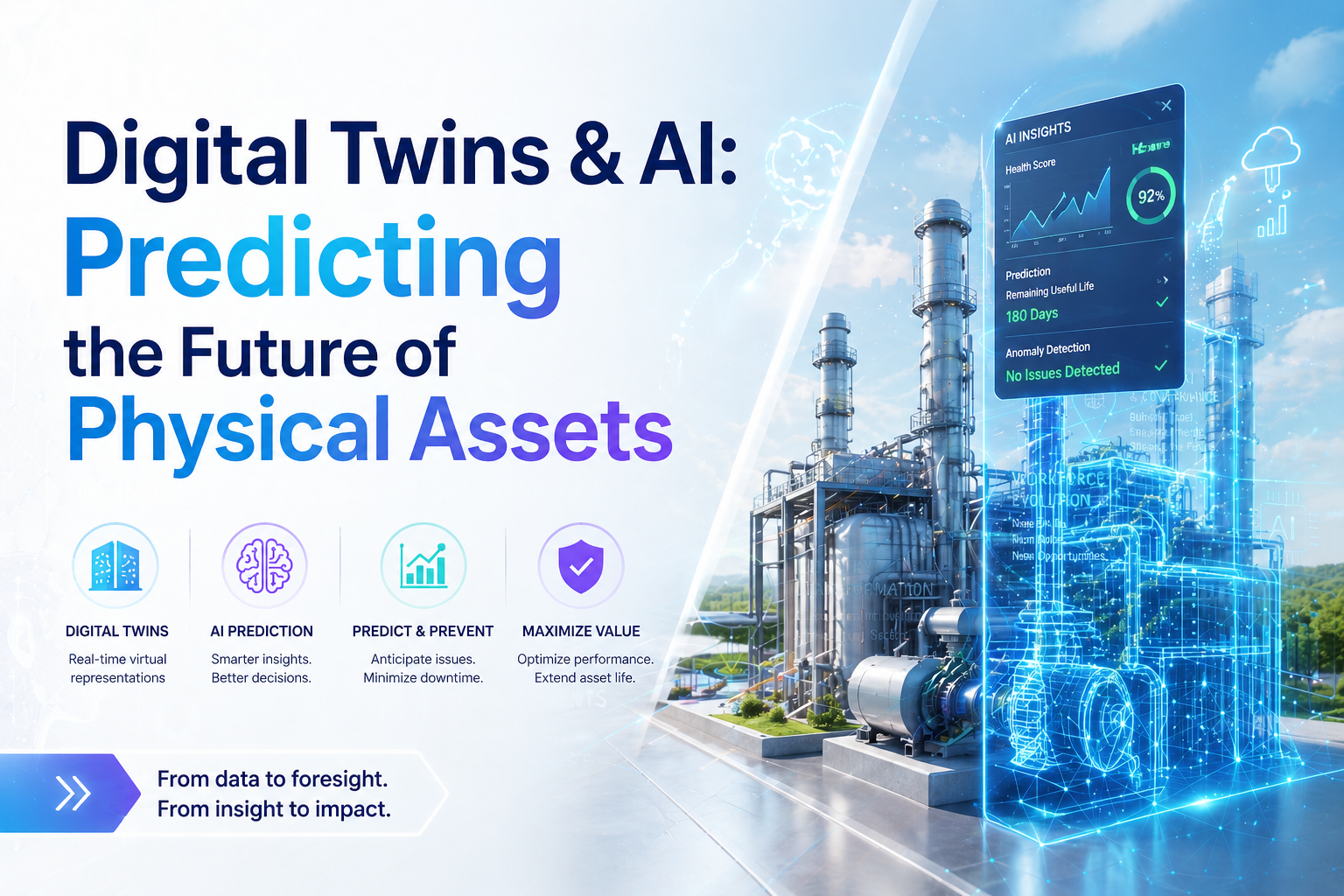
1. What exactly is a "Digital Twin" in 2026?
A Digital Twin is a living, breathing virtual replica of a physical object. But here’s the kicker: it’s not just a 3D model. It is fed by thousands of IoT sensors that stream real-time data on temperature, vibration, and pressure.
The AI Layer: The AI is the "brain" inside the twin. It takes that raw sensor data and compares it to billions of past data points to simulate the future.
2. The "Pre-Crime" of Maintenance
Remember when "maintenance" meant waiting for something to smoke before fixing it? That’s ancient history.
With Predictive & Prescriptive AI, your equipment now practices "self-preservation."
The Prediction: Your jet engine’s digital twin notices a microscopic vibration pattern that usually leads to a failure in 40 flight hours.
The Prescription: The AI doesn't just alert you; it automatically orders the replacement part and schedules the repair during the next scheduled layover.
3. NVIDIA Omniverse & "Physics-AI"
One of the biggest breakthroughs this year is the integration of AI Physics. Companies like NVIDIA and Dassault Systèmes have built world models where the AI understands gravity, friction, and heat as real-world laws.
Virtual Stress Tests: You can "drop" a virtual car from a building or run a virtual factory at 300% speed for a simulated year just to see where the first bolt loosens—all in a few seconds of computing time.
The Impact: Why This Matters to You
Industry The Physical Asset The Digital Twin Advantage
Energy Wind Turbines Optimizes blade angle in real-time to catch 15% more wind.
Healthcare The Human Heart Surgeons "practice" a specific surgery on a patient's twin before the first incision.
Manufacturing Production Lines Identifies bottlenecks and "re-routes" robots without stopping the line.
Smart Cities Traffic Grids Simulates a sudden rainstorm to prevent gridlock before the first drop falls.
4. Sustainability: The Green Side of the Twin
Digital twins aren't just about saving money; they’re about saving the planet. By optimizing how a building breathes (HVAC) or how a truck fleet moves, AI twins are helping companies hit their ESG (Environmental, Social, and Governance) goals.
Waste Reduction: Factories are using twins to simulate "zero-waste" production cycles, catching errors in the virtual world so they never become scrap metal in the real one.
The Verdict
We are entering the era of the Autonomous Asset. By 2026, the gap between "Digital" and "Physical" has officially closed. We no longer just build things; we grow them alongside a digital mind that protects them.
Are you ready to see the future? If your business relies on physical gear, it’s time to start building its twin.
If you could have a "Digital Twin" of one thing in your life to predict its future—your car, your house, or even your own health—which would you choose?