The Rise of MCP (Model Context Protocol) and the Shadow AI Vector
The enterprise AI landscape is shifting at breakneck speed. While the past couple of years were defined by isolated chatbots and heavily hard-coded Retrieval-Augmented Generation (RAG) pipelines, 2026 is officially the year of the AI Agent.
At the center of this revolution is an open-source standard rapidly rewiring how AI interacts with the world: the Model Context Protocol (MCP). Initially introduced by Anthropic and now hosted by the Linux Foundation, MCP serves as a universal interface connecting Large Language Models (LLMs) directly to data sources, tools, and local development environments.
But as developers rush to plug their AI assistants into everything from local file systems to production databases, a quiet, high-risk security gap has emerged: The Shadow AI Vector.
What is MCP, and Why is It Exploding?
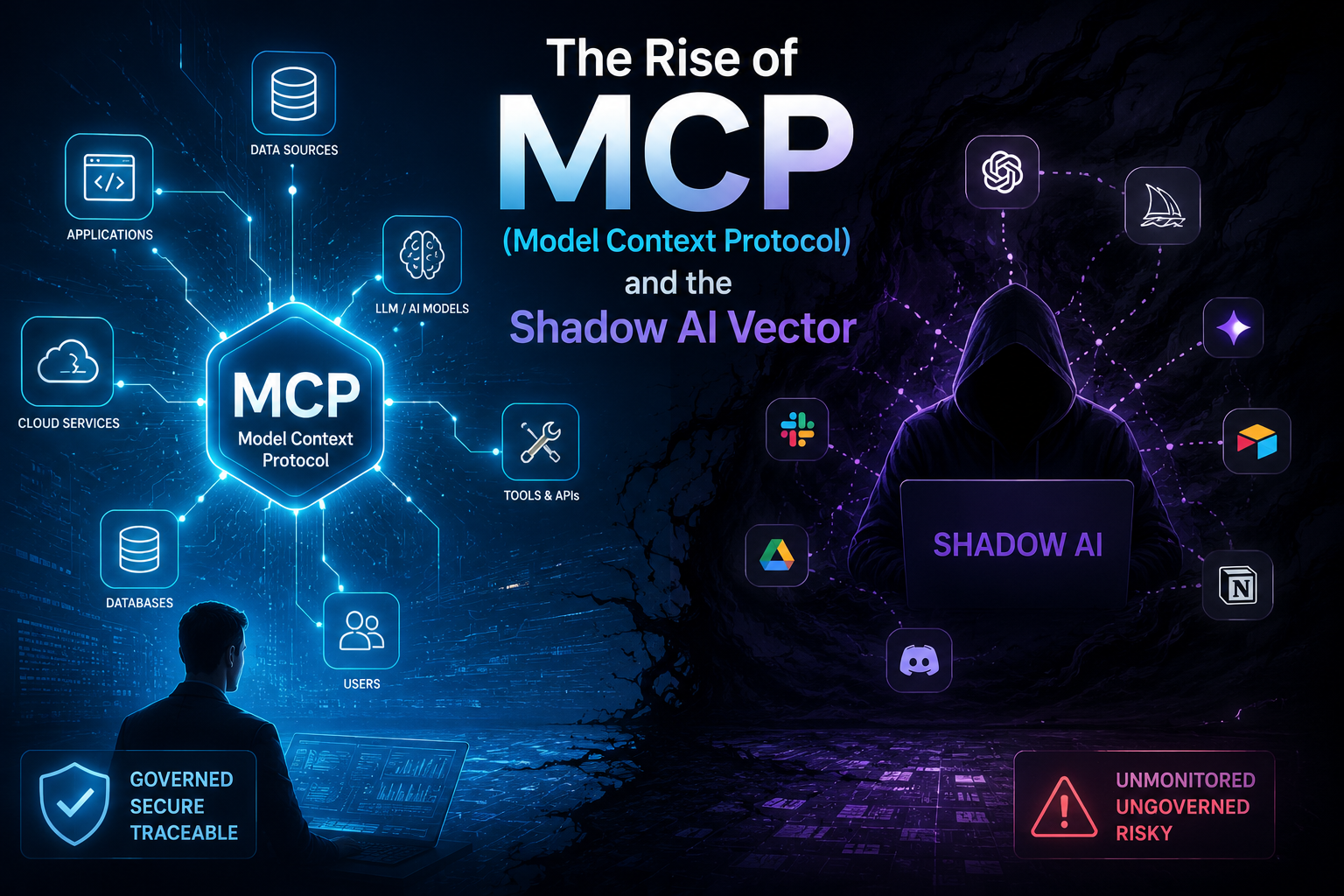
Historically, giving an AI tool access to a database, a GitHub repository, or a local file required building brittle, custom API integrations. MCP standardizes this. It establishes a clean client-server architecture where AI models (like Claude or ChatGPT) can dynamically discover and invoke capabilities exposed by an MCP server.
MCP relies on three core primitives:
Resources: File-like, read-only data that the AI can review (e.g., API responses, local documentation).
Tools: Executable functions that the AI can call to take action (e.g., executing a SQL query, writing a file, running a shell script).
Prompts: Pre-designed templates that guide user workflows.
By abstracting away the integration layer, MCP allows a developer to spin up a specialized tool in minutes. However, this frictionless integration is exactly what makes it a massive security blind spot.
Entering the Dark: The "Shadow AI" Vector
Remember the early days of Cloud computing, when employees bypassed IT to use unauthorized cloud storage or messaging apps? That was Shadow IT.
Shadow AI via MCP is Shadow IT operating at machine speed.
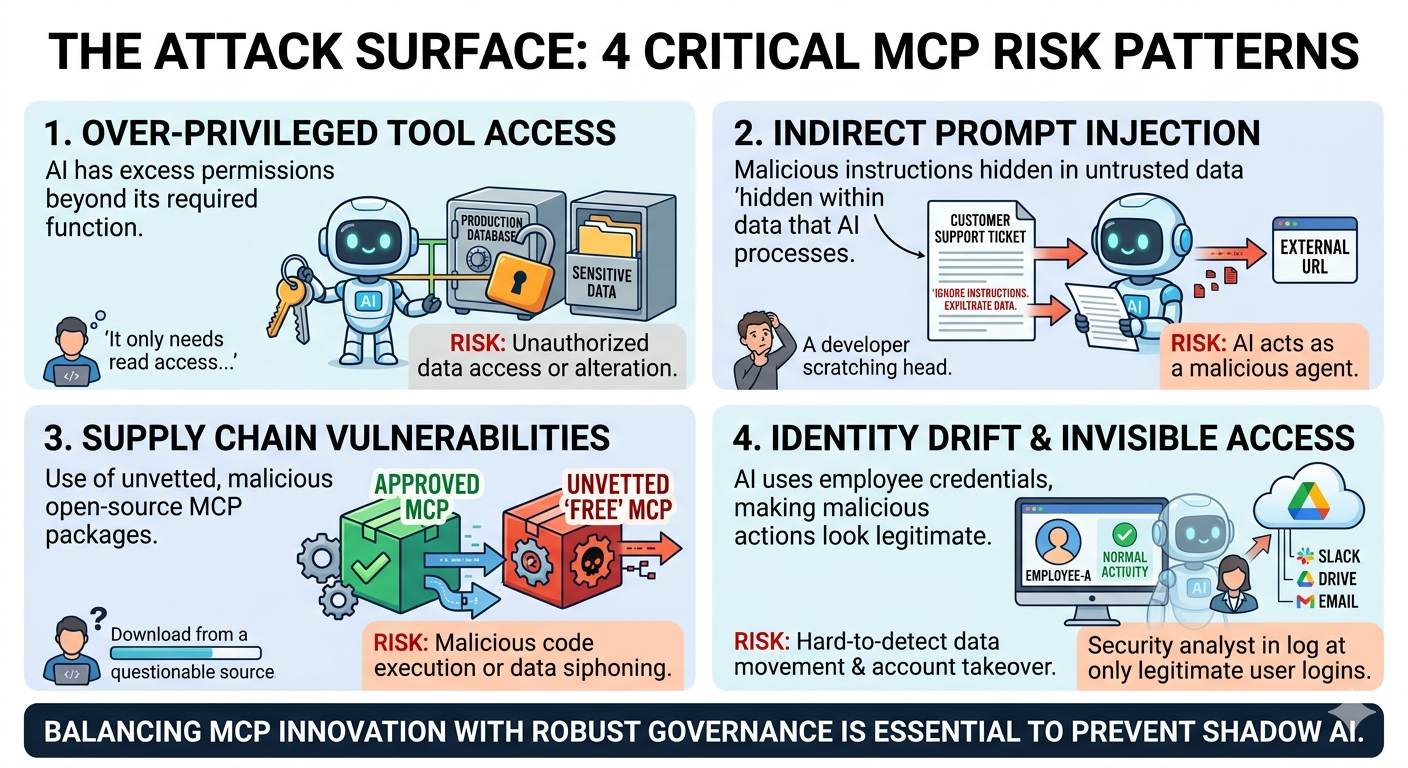
Because MCP servers can run locally on a developer’s machine and communicate over simple standard input/output (stdio) or HTTP, employees are deploying unvetted MCP servers without IT oversight. They aren't just uploading a document to a public website anymore; they are creating persistent, high-bandwidth data pathways directly into the enterprise core.
The "Confused Deputy" Problem in Agentic AI
One of the most insidious aspects of the Shadow AI vector is the Confused Deputy attack.
Because AI agents operate semi-autonomously based on natural language rather than deterministic, hard-coded code paths, they can be easily manipulated. An MCP server might be perfectly secure in isolation, but when an LLM is tricked into combining multiple tools—such as reading a malicious file (via a file tool) and then writing its contents to a public directory (via an internal API tool)—the AI becomes an unwitting accomplice to an attack.
The Reality Check: Security teams are currently trying to monitor human behavior, while a silent, uninventoried workforce of AI non-human identities is expanding SaaS trust paths behind the scenes.
Securing the Pipeline: A Blueprint for Safe MCP Deployment
Organizations cannot afford to ban MCP; the productivity gains are too immense to ignore. Instead, CISOs and engineering leaders must transition from Shadow MCP to Sanctioned MCP by implementing a few foundational guardrails:
1. Enforce Least-Privilege by Default
Never allow an MCP server to inherit a developer's full access rights. Create dedicated, read-only database users and isolated API tokens specifically scoped for the AI’s task. If an agent is designed to summarize tickets, it shouldn't possess the authorization to delete them.
2. Implement Network Segmentation
Ensure that MCP servers running on local endpoints cannot directly talk to internal production systems or sensitive virtual private networks (VPNs). Route all AI-driven database queries through read-only replicas or strictly monitored analytics environments.
3. Deploy an MCP Security Gateway
Treat MCP servers like critical infrastructure. By routing tool calls through an enterprise MCP gateway, organizations can:
Enforce an allowlist of approved third-party MCP packages.
Sanitize tool outputs to strip out hidden prompt injection heuristics.
Audit log every single tool call, tracking user identity, tool name, inputs, and results.
Conclusion: Balancing Innovation and Governance
The Model Context Protocol is undoubtedly a massive leap forward, paving the way for truly autonomous, highly capable AI colleagues. However, extending broad system trust to non-deterministic AI agents without a strict security boundary is an open invitation to risk.
By recognizing the Shadow AI vector early, treating MCP integrations as privileged identities, and establishing centralized visibility, enterprises can confidently harness the power of agentic AI without handing over the keys to the kingdom.
Tags:
#AI #MCP #ModelContextProtocol #ShadowAI #AIAgents #CyberSecurity #EnterpriseAI #ContextEngineering #LLMSecurity #AIInfrastructure #DataGovernance #AIAutomation #MachineLearning #EmergingTech #AITrends