The New Soundscape: How Spotify and AI Are Rewriting the Music Rules
The relationship between artificial intelligence and the music industry has officially graduated from viral novelty acts to a full-scale institutional evolution. We are no longer just talking about algorithms guessing your favorite tracks; we are talking about a fundamental shift in how music is created, licensed, and consumed.
Streaming platforms like Spotify are aiming for their own "ChatGPT moments," transforming into fully personalized, generative audio spaces. Here is a breakdown of what is happening right now in the world of AI music inclusion, how copyright frameworks are shifting to protect human artists, and what major advancements are coming next.
Spotify's Generative Leap: From "Press Play" to "Co-Create"
For years, Spotify’s competitive edge was its discovery algorithm—learning your taste to serve up the perfect Discover Weekly. Now, the focus is shifting from curation to generation.
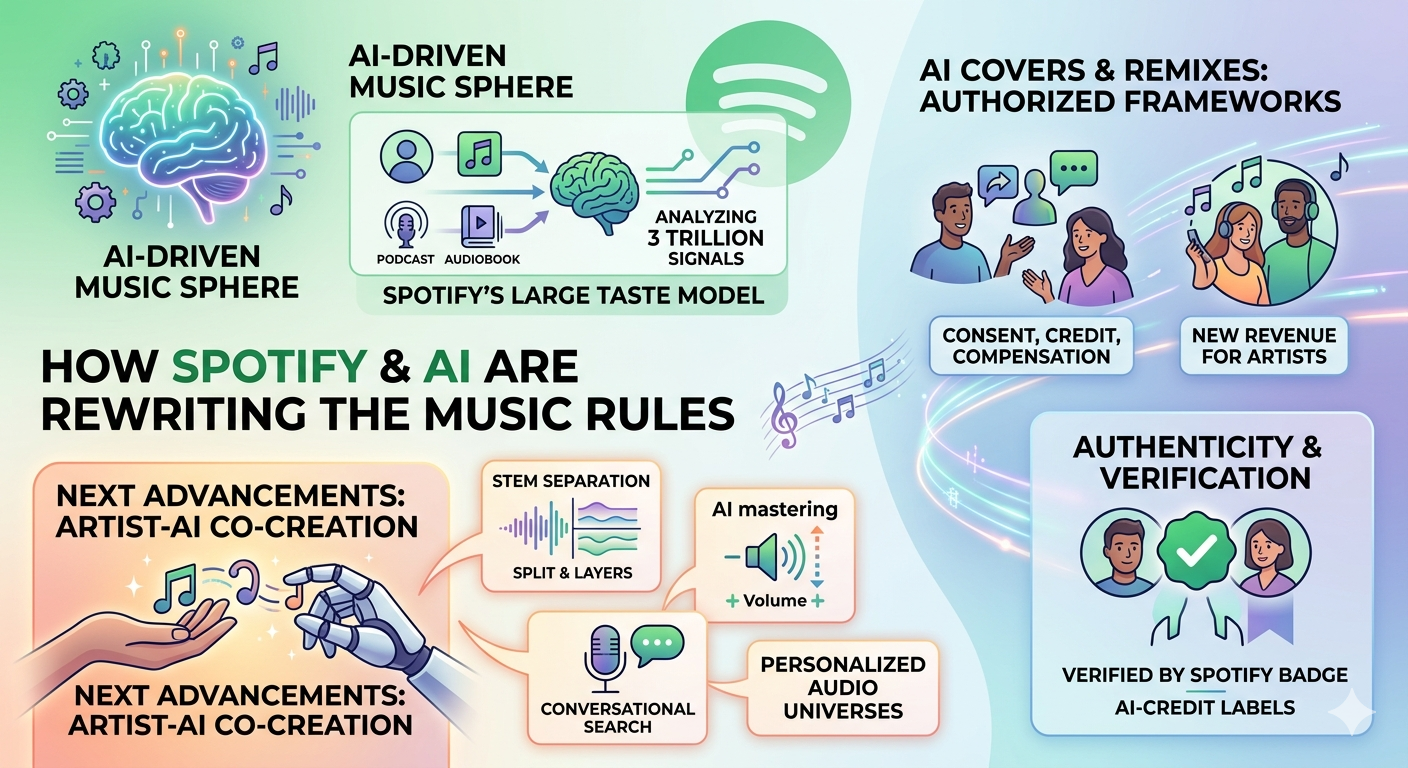
Spotify is developing what executives call a "Large Taste Model", trained on over 3 trillion daily signals from users listening to music, podcasts, and audiobooks. The goal is to use AI to build entirely personalized audio universes tailored to specific moments in a listener's day.
The Universal Music Deal: Licensed Remixes & Covers
One of the biggest pain points of the early AI music boom was "ghost tracks"—unauthorized AI clones mimicking famous artists without permission. Spotify has officially tackled this head-on by partnering with Universal Music Group (UMG) to launch an authorized, legal AI Covers and Remixes tool.
The Deal: Available as a paid add-on for Premium subscribers, the tool allows fans to legally remix tracks and create AI-driven covers using songs from participating artists.
The Catch: Unlike the wild-west AI clones of the past, this framework is entirely rooted in consent, credit, and compensation. Artists and songwriters receive a slice of the revenue generated from these fan-made remixes, turning a former copyright nightmare into a legitimate income stream.
Next Advancements: What the Future of AI Music Looks Like
The next wave of music technology isn't about replacing the human artist—it's about supercharging the creative process and deeply personalizing the user experience.
1. Studio by Spotify Labs
Spotify is testing a standalone desktop application called Studio by Spotify Labs. Rather than just playing media, it uses advanced AI to generate private, highly customized audio on your behalf. Imagine asking your app: "Create a daily 15-minute morning brief that syncs with my calendar, summarizes my unread emails, and blends into a lo-fi playlist based on my current mood." It turns your streaming app into a conversational assistant.
2. AI as the Ultimate Co-Producer
In the studio, AI is solidifying its place as a collaborative partner rather than a competitor. Over 60% of music producers utilize AI-driven tools for:
Stem Separation: Splitting a fully mixed track into individual components (vocals, drums, bass) with near-perfect isolation.
Audio Clean-up & Restoration: Instantly removing background noise or balancing frequencies.
Instant Smart Mastering: Making high-quality engineering tools accessible to independent bedroom pop artists operating on zero budget.
3. Hyper-Personalized Conversational Listening
We are moving rapidly toward conversational search extensions. Instead of typing an artist's name into a search bar, listeners can chat with embedded AI agents inside their music apps—requesting niche genre mashups like "give me a playlist that bridges 90s shoegaze with modern outlaw country"—and watching the engine build it flawlessly in real-time.
The Takeaway: The narrative that AI will simply "destroy" music jobs is giving way to a more nuanced reality. By combining rigorous copyright enforcement, artist verification, and licensed creator tools, the music industry is attempting to build an ecosystem where human creativity remains the heart of the track, and AI acts as the ultimate amplifier.
Tags
#AI #Spotify #ArtificialIntelligence #MusicIndustry #AIInMusic #MusicStreaming #SpotifyAI #FutureOfMusic #DigitalMusic #MusicTechnology#GenerativeAI #MusicDiscovery #StreamingPlatforms #TechTrends #MachineLearning #AudioInnovation #MusicAlgorithms #CreativeAI #MusicBusiness #AIContent