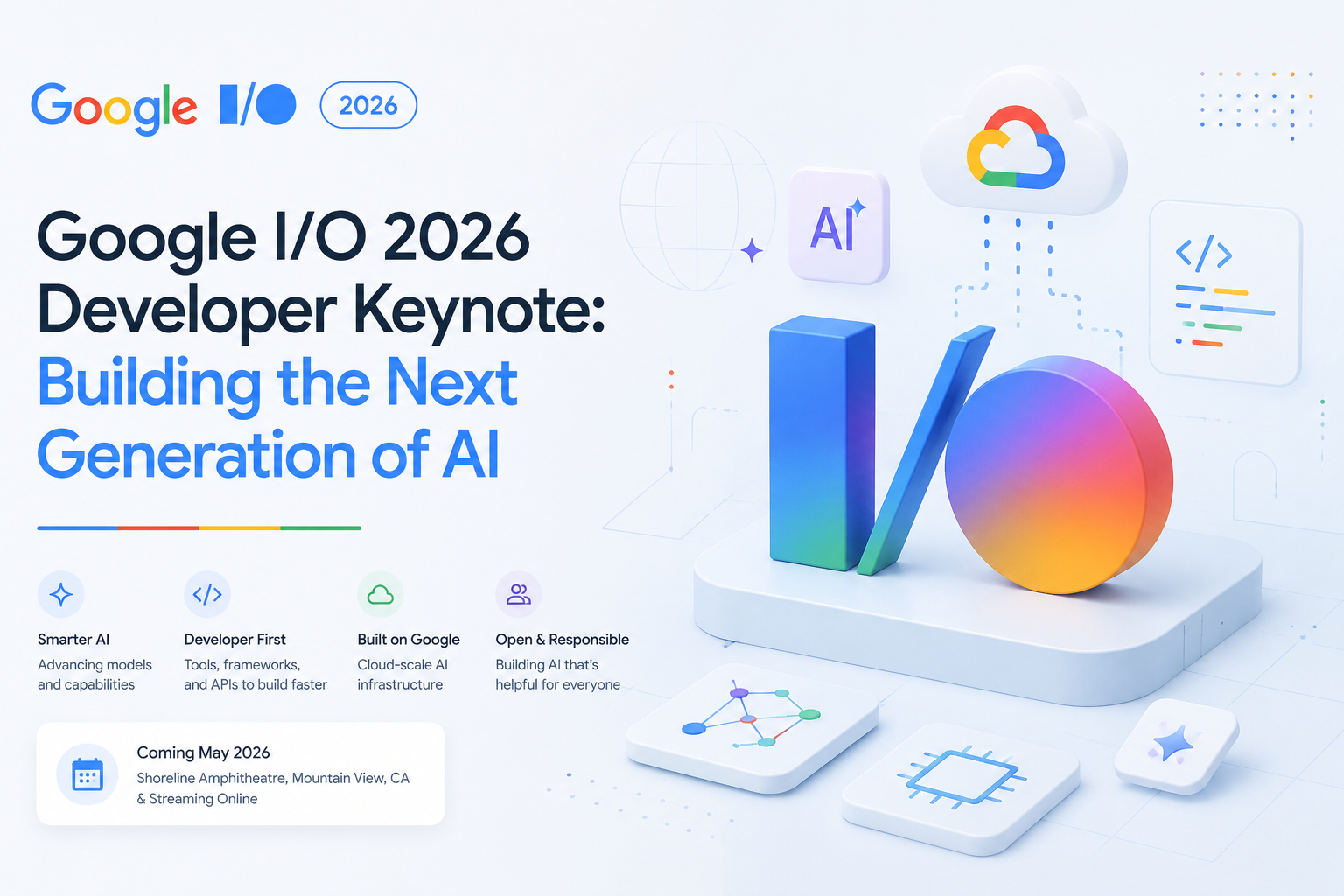
Google I/O 2026 Developer Keynote: Building the Next Generation of AI
May 19, 2026 — Google’s annual I/O developer keynote delivered a masterclass in the next evolution of artificial intelligence, ecosystem integration, and developer-first tooling. This year, the focus shifted from raw model scale to multi-modal efficiency, context-aware agentic workflows, and making advanced AI deeply personal and secure.
Here is a breakdown of the biggest announcements, breaking down exactly what they mean for developers, tech enthusiasts, and the future of software.
1. Gemini 2.5: The Era of Instantaneous Reasoning
Google officially unveiled Gemini 2.5, their latest flagship AI model family. While previous iterations focused on massive context windows, Gemini 2.5 prioritizes low-latency reasoning and native audio-visual synthesis.
Key Upgrades for Developers:
True Multi-Modal Streaming: The API now handles simultaneous live video, audio, and text streams with sub-100ms latency.
Ultra-Low Compute Costs: A new distilled version, Gemini 2.5 Flash-Plus, slashes token costs by 40% while maintaining high accuracy in code generation and debugging.
10M Token Context Window: Google has expanded the production context window to an astonishing 10 million tokens, allowing developers to feed entire enterprise codebases or hours of high-definition video directly into a single prompt.
2. Project Astra & Android 17: Agentic AI is Everywhere
What was teased in previous years is now a core reality. Google showed off the deep integration of Project Astra (their real-time AI assistant) into the fabric of Android 17.
[User Request] ➔ [Android 17 Screen Context] ➔ [Project Astra Agent] ➔ [Cross-App Execution]
Instead of just answering questions, AI agents can now perform complex, multi-step actions across different applications. For developers, the new Android Jetpack AI Toolkit allows apps to expose "hooks" so Gemini can securely perform tasks inside third-party apps—like booking a flight, editing a photo, or organizing a playlist—based on simple user voice commands.
3. Web and Cloud: Firebase Genkit Goes 1.0
For web and backend developers, the standout announcement was the 1.0 release of Firebase Genkit.
What is Firebase Genkit? It is an open-source framework designed to make it incredibly easy to build, deploy, and monitor production-ready AI features.
Why it matters:
Framework Agnostic: Seamlessly integrates with Next.js, Angular, and Express.
Local Testing UI: Developers can test prompts, evaluate model outputs, and inspect retrieval-augmented generation (RAG) pipelines locally before deploying to the cloud.
Built-in Security: Automatically handles data masking and PII (Personally Identifiable Information) protection before data ever hits an external LLM.
4. The Hardware Powering the Future: TPU v6e
To support the massive compute required for these next-gen applications, Google introduced the TPU v6e (Tensor Processing Unit). Optimized specifically for transformer-based models and diffusion architectures, it offers a 3x improvement in performance-per-dollar compared to its predecessor. Google Cloud customers can spin up v6e clusters starting today.
The Big Takeaway
Google I/O 2026 made one thing abundantly clear: AI is no longer a feature you bolt onto an application—it is the runtime environment. The barrier to entry for building complex, agentic AI systems has officially vanished. Whether you are building for the web, mobile, or the cloud, the tools are smarter, cheaper, and more accessible than ever.
What are your thoughts?
Which of these announcements are you most excited to implement in your current projects? Are you diving into Firebase Genkit, or planning to leverage the 10M token window of Gemini 2.5? Let us know in the comments below!
Tags
#GoogleIO2026 #AI #ArtificialIntelligence #DeveloperKeynote #GoogleAI #MachineLearning #GenerativeAI #FutureOfAI #AIInnovation #TechConference #CloudAI #AIDevelopment #NextGenAI #DeepLearning #GoogleDevelopers #AIInfrastructure #TechTrends #Innovation #AIRevolution #SmartTechnology