Beyond Transformers: The Quiet Rise of State Space Models
Artificial intelligence moves in waves. A few years ago, convolutional neural networks dominated computer vision. Then transformers arrived and changed almost everything. Today, transformers power large language models, recommendation systems, coding assistants, search engines, and multimodal AI systems. They became the default architecture for modern AI. But behind the scenes, another approach has been quietly gaining momentum.
State Space Models (SSMs) are emerging as a serious alternative for handling long sequences, reducing memory usage, and improving computational efficiency. While transformers continue to dominate headlines, researchers and AI companies are exploring SSMs as a potential next step in the evolution of deep learning.
This shift is not happening because transformers failed. It is happening because scaling transformers indefinitely is becoming expensive, slow, and resource-intensive. The future of AI may not belong to a single architecture. It may belong to hybrid systems where transformers and State Space Models work together.
Why Transformers Became So Important
To understand why State Space Models matter, we first need to understand the transformer era.
Introduced in 2017 through the famous paper “Attention Is All You Need,” transformers revolutionized machine learning by introducing the attention mechanism. Attention allows a model to look at every token in a sequence simultaneously and decide which parts are most important.
For example, in the sentence:
“The robot picked up the glass because it was fragile.”
The model can connect the word “fragile” to “glass” instead of “robot.”
That contextual understanding made transformers dramatically better at:
Language translation
Text generation
Image understanding
Speech recognition
Multimodal reasoning
This architecture became the foundation for systems like GPT, Gemini, Claude, and many others. Transformers scale remarkably well. More data, more parameters, and more compute usually improve performance. But there is a cost.
The Hidden Problem With Transformers
Transformers process information using self-attention. The problem is that self-attention becomes computationally expensive as sequence length grows. If a sequence doubles in size, the attention computation grows roughly four times larger.
This creates several challenges:
1. High Memory Usage
Long documents, audio streams, video frames, and genomic sequences require enormous memory.
2. Expensive Training
Training large transformer models demands massive GPU clusters and huge energy consumption.
3. Slow Long-Context Processing
Even advanced transformer systems struggle with extremely long contexts.
4. Difficult Edge Deployment
Running large transformer models on mobile devices or low-power hardware is challenging.
Researchers began asking an important question:
Is attention really the only path forward?
That question reopened interest in older mathematical ideas. One of those ideas evolved into modern State Space Models.
What Are State Space Models?
State Space Models are not entirely new.
They originated decades ago in control systems, signal processing, and physics.
Traditionally, state space methods were used to describe dynamic systems such as:
Aircraft navigation
Weather forecasting
Robotics
Electrical systems
Financial modeling
The core idea is simple:
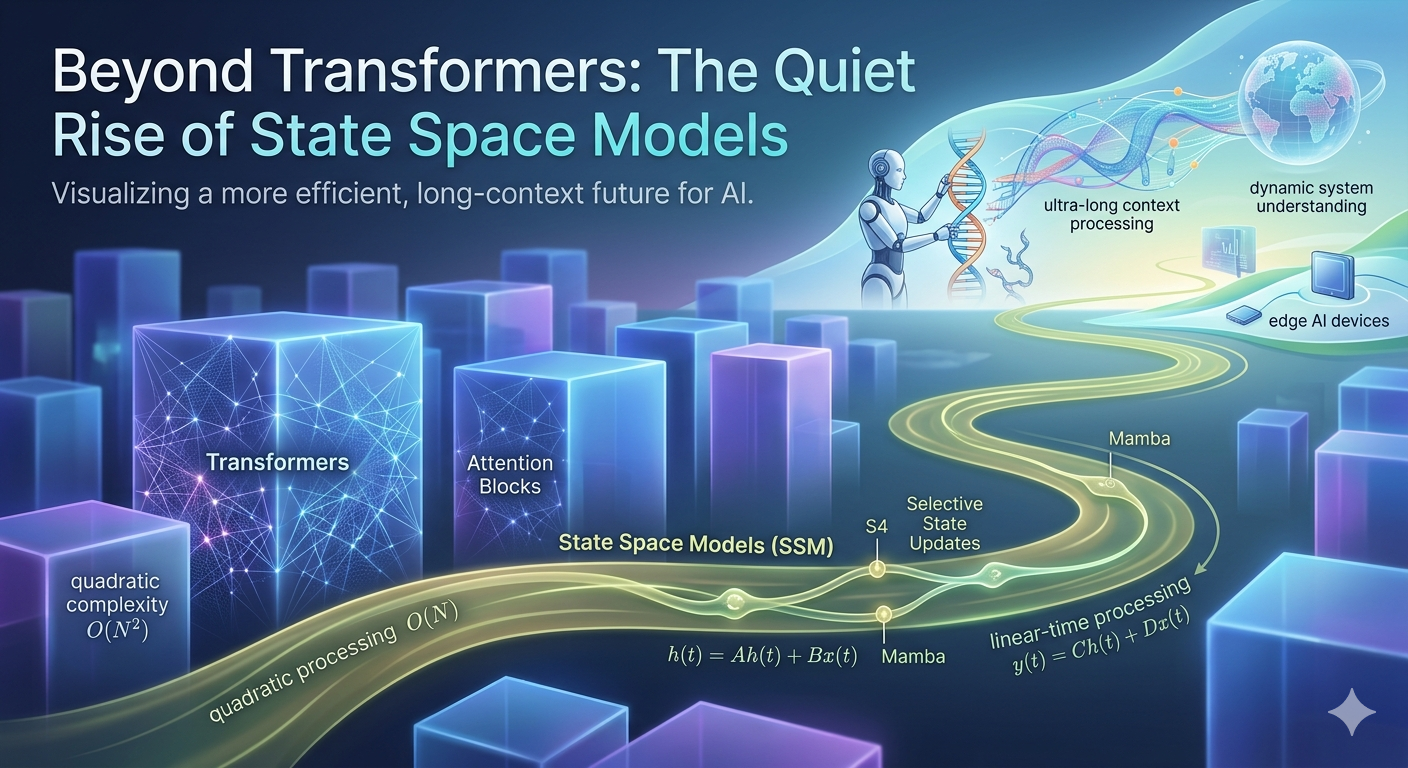
A system maintains an internal “state” that evolves over time. Instead of comparing every token with every other token like transformers do, State Space Models continuously update a compressed memory representation.
Think of it like this:
A transformer often tries to remember everything at once.
A State Space Model tries to remember only what matters.
That difference changes everything.
Why SSMs Are Suddenly Important
Modern AI systems increasingly deal with long sequential data.
Examples include:
Hour-long conversations
Massive codebases
Scientific research papers
DNA sequences
Sensor streams
Video processing
Financial time-series data
Transformers can process these tasks, but efficiency drops quickly as context size grows. State Space Models are attractive because they scale more efficiently. Instead of quadratic complexity like attention mechanisms, many SSM architectures scale almost linearly.
That means:
Lower memory requirements
Faster inference
Better long-sequence handling
Reduced hardware costs
This efficiency advantage has attracted growing industry attention.
The Rise of Mamba and Modern SSM Architectures
One of the biggest turning points came with the release of Mamba.
Mamba introduced a selective State Space architecture designed specifically for deep learning.
Unlike older SSM approaches, Mamba showed that State Space Models could compete with transformers on real-world AI tasks.
Researchers found that Mamba could:
Process long sequences efficiently
Maintain strong language modeling performance
Use less memory during inference
Achieve faster token generation in some scenarios
What made Mamba especially interesting was its selective mechanism. Instead of treating all information equally, the model learns which information should persist in memory and which should fade away. This behavior resembles how humans prioritize information.
We do not remember every word from every conversation. We remember the important parts.
That selective memory principle may become increasingly important as AI systems scale further.
Transformers vs State Space Models
The competition between transformers and SSMs is not as simple as “old versus new.” Both architectures have strengths.
Transformers Excel At:
Global contextual understanding
Parallel training
Large-scale language generation
Multimodal reasoning
Rich attention-based relationships
State Space Models Excel At:
Long-sequence efficiency
Lower memory consumption
Streaming data processing
Real-time inference
Hardware efficiency
In practice, researchers are beginning to explore hybrid approaches. Instead of replacing transformers entirely, SSMs may complement them.
For example:
Transformers could handle reasoning-heavy tasks
SSMs could manage long-term memory and sequence compression
Hybrid systems could balance quality and efficiency
This may become a major architectural trend over the next few years.
Why This Matters for the Future of AI
The AI industry is reaching a point where efficiency matters almost as much as intelligence. Training larger models indefinitely is becoming financially difficult.
Companies now care about:
Compute costs
Energy efficiency
Latency
Mobile deployment
Real-time applications
Scalability
A model that performs slightly worse but costs dramatically less may become commercially attractive. This is where State Space Models become strategically important.
They could enable:
Smaller AI devices
Better offline AI systems
Faster edge computing
Affordable enterprise AI
Longer-context assistants
More sustainable AI infrastructure
As AI adoption expands globally, efficient architectures may determine which companies succeed.
The Bigger Picture: AI Architecture Is Diversifying
For several years, the AI conversation became heavily centered around transformers. But history shows that no architecture dominates forever. Machine learning evolves through cycles. New limitations create opportunities for new ideas.
State Space Models represent part of a broader shift toward architectural diversification.
Researchers are now exploring:
Retrieval-based systems
Memory-augmented networks
Mixture-of-experts architectures
Neuromorphic computing
Sparse attention systems
Hybrid reasoning models
State Space Models
The next generation of AI may look very different from today’s large transformer stacks. Instead of one giant universal model, future systems may combine specialized components optimized for different tasks. SSMs fit naturally into that future.
Are State Space Models the Next Transformer?
It is still too early to say. Transformers remain extraordinarily powerful and continue improving rapidly. However, State Space Models have already proven something important: Attention is not the only viable scaling strategy. That realization alone is significant.
In AI research, breakthroughs often begin quietly. Before transformers dominated the industry, attention mechanisms were considered experimental. Today, State Space Models may be entering a similar phase. They are not replacing transformers overnight. But they are expanding the design space of modern AI. And in technology, expanding the design space often leads to the next wave of innovation.
Final Thoughts
The rise of State Space Models signals a deeper transition in artificial intelligence. The industry is moving from a period of pure scaling toward a period of architectural optimization. Bigger models alone may not define the future. Smarter, faster, and more efficient systems could become equally important. Transformers changed AI by teaching machines how to focus. State Space Models may help machines learn how to remember. The next era of AI could emerge from combining both. And that shift is already underway.
Tags
#AI #ArtificialIntelligence #StateSpaceModels #Transformers #BeyondTransformers #MambaAI #DeepLearning #MachineLearning #NeuralNetworks #AIArchitecture #FutureOfAI #GenerativeAI #LargeLanguageModels #LLMs #AIResearch #LongContextModels #EfficientAI #AIInnovation #SequenceModeling #AttentionMechanism #ModernAI #AITechnology #AITrends #ComputationalEfficiency #AISystems #NextGenerationAI #AIInfrastructure #EmergingAIModels #AIDevelopment #AdvancedAI