The Rise of AI Operating Systems: Why Agents Need More Than Models
Look back at the tech headlines over the last few years, and you’ll notice a distinct, unshakeable pattern. The AI industry hasn't just been growing; it has been entirely hyper-focused on one massive, landscape-shifting goal. Everything else has just been background noise.
For the past few years, the AI industry has been obsessed with one thing:
Models.
Every major breakthrough seemed to revolve around larger context windows, better benchmarks, and smarter Large Language Models (LLMs).
GPT.
Claude.
Gemini.
Llama.
Mistral.
The conversation was simple:
"Which model is the smartest?"
But something interesting is happening.
As AI agents become more capable, we're discovering that intelligence alone isn't enough.
The next generation of AI won't be defined by models.
It will be defined by AI Operating Systems.
Because agents need much more than intelligence.
They need memory.
They need tools.
They need workflows.
They need context.
And most importantly, they need coordination.
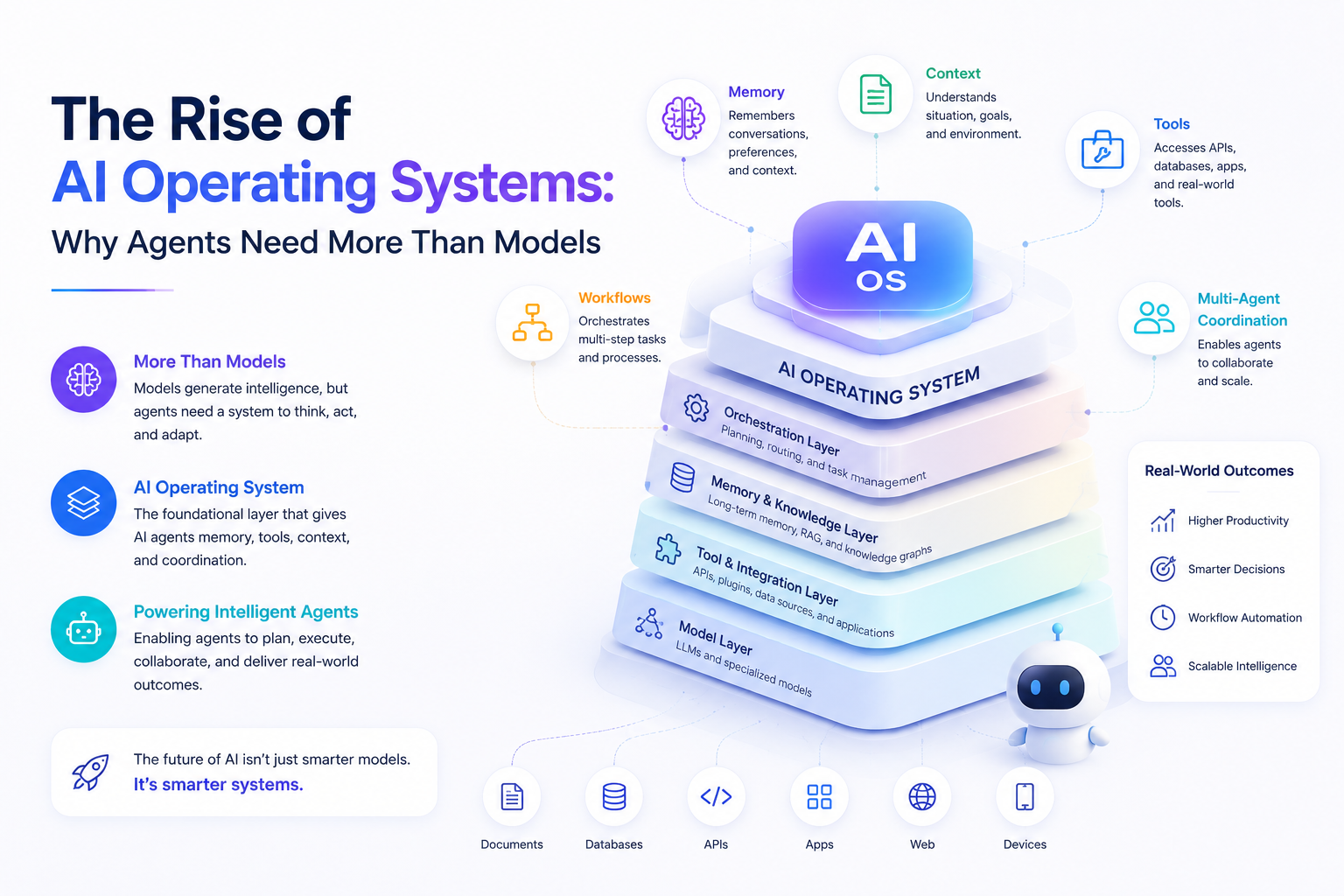
The Industry Is Focusing on the Wrong Layer
Imagine buying a laptop with the world's most powerful processor.
Sounds great.
Now imagine it has no operating system.
No Windows.
No macOS.
No Linux.
Suddenly that powerful processor isn't very useful.
That's exactly where AI is today.
Large Language Models are becoming incredibly powerful.
But they're increasingly looking like processors rather than complete systems.
And processors alone don't create value.
Operating systems do.
What Exactly Is an AI Operating System?
Think of an AI Operating System as the layer that sits between intelligence and execution.
The model generates intelligence.
The AI Operating System manages everything else.
It helps AI agents:
Remember information
Access tools
Coordinate workflows
Retrieve knowledge
Execute actions
Collaborate with other agents
Maintain long-term context
Without an operating system, an AI model is simply responding.
With an operating system, it can actually work.
Why Models Alone Aren't Enough
Today's AI models are impressive.
They can write code.
Generate reports.
Analyze documents.
Answer complex questions.
But ask yourself this:
Can a model remember what happened last month?
Can it coordinate a project?
Can it manage a multi-step workflow across multiple applications?
Can it learn from previous interactions without external systems?
Not really.
Most AI models are still stateless by nature.
Every conversation begins almost from scratch.
That's a major limitation if we're building agents designed to assist us every day.
The Secret Ingredient: Memory
One of the biggest missing pieces in AI today is memory.
Humans rely on memory constantly.
We remember:
Conversations
Preferences
Goals
Experiences
Relationships
That's what makes us effective.
AI agents need similar capabilities.
Imagine telling your AI assistant:
"Remember that I prefer technical explanations over marketing language."
A week later, it still remembers.
A month later, it still remembers.
That's not just intelligence.
That's memory.
And memory is becoming a foundational component of AI Operating Systems.
Context Is Becoming More Important Than Prompts
For years, everyone talked about Prompt Engineering.
Today, the conversation is shifting toward Context Engineering.
Why?
Because the quality of an AI response depends less on the wording of a prompt and more on the information available to the agent.
A modern AI Operating System manages:
User context
Business context
Historical context
Project context
Real-time context
The result is an agent that understands not just what you're asking, but why you're asking it.
And that changes everything.
The Rise of Tool-Using Agents
The most powerful AI systems don't rely solely on their training data.
They use tools.
Think about what a modern agent might access:
Search engines
Databases
APIs
Calendars
Email
CRM platforms
Internal documentation
An AI Operating System acts as the bridge between the agent and these external systems.
Instead of simply answering questions, the AI can take action.
That's a huge leap forward.
From Chatbots to Digital Workers
Most people still think of AI as a chatbot.
Ask a question.
Get an answer.
Done.
But AI agents are moving beyond conversations.
Imagine saying:
"Prepare a competitor analysis for tomorrow's strategy meeting."
The agent could:
Gather market data
Analyze competitors
Create charts
Write a report
Generate a presentation
Without you opening a single application.
That's not a chatbot.
That's a digital worker.
And digital workers require operating systems.
Why Enterprises Are Paying Attention
Businesses aren't looking for clever chatbots anymore.
They're looking for measurable outcomes.
They want AI that can:
Improve productivity
Reduce manual work
Accelerate decision-making
Automate repetitive tasks
Support employees
Achieving those goals requires more than a powerful model.
It requires an entire operating layer capable of managing intelligence at scale.
This is why AI Operating Systems are becoming one of the hottest topics in enterprise AI.
The Next Platform Shift Is Already Beginning
Every major technology revolution has been built on a platform.
Personal computers had operating systems.
Smartphones had operating systems.
Cloud computing had platforms.
AI is now entering the same phase.
The companies shaping the future aren't just building better models.
They're building ecosystems where:
Models
Memory
Context
Tools
Workflows
Agents
all work together seamlessly.
That ecosystem is what we call an AI Operating System.
What the Future Might Look Like
Picture your workday five years from now.
You open your laptop and simply say:
"Review overnight market developments, analyze customer feedback, update our competitive intelligence dashboard, and prepare today's executive summary."
Your AI Operating System coordinates everything behind the scenes.
Research agents gather information.
Analysis agents identify trends.
Content agents create reports.
Workflow agents distribute results.
The entire process happens automatically.
That's where the industry is heading.
And it's arriving faster than many people realize.
Final Thoughts
The AI industry spent years competing on models.
The next decade will be about systems.
Because intelligence alone doesn't solve real-world problems.
Execution does.
The future belongs to AI systems that can remember, reason, coordinate, learn, and act.
That's why AI Operating Systems are emerging as one of the most important layers in the technology stack.
The question is no longer:
"Which model is the smartest?"
The real question is:
"Which AI Operating System can turn intelligence into action?"
And that may define the next era of artificial intelligence.
Tags
#AI #ArtificialIntelligence #AIOperatingSystem #AIOS #AIAgents #AgenticAI #GenerativeAI #FutureOfAI #EnterpriseAI #AIInfrastructure #ContextEngineering #AIMemory #AIWorkflows #MultiAgentSystems #LLM #LargeLanguageModels #AIAutomation #DigitalTransformation #Innovation #TechnologyTrends #SmartSystems #FutureOfWork #AIPlatform #IntelligentAgents #TechLeadership #Automation #AIRevolution #NextGenTech #EmergingTechnology #AIInnovation