The Agent Governance Stack: From MCP to Permissions, Identity and Deterministic Controls
Introduction: Agents Need Guardrails, Not Just Prompts
AI agents are moving from demos into real enterprise workflows. They can search systems, summarize data, call APIs, update tickets, trigger workflows, and make recommendations. That power is useful, but it also creates a new governance problem: an agent is not just a chatbot. It is a software actor that can reason, decide, and act across business systems.
For CIOs and AI teams, the core question is no longer, “Can we build an agent?” The better question is, “Can we let this agent act without giving it more power than it needs?”
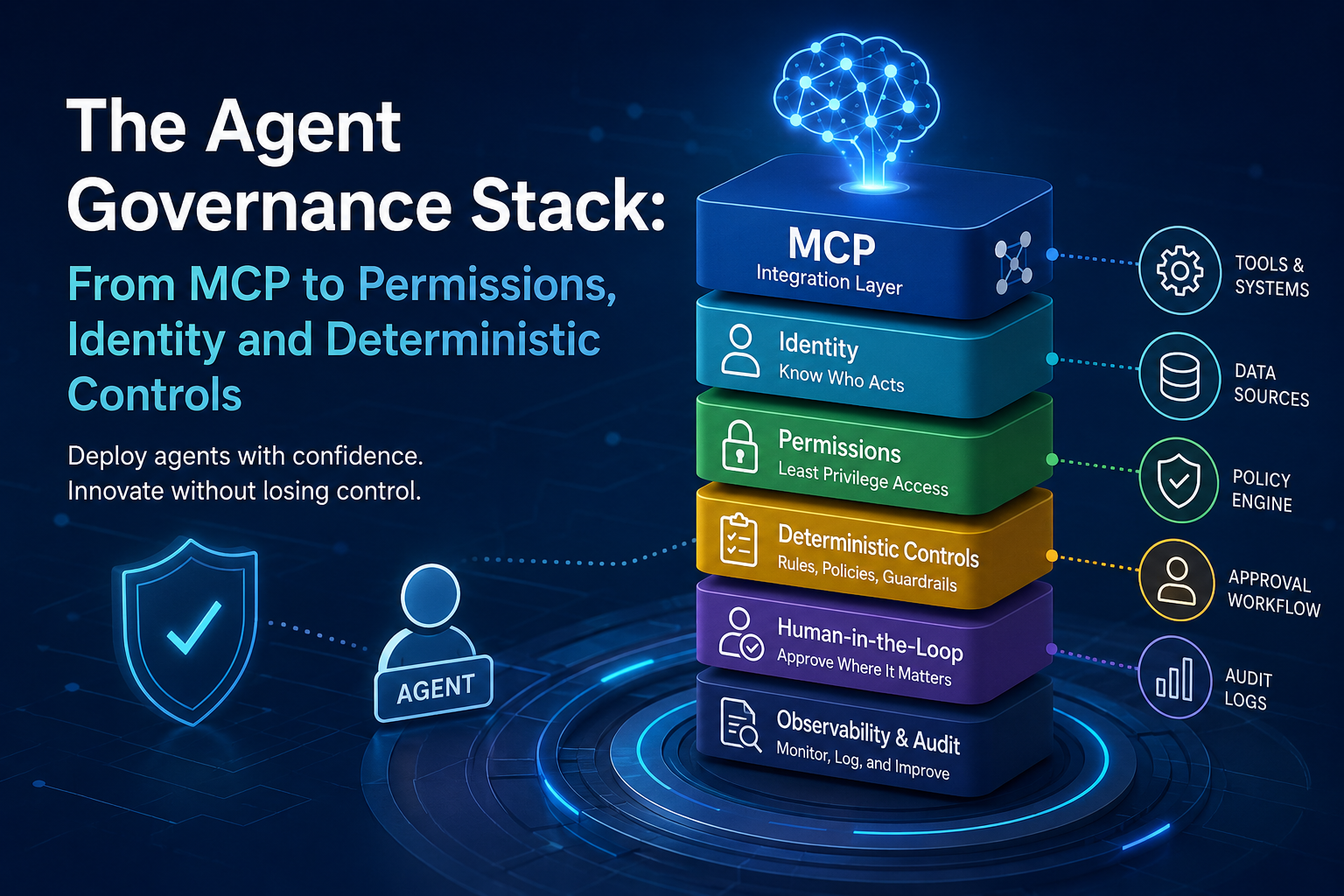
The answer is an agent governance stack: a layered control model that combines standards like the Model Context Protocol, strong identity, scoped permissions, deterministic rules, auditability, and human oversight.
MCP provides a standardized way for AI applications to connect with tools, resources, prompts, and external systems through hosts, clients, and servers using JSON-RPC-style communication. It is useful because it helps create a cleaner integration layer between agents and enterprise systems. But MCP alone is not governance. It is one layer in a broader control architecture.
Why Agent Governance Is Different From Traditional AI Governance
Traditional AI governance often focuses on model risk, data privacy, bias, accuracy, and acceptable use. Those still matter. But agents introduce another dimension: action risk.
A normal AI assistant might provide a wrong answer. An agent might provide a wrong answer, then send an email, change a CRM record, approve a refund, create a support ticket, query sensitive data, or call an internal API.
That means agent governance must cover three things at the same time:
What the agent knows
What data, documents, memory, and context can it access?What the agent can do
Which tools, APIs, workflows, and systems can it invoke?When the agent must stop
Which actions require approval, verification, deterministic validation, or escalation?
A good governance stack does not depend on the model “behaving well.” It assumes the model may misunderstand, hallucinate, be manipulated, or face conflicting instructions. The control system must remain reliable even when the agent is uncertain.
The Practical Agent Governance Stack
Think of the stack as a set of layers. Each layer reduces a different type of risk.
1. Use Case Registry and Risk Tiering
Before connecting agents to tools, create a registry of agent use cases. Every agent should have an owner, purpose, risk level, approved systems, data boundaries, and escalation path.
For example, an internal research assistant may be low risk if it only searches public documents. A finance operations agent that can initiate vendor payments is high risk. A customer service agent that can issue refunds may sit somewhere in the middle, depending on limits and approval rules.
A useful risk-tiering model should consider:
Business impact if the agent makes a mistake
Sensitivity of the data it can access
Whether it can take external actions
Whether actions are reversible
Whether humans review outputs before execution
Regulatory, legal, or customer-impact exposure
This aligns with the broader idea behind the NIST AI Risk Management Framework, which organizes AI risk management around governance, mapping, measurement, and management.
Best approach: Do not approve “AI agents” in general. Approve specific agents for specific tasks under specific limits.
2. MCP as the Integration Control Layer
MCP can help standardize how agents discover and use tools, resources, and prompts. Instead of building one-off integrations between each agent and each system, MCP servers can expose capabilities in a structured way. MCP defines concepts such as tools, resources, prompts, lifecycle management, and authorization support.
This matters because governance becomes harder when every integration is custom. A standardized protocol makes it easier to inspect, register, restrict, and monitor what an agent can access.
However, enterprises should avoid treating MCP as a free-for-all connector layer. Every MCP server should be treated like a production integration surface. It needs ownership, authentication, authorization, logging, versioning, testing, and security review.
Best approach: Use MCP as a governed gateway, not as an open plug-in marketplace inside the enterprise.
A mature MCP deployment should include:
Approved MCP server registry
Tool metadata and ownership
Environment separation for development, testing, and production
Tool allowlists by agent and role
Input and output validation
Logging of tool calls and results
Rate limits and transaction limits
Security review before new tools are exposed
The goal is simple: agents should not discover powerful tools just because those tools exist. They should only discover the tools they are approved to use.
3. Identity: Know Who the Agent Is Acting For
Identity is one of the most important parts of agent governance. An agent should never operate as a vague “AI system” with broad shared credentials.
Every agent action should answer four identity questions:
Which user requested the action?
Which agent performed the action?
Which system or tool was called?
Which policy allowed or blocked the action?
This requires separating user identity, agent identity, and workload identity.
For example, when an employee asks an HR agent to retrieve policy information, the agent should act within that employee’s permissions. If an HR manager uses the same agent, the agent may see more information, but only because the human requester has the right access.
This prevents privilege expansion. The agent should not become a shortcut around enterprise access controls.
MCP’s authorization specification supports HTTP-based authorization flows where an MCP client can request access to protected servers on behalf of a resource owner, with OAuth 2.1 used in the authorization model.
Best approach: Agents should use delegated, scoped, time-limited access. Avoid long-lived shared secrets and broad service accounts.
4. Permissions: Give Agents the Smallest Useful Set of Capabilities
A human employee may have broad access because they are trusted to use judgment. An agent should not inherit all of that access automatically.
Agent permissions should be designed around the task, not the user’s full role.
For example, a sales operations agent may need to read CRM opportunities and draft account updates. It may not need to delete accounts, export customer lists, or change commission data.
Strong permission design should include:
Read versus write separation
Tool-specific permissions
Data-specific permissions
Transaction limits
Time-bound access
Approval thresholds
Environment restrictions
Tenant, geography, or business-unit boundaries
A practical pattern is to create permission bundles such as:
Research only
Draft only
Recommend only
Execute with approval
Execute within limits
Execute fully automated for low-risk tasks
This makes agent access easier to review. It also helps CIOs explain governance to business stakeholders in plain language.
Best approach: Start agents in “read” or “draft” mode. Add execution rights only after testing, monitoring, and business approval.
5. Deterministic Controls: Do Not Let the Model Be the Final Control Point
The most important rule in agent governance is this: use deterministic systems for deterministic decisions.
A language model is probabilistic. It is good at interpreting, summarizing, planning, and generating. It is not the right place to enforce payment limits, regulatory rules, segregation of duties, access policies, or financial controls.
Those controls should live outside the model in policy engines, workflow systems, business rules, validators, and approval gates.
For example:
The model can draft a refund recommendation.
A deterministic rule checks whether the refund is under the approved limit.
A policy engine checks whether the customer, product, and region qualify.
A workflow system requires human approval if the amount exceeds a threshold.
An audit log records the decision, approval, and execution.
This pattern keeps the agent useful without making it the authority.
Best approach: Let the model propose. Let deterministic controls decide what is allowed.
6. Human-in-the-Loop Where It Actually Matters
Human approval is important, but it should be applied carefully. Too much approval slows everything down and causes alert fatigue. Too little approval creates unacceptable risk.
The right approach is risk-based intervention.
Low-risk actions can be automated. Medium-risk actions may need review. High-risk actions should require explicit approval, and in some cases, dual approval.
Examples of actions that often require human review include:
Sending external communications
Updating regulated records
Issuing refunds or credits
Changing employee, customer, or vendor data
Running large data exports
Triggering payments
Modifying production systems
Taking irreversible actions
The latest MCP tools specification notes that tools are designed to be model-controlled, while also stating that implementations should provide a human ability to deny tool invocations for trust, safety, and security.
Best approach: Do not place humans everywhere. Place humans at points of material business, legal, financial, operational, or reputational risk.
7. Data Boundaries and Context Governance
Agents are only as safe as the context they receive. If an agent can access too much data, it can accidentally expose, misuse, or combine information in ways the business did not intend.
Context governance should answer:
What data sources can the agent access?
Which documents are approved for retrieval?
Can the agent access personal, confidential, or regulated data?
Can the agent store memory?
How long is interaction history retained?
Can outputs include sensitive data?
Are data classifications enforced before retrieval and response?
Retrieval should be permission-aware. The agent should not retrieve a document unless the user is allowed to access that document. The same rule should apply to databases, tickets, knowledge bases, CRM records, code repositories, and collaboration tools.
Best approach: Treat context as a controlled asset. Retrieval should follow the same access rules as the source system.
8. Tool Mediation and Safe Execution
Agents become risky when they can call tools directly without mediation. A safer pattern is to put a control layer between the agent and the tool.
This mediation layer can inspect the request, validate inputs, apply policy, check identity, enforce limits, and log the outcome.
For example, before an agent calls a “create purchase order” tool, the control layer can check:
Is this agent allowed to create purchase orders?
Is the requester allowed to perform this action?
Is the amount below the limit?
Is the supplier approved?
Is the cost center valid?
Does this require approval?
Has the same request been submitted before?
Is the tool being called at an unusual volume?
This design is especially important because agentic systems face security risks that go beyond normal application security. OWASP’s Agentic Applications work focuses specifically on risks in autonomous and tool-using AI systems.
Best approach: Never connect an agent directly to a powerful enterprise action if a policy-enforcing gateway can sit in between.
9. Observability, Audit, and Forensics
If an agent takes an action, the organization must be able to reconstruct what happened.
A strong audit record should capture:
User request
Agent identity
Model used
Prompt or instruction context
Retrieved documents or data sources
Tool calls attempted
Tool calls approved or denied
Policy decisions
Human approvals
Final action taken
Output delivered
Error, retry, and override events
This is not only for compliance. It is also necessary for debugging, incident response, model improvement, and business trust.
CIOs should ask a simple question before approving any production agent: “Can we explain exactly why this agent took this action?”
If the answer is no, the agent is not ready for high-impact workflows.
Best approach: Build auditability before production. Retrofitting audit logs after an incident is too late.
A Practical Deployment Model for CIOs
A controlled agent rollout can follow a simple maturity path.
Phase 1: Assistive Agents
Agents can search, summarize, classify, and draft, but they cannot take action. This phase is ideal for knowledge management, support, internal research, policy Q&A, and productivity use cases.
Governance focus:
Data permissions
Source citation
Prompt injection testing
User feedback
Output review
Phase 2: Recommended Actions
Agents can recommend actions but cannot execute them. A human makes the final decision.
Governance focus:
Recommendation quality
Confidence scoring
Approval workflow
Business rule validation
Audit trail
Phase 3: Human-Approved Execution
Agents can prepare actions and route them for approval. The human approves, rejects, or edits before execution.
Governance focus:
Approval thresholds
Segregation of duties
Identity delegation
Tool mediation
Exception handling
Phase 4: Limited Autonomous Execution
Agents can execute low-risk, reversible, well-bounded actions without approval.
Governance focus:
Transaction limits
Real-time monitoring
Rollback procedures
Rate limiting
Drift detection
Phase 5: High-Assurance Agent Operations
Agents operate across multiple systems with mature controls, deterministic policy enforcement, continuous monitoring, red teaming, and formal governance.
Governance focus:
Enterprise policy engine
Continuous evaluation
Incident response
Compliance reporting
Executive risk review
The mistake many organizations make is trying to jump from Phase 1 to Phase 4. A safer approach is to earn autonomy gradually.
Best Approaches for Building the Stack
1. Design for Least Privilege From Day One
Do not give agents broad access during pilots just to move quickly. Early design choices often become production defaults. Start with narrow access and expand only when justified.
2. Separate Reasoning From Execution
Let the agent reason, summarize, and recommend. Let deterministic systems enforce rules and execute transactions.
3. Make Every Tool Explicit
Every tool should have a name, owner, purpose, risk level, input schema, output schema, permission model, and logging requirement.
4. Use Policy-as-Code
Agent permissions should not live only in documentation. They should be enforceable through policy engines, workflow systems, API gateways, and identity platforms.
5. Keep Humans in Control of Material Risk
Human review should be required for actions that are expensive, irreversible, regulated, customer-facing, or security-sensitive.
6. Monitor Agent Behavior Continuously
Agents should be monitored like production systems. Track errors, refusals, tool failures, unusual usage, policy denials, sensitive data exposure, and user overrides.
7. Red Team Before Scaling
Test for prompt injection, excessive permissions, tool misuse, data leakage, unsafe delegation, and approval bypass. OWASP’s LLM and agentic AI guidance is a useful reference point for these categories of risk.
The CIO Checklist for Agent Governance
Before deploying an enterprise agent, ask:
Does the agent have a named business owner?
Is the use case registered and risk-rated?
Are approved tools clearly defined?
Are permissions scoped by user, agent, tool, and task?
Is the agent using delegated identity rather than shared credentials?
Are sensitive data boundaries enforced?
Are deterministic business rules outside the model?
Are high-risk actions routed for human approval?
Are tool calls logged and auditable?
Can actions be reversed or contained?
Has the agent been tested for prompt injection and tool misuse?
Is there an incident response plan?
Is performance monitored after launch?
A “no” on any of these does not always block deployment. But it should lower the agent’s autonomy until the gap is fixed.
Common Mistakes to Avoid
Mistake 1: Treating MCP as the Whole Governance Strategy
MCP can standardize integration, but it does not automatically solve identity, permissions, audit, approval, or business-rule enforcement.
Mistake 2: Giving Agents Human-Level Access
Agents should not automatically inherit every permission the requesting user has. The agent should receive only the permissions needed for the approved task.
Mistake 3: Depending on Prompts for Compliance
Prompts are useful, but they are not reliable control systems. Compliance rules should be enforced outside the model.
Mistake 4: Skipping Audit Design
If the agent cannot be audited, it should not be trusted with important actions.
Mistake 5: Automating Too Early
Autonomy should be earned through evidence: evaluation results, monitoring data, low incident rates, and clear business value.
Conclusion: Govern the Action, Not Just the Model
The future of enterprise AI will not be defined only by better models. It will be defined by better control systems around those models.
Agents can create real business value, but only when they are deployed with clear boundaries. CIOs and AI teams need to govern the full chain: identity, context, tools, permissions, approvals, deterministic controls, observability, and incident response.
MCP is an important part of the emerging agent ecosystem because it gives teams a more standardized way to connect agents to tools and data. But the winning architecture is bigger than MCP. It is a full agent governance stack.
The principle is simple:
Agents should be powerful enough to help the business, but never powerful enough to bypass the business.
Tags
#AI #AgentGovernance #AIAgents #MCP #AgentIdentity #AgentPermissions #DeterministicAI #AIControls #EnterpriseAI #AIGovernance #AgentSecurity #ResponsibleAI #IdentityManagement #AICompliance #AgentOrchestration #FutureOfAI