Google’s Agentic Gemini Strategy: Search, Apps, Video and Personal Agents
Google is turning Gemini from a chatbot into an action layer across Search, Android, Workspace, video creation, developer tools and personal productivity.
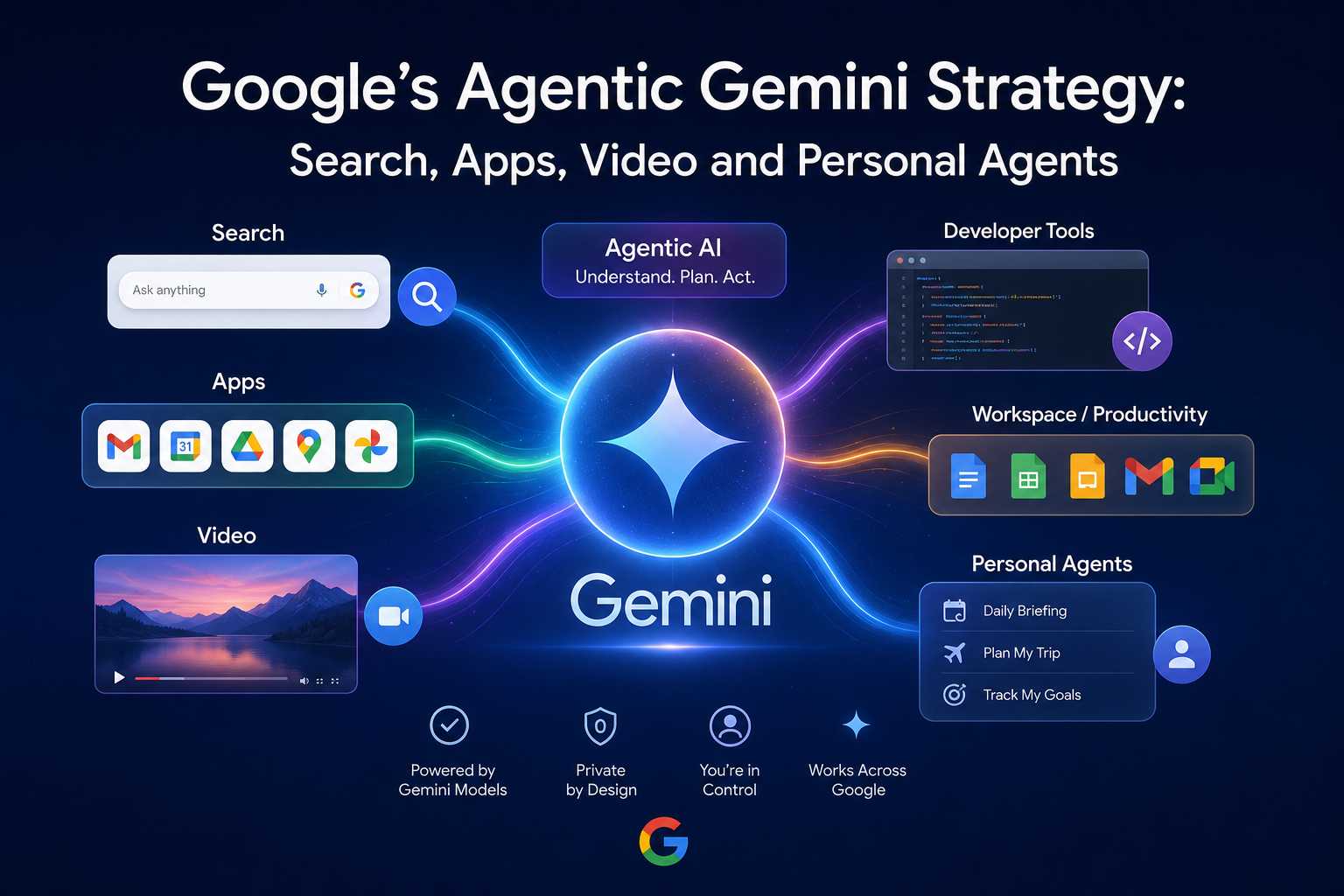
Google’s Gemini strategy is becoming much bigger than “ask a question and get an answer.” The company is positioning Gemini as an action layer: an AI system that can understand intent, use context, connect with apps, and help people complete tasks across Google’s ecosystem.
This shift matters because Google already owns many of the surfaces where people search, work, watch, write, navigate, communicate and build software. By placing Gemini inside those surfaces, Google is not just adding AI features. It is trying to change how people interact with digital tools altogether.
From answers to actions
For years, Google’s core strength was helping users find information. Search connected people to web pages. Gmail helped them manage messages. Maps helped them move through the world. Docs helped them create and collaborate.
Gemini changes the role of these products. Instead of simply showing information, Gemini can interpret what the user wants and help move the task forward. That may mean summarizing an email thread, planning a trip, generating a video scene, helping a developer ship code, or running a background agent that watches for useful information.
Google has been clear about this direction. At Google I/O 2026, the company described its shift toward more agentic AI, with Gemini 3.5 Flash powering AI Mode in Search and the Gemini app globally. Google also introduced Gemini Spark, a personal AI agent designed to run in the background and take action under the user’s direction.
Search becomes a task engine
Search is still the most important surface for Google’s Gemini strategy. The old search model was built around keywords. The new model is built around intent.
Google says AI Mode in Search now uses Gemini 3.5 Flash globally, and the company is redesigning the search box so people can ask using text, images, files, videos and Chrome tabs. Google also says AI Mode has passed one billion monthly users, which shows that AI-powered search is no longer just an experiment.
The bigger change is the arrival of Search agents. Instead of asking one question at a time, users will be able to create and manage AI agents inside Search. These agents can work in the background, reason across information and surface useful updates when needed.
This turns Search into more than a discovery tool. It becomes a place where users can delegate research, monitoring and planning. That is a major strategic move because it protects Google’s search habit while making the experience feel closer to an assistant than a list of links.
Gemini connects consumer apps into one experience
The second part of Google’s strategy is app integration. Gemini becomes more useful when it can understand what is happening across Gmail, Calendar, Photos, YouTube, Search and other Google services.
Google’s Personal Intelligence feature connects Gemini to apps such as Gmail and Google Photos when users opt in. The goal is to let Gemini reason across personal information and retrieve details that would otherwise be buried in emails, photos or past activity.
Google has also expanded Personal Intelligence across AI Mode in Search, the Gemini app and Gemini in Chrome in the U.S. The company describes use cases such as personalized shopping help, travel planning and troubleshooting based on information from connected Google apps.
This is where Gemini becomes more than a chatbot. A chatbot waits for context. A personal AI layer already has relevant context, with permission, and can use it to give more specific help.
Android becomes a proactive AI surface
Android is another key part of the Gemini strategy. Google is using Gemini to make the phone feel less like a grid of apps and more like an intelligent interface.
With Gemini Intelligence on Android, Google says Gemini can automate multi-step tasks, help fill out forms, summarize and compare web content in Chrome, and use screen or image context to trigger actions. For example, a user could show Gemini a list and ask it to build a shopping cart, or show a travel brochure and ask it to find a similar tour.
This matters because mobile tasks are often fragmented. A simple goal may require opening five apps, copying details, comparing options and confirming a final step. Gemini’s role is to sit above those apps and reduce the manual switching.
Google also emphasizes that users remain in control, with final confirmation required for actions in many cases and opt-in controls for connected experiences.
Video becomes a Gemini-powered creation layer
Google is also extending Gemini into creative production, especially video.
Flow, Google’s AI filmmaking tool, was designed around Veo, Imagen and Gemini. Google says Flow uses Veo for cinematic video generation while Gemini helps users describe creative ideas in natural language.
The newer Gemini Omni direction goes further. Google describes Gemini Omni Flash as a model that can create from multiple input types, starting with video. It can combine images, audio, video and text, generate video grounded in Gemini’s world knowledge, and support conversational video editing.
This shows that Google does not see Gemini only as a productivity assistant. It sees Gemini as a creative operating layer too. Instead of using separate tools for prompting, editing, organizing and revising, creators can increasingly use a conversational workflow to move from idea to output.
In Google Flow, this becomes even more agentic. Google says Flow Agent can help with brainstorming, editing, creating variations, organizing assets and reasoning through creative projects under the user’s control.
Developers get agent-first tools
Google’s agentic Gemini strategy also targets developers. The company wants builders to create agents, not just call AI models.
At Google I/O 2026, Google highlighted Antigravity, AI Studio, Managed Agents in the Gemini API, and Android development tools as part of its shift from prompts to action.
Antigravity is especially important. Google describes it as an agentic development platform where agents can plan, execute and verify tasks across the editor, terminal and browser. This moves AI coding beyond autocomplete and into task delegation.
Google is also building agent infrastructure for companies. Gemini Enterprise Agent Platform is described as a platform to build, scale, govern and optimize agents, combining model selection, model building and agent building with orchestration, security and DevOps features.
This gives Google a path to compete not only in consumer AI but also in enterprise AI workflows. The strategy is clear: give developers and businesses the tools to build agents, then connect those agents back into Google Cloud, Workspace and Gemini.
Workspace turns everyday work into delegatable workflows
Gemini’s role in Workspace is about productivity at scale. Instead of simply helping users write emails or summarize documents, Google is moving toward agents that can automate repeated business processes.
Google Workspace Studio lets users design, manage and share AI agents inside Workspace. Google says users can build agents with natural language and use them to automate tasks such as email triage, status updates, reminders and more complex workflows.
This is a natural fit for agentic AI because office work is full of repetitive coordination. Emails need labels. Meetings create follow-ups. Documents need summaries. Teams need updates. If Gemini can reliably handle these small workflows, Workspace becomes more valuable and harder to leave.
The personal agent is the endgame
The most ambitious part of Google’s strategy is the personal agent.
A personal agent is different from a normal assistant. It does not just respond when asked. It can understand user goals, monitor relevant context, suggest next steps and take action with permission.
Google’s Gemini app is already moving in this direction. Its Daily Brief feature works across connected apps after opt-in, gathering urgent updates from Gmail, tracking Calendar events and organizing follow-up details into a briefing.
Gemini Spark pushes this further by running continuously and helping users navigate their digital lives under their direction.
This is the real strategic prize. If Gemini becomes the trusted layer for personal productivity, it can sit between the user and almost every digital task: search, email, calendar, browsing, shopping, travel, work, media and app automation.
Why Google has an advantage
Google has three major advantages in the agentic AI race.
First, it has distribution. Gemini can appear inside Search, Android, Chrome, Gmail, Workspace, YouTube, Maps and Cloud.
Second, it has context. With permission, Gemini can connect to the user’s emails, photos, calendar events, documents, searches and app activity.
Third, it has infrastructure. Google can serve consumers, developers and enterprises through the same broad AI stack: Gemini models, AI Studio, Cloud, Workspace, Android and agent platforms.
This combination makes Google’s strategy different from companies that only offer a standalone chatbot. Google can place AI directly where tasks already happen.
The risks Google must manage
The opportunity is huge, but so are the risks.
The first risk is trust. Users may like AI summaries, but they will be more cautious about AI agents that act on their behalf. Google will need strong permission controls, clear confirmations and transparent activity logs.
The second risk is reliability. An answer can be corrected. A wrong action can be costly. If an agent books the wrong reservation, sends the wrong message or changes the wrong file, users may lose confidence quickly.
The third risk is privacy. The more useful Gemini becomes, the more personal context it may need. Google’s challenge is to make connected experiences powerful without making users feel watched or locked in.
The fourth risk is the open web. If Search becomes more agentic and answer-focused, publishers and businesses will keep asking how traffic, attribution and visibility will work in an AI-first search experience.
Bottom line
Google’s Gemini strategy is not just about building a smarter model. It is about turning Gemini into the action layer for Google’s entire ecosystem.
In Search, Gemini helps users move from questions to tasks. In apps, it connects personal context. On Android, it automates mobile workflows. In video, it becomes a creative partner. For developers and enterprises, it becomes a platform for building agents. In personal productivity, it becomes a background assistant that can brief, plan and act.
The big idea is simple: Google wants Gemini to become the AI layer that understands what you want, connects to the tools you already use and helps you get things done.
That is why Google’s agentic Gemini strategy may be one of the most important AI moves in the market. It is not only about who has the best chatbot. It is about who controls the next interface for digital action.
Tags
#AI #GoogleGemini #AgenticAI #AIAgents #GoogleAI #PersonalAgents #AISearch #AIApps #AIVideo #GenerativeAI #EnterpriseAI #AgentOrchestration #DigitalTransformation #FutureOfAI #ArtificialIntelligence #TechInnovation