The Rise of AI Nations: When Every Country Builds Its Own Intelligence
The Rise of AI Nations: When Every Country Builds Its Own Intelligence
Digital sovereignty used to be a theoretical debate for academics and privacy advocates; in 2026, it is a matter of national survival. We have entered an era where relying on a foreign superpower for artificial intelligence is as risky as relying on a rival for your water supply. The world is waking up to a stark reality: if you don’t build your own national intelligence, you are essentially outsourcing your country’s brain.
The "One Model to Rule Them All" era is dead. In its place, we are seeing the rise of Sovereign AI, where nations are treating compute power and data sets as the new national infrastructure—as vital as roads, bridges, and power grids.
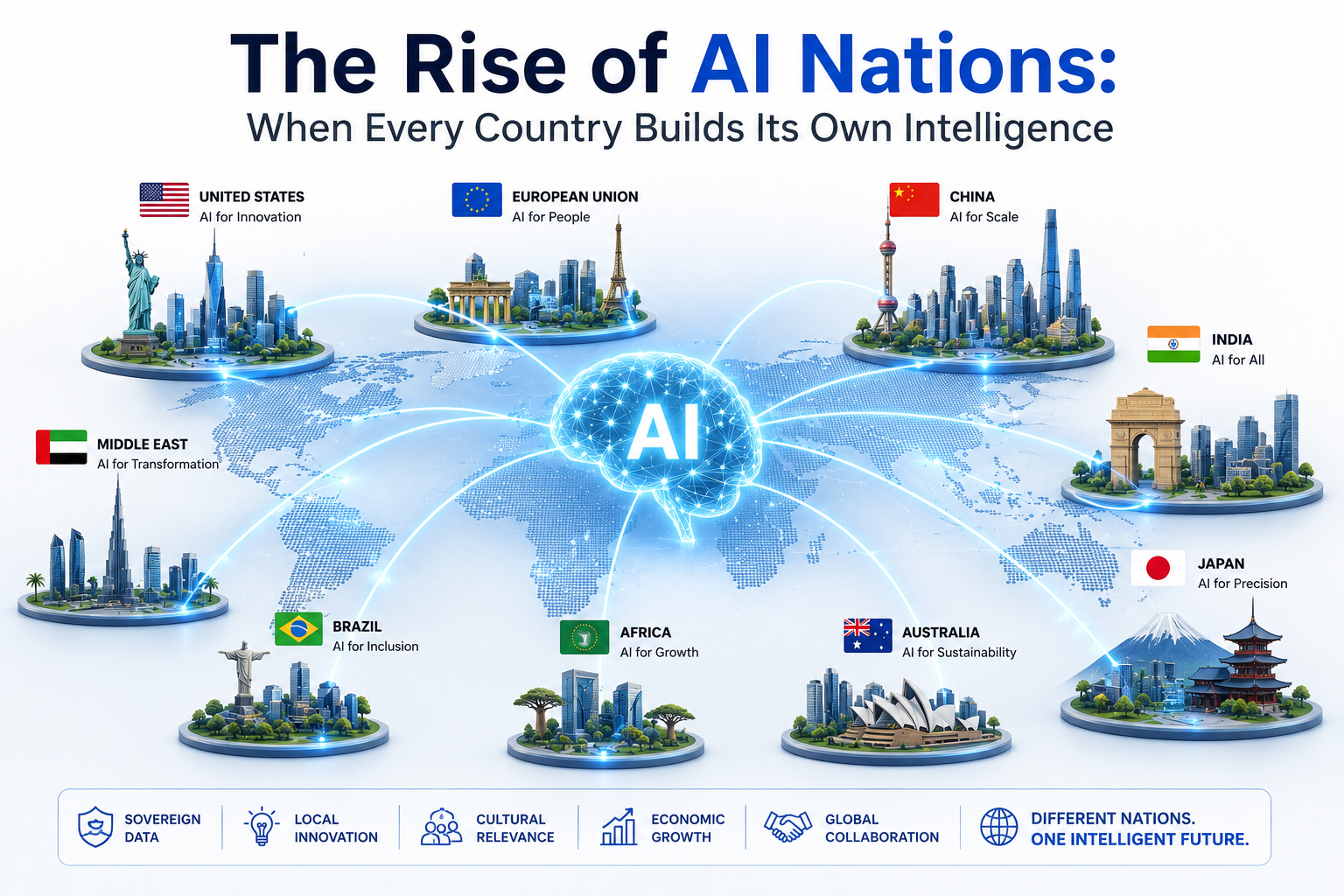
The End of Data Colonialism
For years, the global south and smaller tech economies acted as "data colonies"—exporting their raw human interactions to Silicon Valley to train models, only to buy back the finished intelligence at a premium.
Nations are now reclaiming their digital borders. This shift is driven by three critical realizations:
Linguistic Identity: A model trained on the English-centric internet will never truly understand the cultural nuances of Hindi, Swahili, or Arabic. Countries are building "Domestic LLMs" to ensure their heritage isn't erased by an algorithmic average.
Economic Insulation: By owning the stack—from the data centers to the weights of the model—nations protect themselves from foreign policy shifts or corporate rug-pulls that could cripple their digital economies.
The Privacy Fortress: Government intelligence, healthcare records, and military logistics cannot be fed into a public cloud owned by a foreign entity. Sovereign AI allows for "Local-First" processing that keeps a nation's most sensitive secrets on home soil.
The Blueprint of an AI Superpower
The race is no longer just between companies like Google and OpenAI; it is between capitals like Riyadh, Paris, Tokyo, and New Delhi. The new national budget priority is "Compute-per-Capita."
The Strategic Pillars of the AI Nation:
The Intelligence Factory: Governments are bypassing traditional cloud providers to build state-owned supercomputing hubs. These "AI Factories" provide subsidized compute to local startups and researchers, ensuring the next unicorn company stays in the country.
Curation of the National Corpus: Nations are digitizing their entire libraries, legal codes, and historical archives into proprietary datasets. This "National Corpus" is the secret sauce that makes a domestic AI more accurate and relevant than a generic global model.
The Talent Anchor: To stop the "brain drain" to California, countries are creating Sovereign AI fellowships, tying national service to the development of homegrown technology.
From Global Cloud to Digital Embassies
We are shifting toward a "multipolar" digital world. Instead of one global internet, we are seeing the emergence of Digital Embassies—secure, localized versions of AI technology that sit within a country's physical borders.
Infrastructure providers are pivotting to meet this demand, selling "AI-in-a-Box" solutions that allow a nation to turn on its own sovereign intelligence in months rather than years. It is a transition from Intelligence-as-a-Service to Intelligence-as-Infrastructure.
The Bottom Line
In 2026, the strength of a passport is no longer just about where it allows you to travel; it’s about the digital ecosystem that supports the person carrying it. The nations that win the next decade won't be those that use the best AI, but those that own the AI they use.
Intelligence is the ultimate soft power. And for the first time in history, that power is being localized.
"A nation that does not own its own intelligence is a nation that has agreed to be governed by someone else's algorithms."
Tags
#AI #ArtificialIntelligence #AINations #SovereignAI #NationalAI #AIInfrastructure #GlobalAI #AIGeopolitics #DigitalSovereignty #AITransformation #FutureOfAI #CountryScaleAI #AIInnovation #LocalizedAI #AILeadership #AIEconomy #StrategicAI #AICompetition #NextGenTechnology #GlobalInnovation