The Era of Synthetic Employees: When AI Stops Assisting and Starts Working
The honeymoon phase of the "helpful chatbot" is officially over. We’ve spent the last few years treating AI like a polished intern—someone to draft an email or summarize a meeting. But in 2026, the paradigm has shifted from augmentation to autonomy. We are no longer just using AI tools; we are hiring Synthetic Employees.
A synthetic employee doesn’t wait for a prompt to be useful. It doesn't just suggest a better sentence; it manages a budget, negotiates with vendors, and hits quarterly targets while you sleep. We have moved from the era of the "Co-pilot" to the era of the "Autopilot."
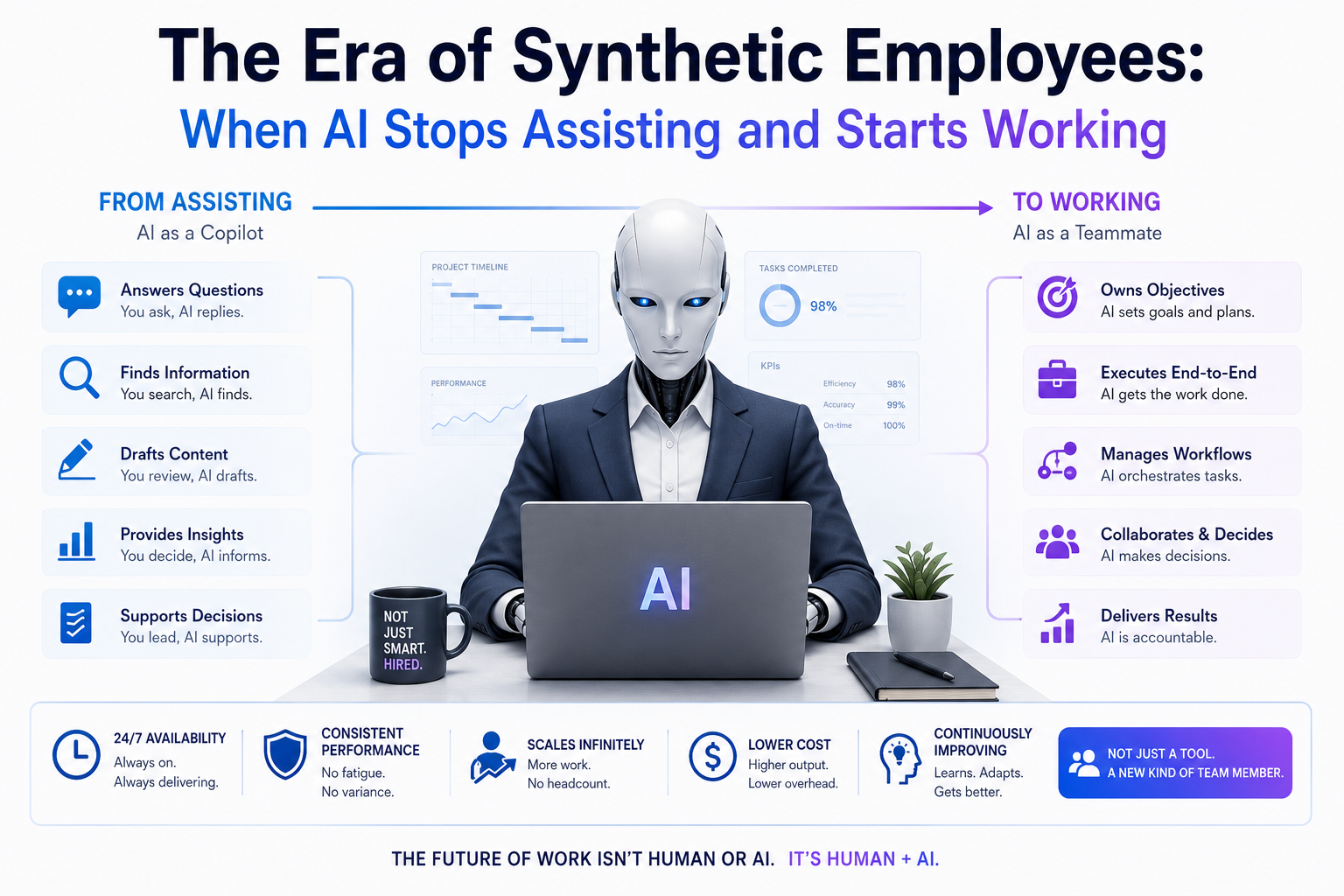
The Evolution: Assistant vs. Employee
What is the difference between an AI tool and a synthetic worker? It comes down to Agency.
While traditional AI acts like a high-end calculator—requiring a human to provide the numbers and hit "equals"—synthetic employees operate on Goal-Oriented Logic. You give them a destination ("Increase retention by 5%"), and they figure out the route, the vehicle, and the fuel.
Tool-Based AI: You write the prompt; it gives you the text.
Synthetic Employee: You grant access to your CRM and Slack; it identifies churn risks, drafts personalized recovery offers, and updates the database without you ever opening a tab.
The Rise of the "Agentic Stack"
Businesses are no longer looking for "All-in-One" AI. Instead, they are building teams of specialized synthetic agents that collaborate with each other.
The Digital SDR: An AI worker that researches leads, monitors LinkedIn for trigger events, and handles the first four rounds of back-and-forth scheduling.
The Autonomous Accountant: Systems that reconcile millions of transactions in real-time, flagging anomalies and filing tax compliance paperwork across multiple jurisdictions.
The Code-Gen Developer: Not just a "Copilot" for snippets, but a synthetic engineer that manages its own GitHub repository, fixes bugs overnight, and pushes to production after passing its own automated tests.
The New Management Challenge
Managing a synthetic workforce requires a completely different skillset than traditional leadership. You aren't managing people; you are managing Workflows and Guardrails.
Orchestration over Instruction: Leaders must learn to orchestrate "swarms" of AI agents, ensuring the Marketing AI is talking to the Sales AI effectively.
The "Human-in-the-Loop" Audit: In 2026, the most valuable employees are those who act as Quality Controllers—humans who have the taste and judgment to sign off on the autonomous outputs of their synthetic peers.
The Proof of Work: We are moving away from "Hours Worked" as a metric. If a synthetic employee does 40 hours of work in 40 seconds, the new metric is Outcome-per-Watt.
Final Takeaway
Synthetic employees aren't here to take your job; they are here to take your tasks. By offloading the "doing" to autonomous agents, humans are being forced upward into the roles we were actually meant for: strategy, empathy, and high-stakes decision-making.
The question for every business leader today isn't "Should we use AI?" but "What is our synthetic headcount for 2027?"
"In the era of synthetic labor, your competitive advantage is no longer how hard your team works, but how well your team thinks."
Tags
#AI #ArtificialIntelligence #GenerativeAI #SyntheticEmployees #FutureOfWork #AIWorkforce #AgenticAI #DigitalWorkers #EnterpriseAI #Automation #AITransformation #AIAgents #BusinessTransformation #WorkplaceAutomation #AIInnovation #HumanAI #IntelligentAutomation #FutureOfJobs #AIProductivity #TechFuture