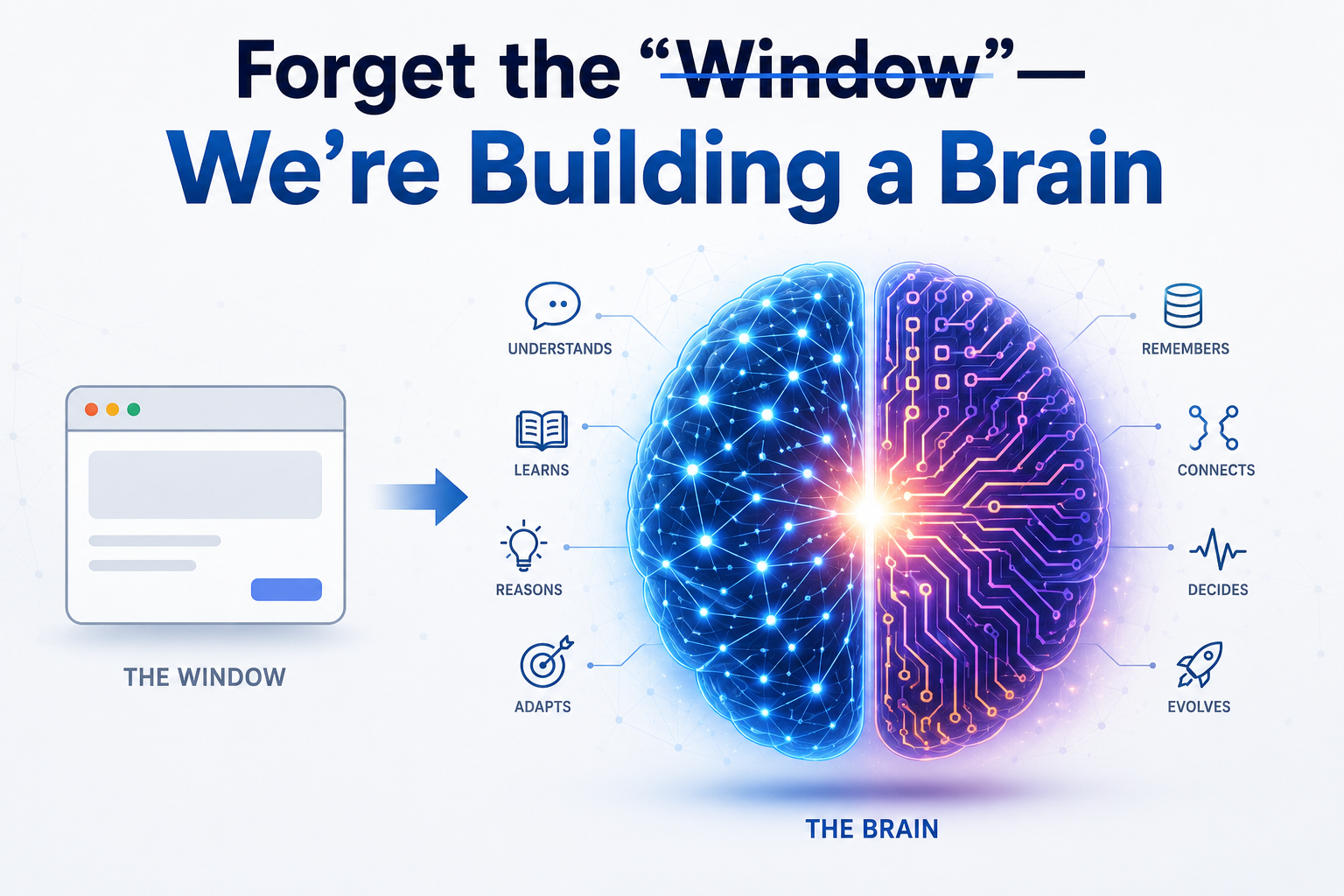
Forget the "Window"—We’re Building a Brain
Imagine if every time you walked into your favorite coffee shop, you had to re-introduce yourself, explain your taste in beans, and remind the barista that you’re allergic to almond milk. That is the current state of AI. No matter how many millions of tokens we cram into a Context Window, the moment you hit "New Chat," the AI develops digital amnesia.
We’ve spent years obsessed with how much information an AI can "hold in its head" at once. But the industry is shifting its gaze toward a much more human goal: Persistence.
The "Goldfish" Problem of Modern AI
We are currently living in the era of the "Mega-Context." Models can now ingest entire codebases or the complete works of Shakespeare in a single prompt. It feels like magic, but it’s actually a brute-force workaround.
The Cost of "Reading": Massive context windows are computationally "heavy." Processing 2 million tokens requires immense energy and causes noticeable latency.
The Session Trap: Your AI doesn't actually know you. It just analyzes the data currently in its "short-term memory." Once that session expires, that knowledge is vaporized.
The Efficiency Gap: Humans don't re-read their entire life history every morning to function. We have a retrieval system; AI, until now, has mostly had a "reading" system.
The Rise of the "Evergreen" AI
Persistent memory moves us away from the "Search and Retrieve" model toward a "Learn and Evolve" model. Here is how the architecture is changing:
1. Recursive Summarization
Instead of keeping every raw word, AI is learning to summarize past interactions into "memory logs." It keeps the essence of your preferences—your coding style, your tone, your project goals—without needing the raw data of a chat from three weeks ago.
2. Vector Databases as "Long-Term Storage"
Think of this as the AI's library. Through Retrieval-Augmented Generation (RAG), the AI can "glance" at its own personal library of your past interactions, pulling only the relevant book off the shelf when needed.
3. State-Full Personas
We are seeing the birth of AI that maintains a "state." This means your AI assistant grows with you. If you told it in January that you’re learning Python, it shouldn't be explaining basic print statements to you in June. It should remember your progress.
Why Persistent Memory is the Real Game-Changer
The transition from context windows to persistent memory is the difference between a tool and a partner.
"A context window is a desk where you lay out your papers. Persistent memory is the filing cabinet—and the experience—behind the desk."
Deep Hyper-Personalization: AI that understands your specific nuances, industry jargon, and internal company politics without being briefed every morning.
True Autonomy: Persistent memory allows AI agents to work on long-term projects over weeks or months, checking in on progress rather than starting from scratch.
Reduced "Hallucinations": By grounded responses in a dedicated, persistent knowledge base of your facts, the AI is less likely to fill in the blanks with nonsense.
The Bottom Line
The "Context Window wars" are cooling down because we’ve realized that bigger isn't always better—smarter is better. As we move into 2026, the focus is no longer on how much an AI can read in a blink, but on how much it can remember over a lifetime.
The era of the "one-night stand" with your LLM is over. The era of the lifelong digital collaborator has begun.
Tags
#AI #ArtificialIntelligence #GenerativeAI #ArtificialGeneralIntelligence #AGI #AIBrain #NeuralNetworks #CognitiveAI #AgenticAI #FutureOfAI #AIInnovation #MachineLearning #DeepLearning #AITransformation #HumanLikeAI #NextGenAI #IntelligentSystems #AIRevolution #DigitalIntelligence #TechFuture