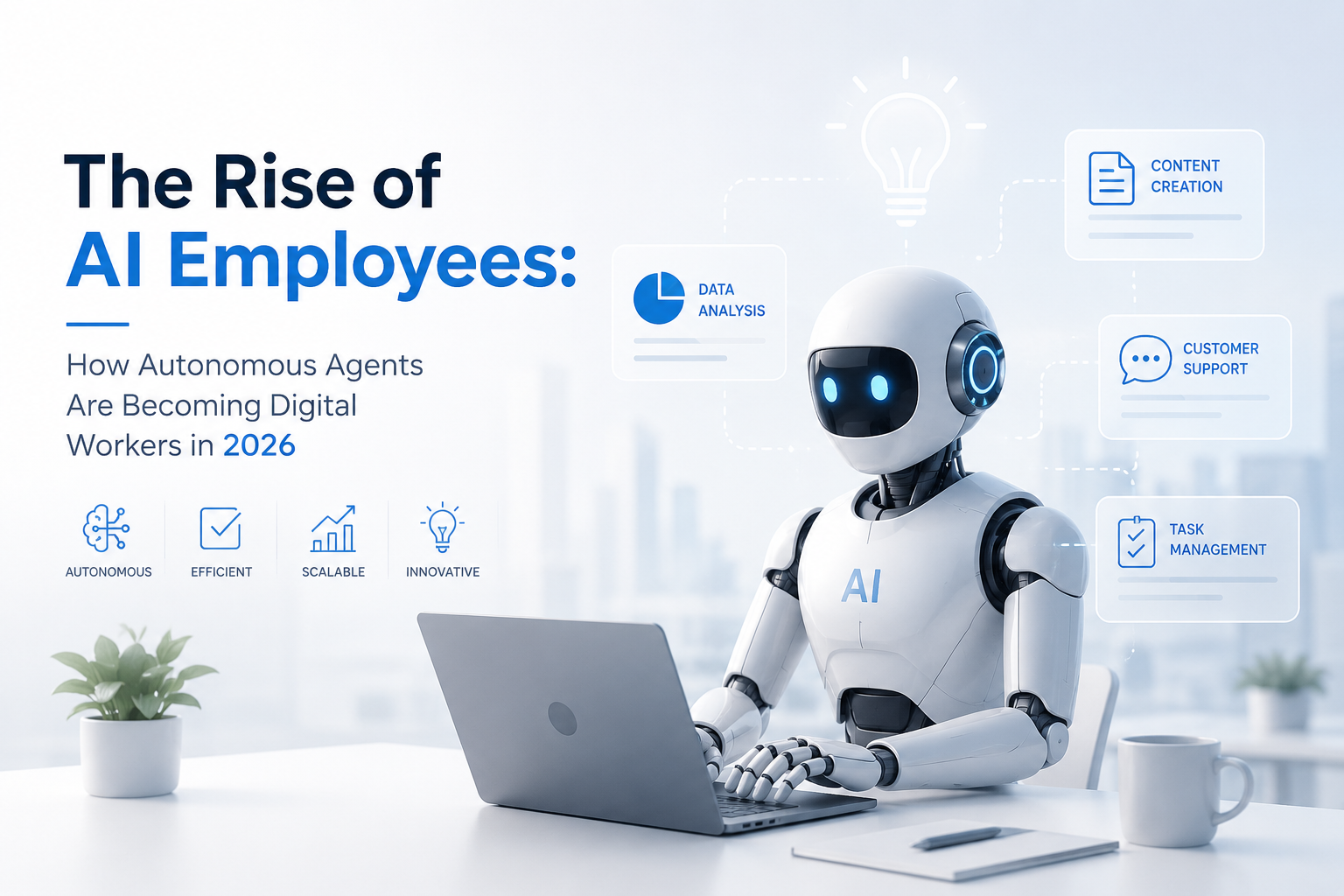
The corporate landscape has officially shifted. If 2024 and 2025 were defined by the novelty of conversational chatbots and writing prompts, 2026 is officially the year of the AI Employee.
We are moving past passive "copilots" that wait for human commands. Today, businesses are deploying Autonomous Agents—digital workers capable of breaking down complex goals, navigating software, collaborating with other AI agents, and executing entire workflows end-to-end with minimal human intervention.
Here is how agentic AI is fundamentally rearchitecting the modern workforce.
Moving From "Chatbots" to "Teammates"
The core differentiator of a 2026 AI agent is autonomy via multi-step reasoning. Traditional AI required step-by-step hand-holding. If you wanted to run a marketing campaign, you had to ask the AI for keywords, copy the output, ask it to write an email, and manually upload it to your CRM.
An AI employee handles the entire pipeline autonomously:
Goal-Oriented Planning: You give the agent a high-level goal: "Analyze our Q1 drop in customer retention and launch a re-engagement campaign."
System Integration: Using advanced protocols like the Model Context Protocol (MCP), agents securely connect directly to your internal enterprise systems—CRMs (like Salesforce Agentforce), ERPs, databases, and communication tools.
Execution & Interconnectivity: The agent pulls data from your database, diagnoses the issue, spins up a targeted email sequence, and monitors performance in real time.
The Concept of the "Digital Assembly Line"
In 2026, we are seeing the massive scaling of multi-agent ecosystems. Instead of relying on one massive, slow AI model to do everything, organizations are building digital assembly lines out of specialized agents.
For example, in engineering and software development, tech giants are utilizing specialized toolkits like NVIDIA’s NemoClaw. One agent acts as the autonomous software engineer writing code, a second sub-agent spins up a sandbox environment to test it, and a third security agent hunts for vulnerabilities before deployment.
The Result: Engineering and design simulation loops that used to take weeks are compressed into a matter of hours, allowing human engineers to focus entirely on creative architecture and strategy.
The New Job Description: The Human AI Orchestrator
The rise of digital workers doesn't mean human employees are becoming obsolete; rather, their roles are being elevated.
The primary skill set of 2026 is AI Orchestration. Instead of spending eight hours a day doing data entry, manual coding, or sorting through customer service tickets, human workers are stepping into managerial roles for their AI counterparts.
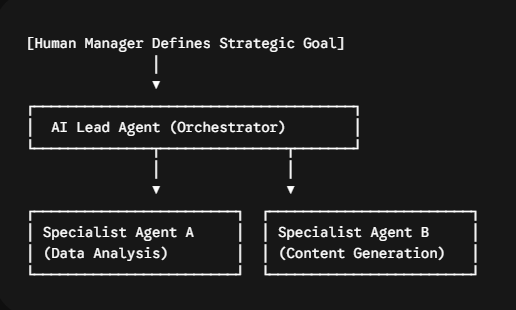
The job is now to define boundaries, set key performance indicators (KPIs), review autonomous outputs, and step in as a "human-in-the-loop" for critical, high-stakes decisions.
Governance, Safety, and the Risks of Autonomy
Of course, giving AI the keys to internal software doesn't come without risks. "Agent loops" (where an AI gets stuck repeating a costly or broken process) and unauthorized data access are serious concerns.
Because of this, 2026 has also seen the rise of Agentic Governance platforms (such as Willow and custom enterprise security runtimes). These platforms act like human HR and IT departments for AI employees—monitoring what internal tools the agents can access, masking sensitive customer data, and ensuring that no financial transactions or code deployments happen without explicit human approval.
Looking Ahead
The integration of AI employees marks a permanent shift in corporate productivity. According to recent 2026 enterprise data, nearly 79% of organizations have adopted some form of agentic AI workflows. The competitive advantage is no longer about who has the smartest chatbot; it's about who builds the most efficient, secure, and harmonious digital workforce.
Tags
#AI #AIEmployees #AutonomousAgents #DigitalWorkers #AgenticAI #ArtificialIntelligence #FutureOfWork #EnterpriseAI #BusinessAutomation #AIAutomation #DigitalTransformation #IntelligentAutomation #VirtualEmployees #AIWorkforce #Productivity #WorkplaceInnovation #AITrends2026 #EnterpriseAIAgents #DigitalLabor #FutureOfWork2026 #AutonomousAI #BusinessTransformation #SmartAutomation