We’ve all seen the dazzling demonstrations of AI "agents"—autonomous software programs that don’t just answer questions, but plan trips, write entire software codebases, and manage complex business workflows. On the surface, they look like real digital workers.
But use them for more than an hour, and the illusion begins to crack.
The agent forgets what you told it twenty minutes ago. It hallucinates a fact it got right at the start of the session. It loses the thread of a complex project and starts going in circles.
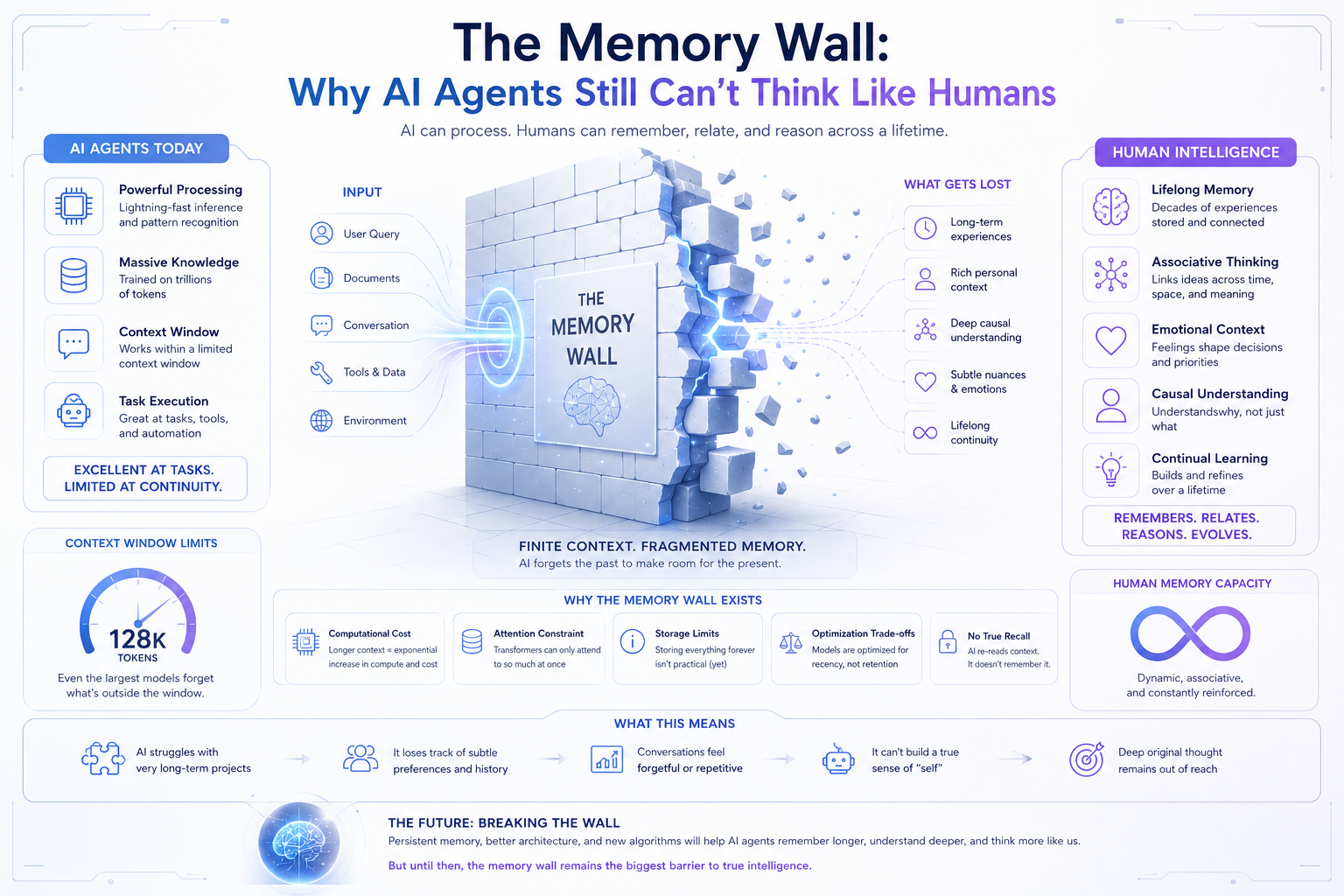
Despite all their data and processing power, today’s AI agents hit a psychological ceiling that humans cross effortlessly. In the tech world, this barrier is known as The Memory Wall. Here is why AI still struggles to remember, and why it's keeping them from truly thinking like us.
The Illusion of "Knowing" vs. The Reality of "Context"
To understand why AI forgets, we have to look under the hood at how an AI "thinks." Humans possess multiple types of memory: working memory for the task at hand, and long-term memory for everything else.
AI models don't have this native division. Instead, they rely heavily on something called a Context Window.
[ THE CONTEXT WINDOW ]
The digital "desktop" of the AI.
If information drops off the edge of the desktop, the AI completely forgets it exists.
Think of the context window as a physical desktop. When you talk to an AI, it places your words on that desktop. Newer models have massive desktops that can hold entire books. But once that desk gets cluttered, the AI has to throw older papers into the shredder to make room for new ones.
Unlike a human, who stores core concepts in their brain forever, an AI doesn't "remember" its past interactions with you—it just rapidly re-reads the digital paperwork on its desk every single time you hit enter.
Why AI Agents Hit the Wall
When we try to turn an AI into an agent that can work for days or weeks on a project, the Memory Wall becomes a structural crisis for three main reasons:
1. The Lost in the Middle Phenomenon
Even when an AI has a massive context window (the ability to read 1 million words at once), it suffers from a mathematical quirk: it is great at remembering the very beginning of a text, and the very end, but it gets incredibly muddy and "forgets" details hidden in the middle. For a human manager, missing the middle of a project directive is a fatal error; for an AI, it’s a standard limitation.
2. The Compounding Error Problem
When an AI agent operates autonomously, it takes an action, observes the result, and logs it into its memory. If it makes a tiny mistake in step 2, that mistake gets written into its context window. By step 50, the AI is reading a history full of its own errors, leading to a total operational meltdown. It lacks the human intuition to say, "Wait, this doesn't feel right. Let me start over."
3. The Computational Cost of Remembering
Every time an AI reads its context window, it requires heavy GPU computation. The longer the conversation goes, the more expensive and slower each subsequent response becomes. Keeping a human-like, lifelong memory active for an AI agent is currently an economic and environmental nightmare.
How Engineers Are Trying to Break the Wall
The race is on to build a better digital brain. Tech companies and researchers are trying to bypass the Memory Wall using a few clever engineering workarounds:
RAG (Retrieval-Augmented Generation): Think of this like giving the AI a Google Search bar for its own past. Instead of cramming everything onto its desk, the AI keeps a vast database of your past interactions and queries it only when necessary.
Vector Databases as Long-Term Memory: Companies are building external "hard drives" meant specifically to store the emotional and factual nuances of an AI's history with a user, acting as a proxy for human long-term memory.
Recursive Summarization: When a conversation gets too long, an AI model will write a quick summary of what happened so far, delete the massive transcript, and just keep the summary. (Imagine trying to do your job knowing only a bulleted summary of your life—it works, but you lose the poetry and the details).
The Human Advantage: Emotional Relevance
Why do humans remember a random childhood event from 15 years ago, but forget what we had for lunch two days ago? Because human memory is anchored by emotion, relevance, and survival mechanics. We don't record data line-by-line; we compress reality into meaning.
AI agents don’t feel boredom, stakes, or triumph. To an AI, a line of code, a piece of gossip, and a financial statistic all carry the exact same mathematical weight. Until AI can learn how to value information rather than just count it, it will remain trapped behind the Memory Wall.
The Way Forward
We are rapidly approaching the day when raw processing power isn't enough. The next breakthrough in artificial intelligence won’t come from making models bigger; it will come from making them smarter about what they choose to forget.
Until then, AI agents remain brilliant calculators with a severe case of short-term amnesia—phenomenal for a sprint, but not quite ready for the marathon of human thought.
Have you noticed your AI assistants losing their train of thought during long projects? How do you work around the "Memory Wall"? Drop your thoughts in the comments below!
Tags
#AIAgents #ArtificialIntelligence #CognitiveArchitecture #MachineLearning #TechTrends #ComputerScience #DeepLearning #LLMs #TechExplainer #FutureOfWork #DataScience #ContextWindow #AGI #ArtificialGeneralIntelligence #TechAnalysis #SoftwareDevelopment #VectorDatabases #RAG #CognitiveComputing #AIRevolution #NeuralNetworks #TechInsights #SmartAgents #Automation #FutureTech #SiliconValley