MCP Explained: Why the Model Context Protocol Is Becoming AI's Universal Standard
If you have tried to build an AI agent over the last two years, you have likely run face-first into the "Integration Nightmare."
Historically, if you wanted an LLM (Large Language Model) to read a specific database, check a Google Calendar, or pull from a Slack channel, you had to write custom, bespoke middleware code for that specific model. If you switched from one AI vendor to another, you had to rewrite the entire integration.
This created a messy $M \times N$ problem—where $M$ different AI models multiplied by $N$ different enterprise tools meant an unmanageable explosion of custom connectors.
Enter the Model Context Protocol (MCP). Now officially managed under the Linux Foundation's Agentic AI Foundation, MCP has rapidly established itself as the universal standard for AI integration. Think of it as the "USB-C port for Artificial Intelligence."
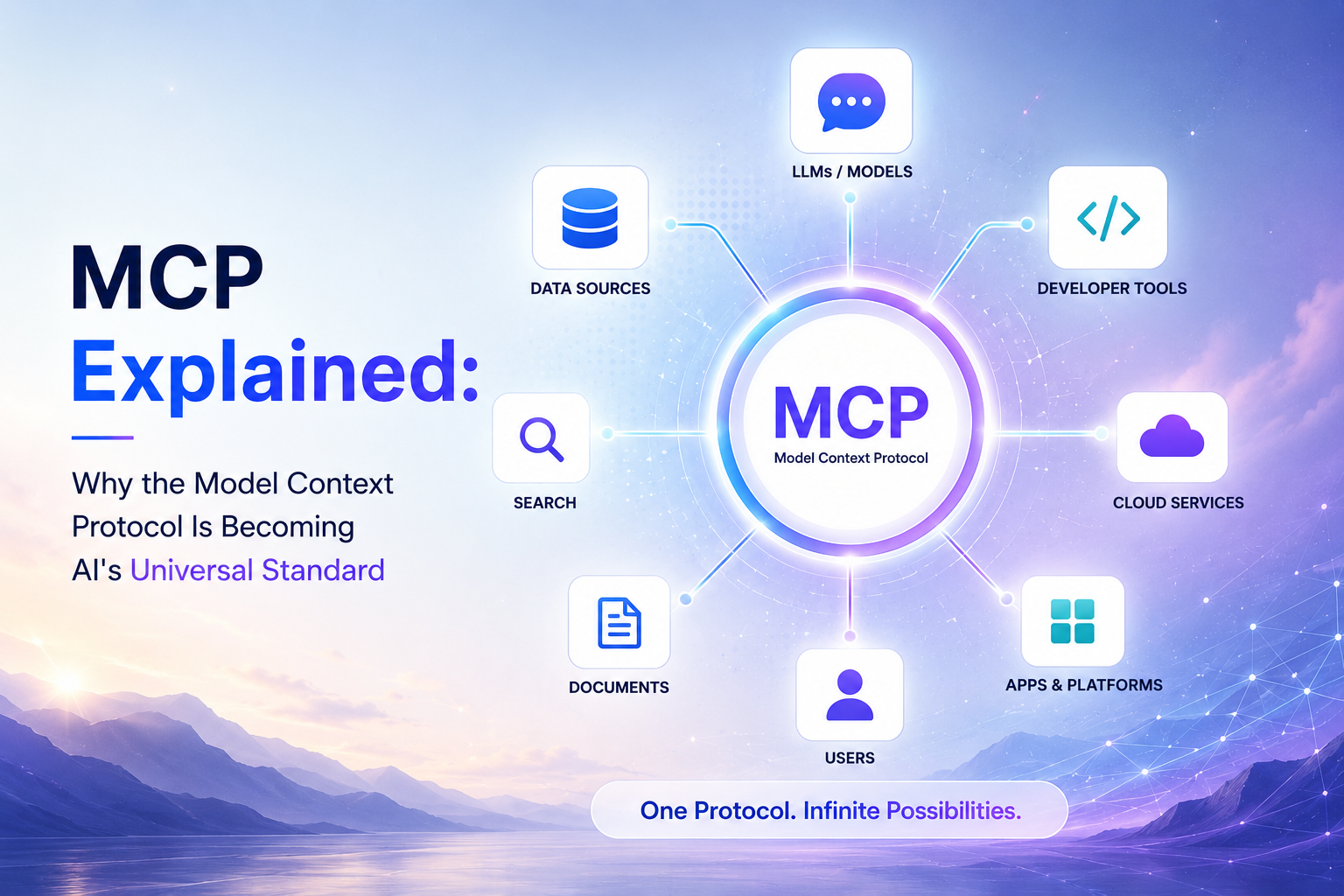
What Exactly is the Model Context Protocol?
Introduced as an open standard, MCP is a standardized, bidirectional communication language built on top of JSON-RPC 2.0. It allows an AI application to securely "plug in" to any external data source or tool without needing custom-coded bridges.
The architecture splits the workload into three distinct primitives:
The Host: The primary AI environment or application (like the ChatGPT desktop app, Claude Code, or development IDEs like Cursor and VS Code).
The Client: The secure engine inside the host that handles the translation between the AI model and external tools.
The Server: A lightweight, specialized container that exposes specific data, files, or APIs to the client.
Instead of teaching an AI model how to use 50 different apps, you simply expose those apps via an MCP server. The model automatically understands how to read from and write to them.
Why MCP Is Becoming the Universal Standard
The industry-wide shift toward MCP is happening at breakneck speed, backed by major tech ecosystems including Anthropic, Google, OpenAI, and Microsoft. There are three core reasons it has won the protocol wars:
1. It Solves AI "Hallucinations" via Real-Time Context
AI models inherently struggle because their training data is static and frozen in the past. MCP bridges this gap through Context Engineering. An AI can use an MCP server to read live code repositories, scan local markdown documentation, or fetch real-time database queries, grounding its answers in verifiable, live data.
2. From Chat to Interactive "MCP Apps"
The protocol has evolved beyond basic text exchanges. Modern extensions allow servers to return rich, interactive HTML interfaces (known as MCP Apps) directly inside a sandboxed iframe in your chat window. An AI can pull up live Figma designs, trigger payment setups, or display interactive data dashboards without the user ever leaving the AI interface.
3. Enterprise-Grade Governance
Giving an AI "read and write" capabilities across business systems requires ironclad security. MCP was built from the ground up to support modern authentication standards (like OAuth 2.1) and strict user-consent gates.
Security by Design: Under MCP, tools operate on a model of least-privilege. The AI only sees what the server explicitly exposes, every tool invocation creates a structured audit trail, and critical actions can be forced to pause for a "human-in-the-loop" sign-off.
The Landscape Ahead
We are quickly moving toward a world where software platforms will ship with a native MCP server out of the box. If a platform wants to be accessible to the growing digital workforce of AI agents, it must support the universal adapter.
By decoupling the AI model from the tools it uses, MCP has successfully commoditized the underlying plumbing of the AI boom—democratizing automation and allowing developers to build once and integrate everywhere.
Tags
#AI #ModelContextProtocol #MCP #AIStandards #AIProtocols #AgenticAI #ArtificialIntelligence #AIAgents #AIIntegration #Interoperability #LLMs #AIDevelopment #AISystems #AIInfrastructure #OpenStandards #EnterpriseAI #AIInnovation #FutureOfAI #MachineLearning #AIEcosystem #TechTrends2026 #ContextEngineering #AIConnectivity