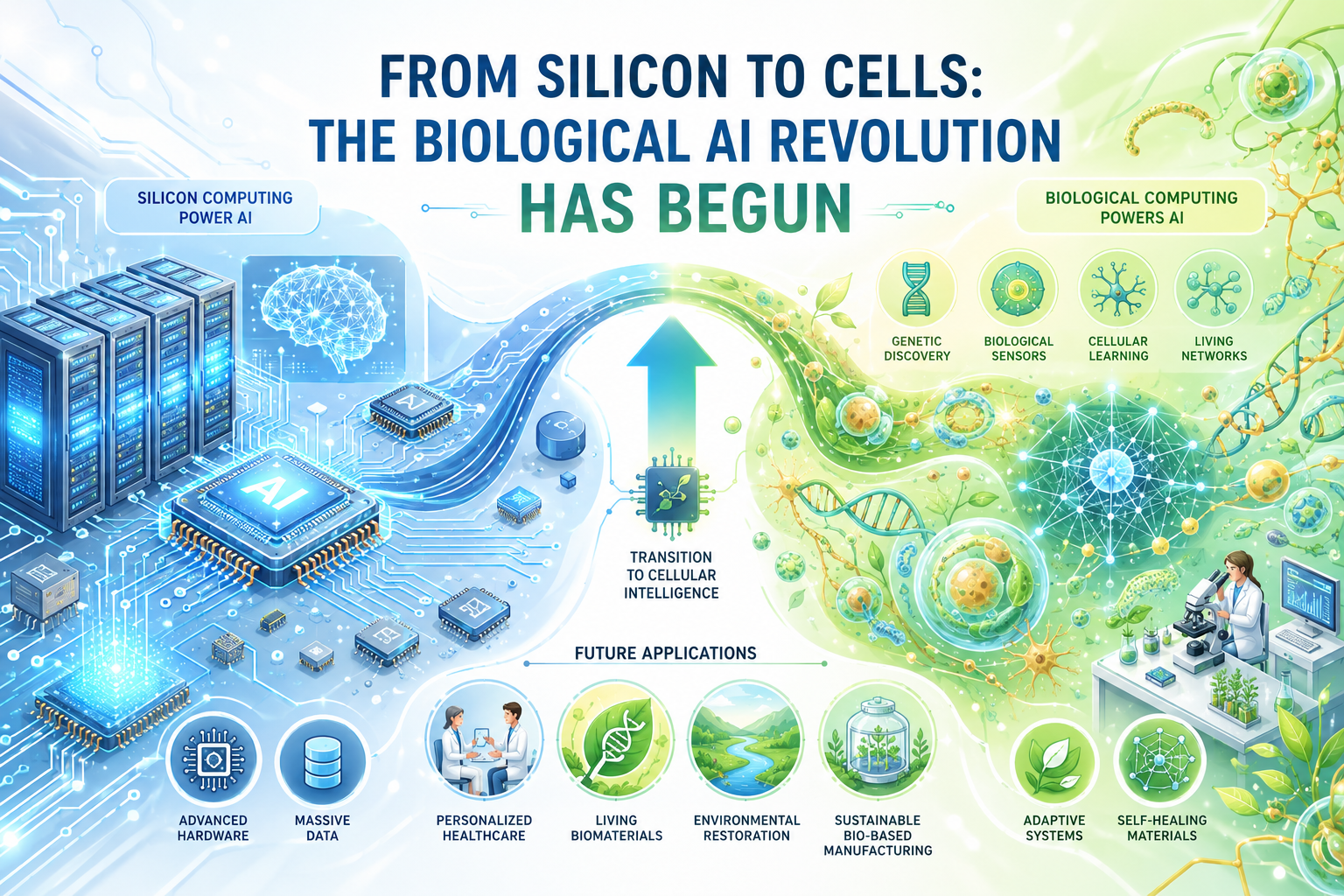
From Silicon to Cells: The Biological AI Revolution Has Begun
We have spent the better part of a century trying to force intelligence into sand. We carved circuits into silicon, chilled them with massive fans, and fed them enough electricity to power small cities. But as we push the limits of traditional computing, a new realization is dawning: the most efficient, powerful, and complex processor ever created isn't made of chips. It’s made of DNA.
The frontier of artificial intelligence is no longer just digital—it is becoming biological. We are moving from "Artificial" Intelligence to "Bio-Digital" Intelligence, and the implications will change everything from how we treat disease to how we store the world’s data.
The End of the Silicon Ceiling
Silicon has been a miraculous medium, but it has a fundamental problem: it is "hot and dry." It requires massive amounts of energy to perform calculations and even more to dissipate the resulting heat.
Biology, on the other hand, is "wet and cool." Your brain operates on roughly 20 watts—about the same as a dim lightbulb—yet it outperforms the world’s largest supercomputers in pattern recognition and real-time adaptability. The goal of the Biological AI revolution is to bridge this gap.
Biocomputing: Researchers are now using "Organoid Intelligence" (OI)—collections of lab-grown brain cells—to perform basic computational tasks. These biological processors can learn faster and use millions of times less energy than a traditional GPU.
Wetware: We are seeing the rise of "Wetware" interfaces, where living neurons are integrated directly onto electronic chips, creating a hybrid system that combines the speed of silicon with the plasticity of biology.
DNA: The Ultimate Hard Drive
Beyond processing, biology is solving the AI data crisis. Every day, the world generates more data than our current manufacturing capacity can create storage for. Nature solved this billions of years ago with DNA.
DNA is the most dense and durable storage medium in the universe. In 2026, we are seeing the first commercial applications of DNA Data Storage.
Infinite Density: You could theoretically store every bit of data currently on the internet inside a container the size of a shoebox.
Eternity-as-a-Service: Unlike a hard drive that fails in a decade, DNA can remain readable for thousands of years if kept cool and dry.
The Molecular Factory
The most exciting shift in this revolution is Generative Biology. Just as ChatGPT can generate a poem, new Bio-AI models can "generate" the code for a protein that has never existed in nature.
Programmable Medicine: Instead of searching for a drug, we use AI to design a specific molecule that fits into a disease-causing protein like a key into a lock.
Synthetic Biology: We are move past "writing code for screens" to "writing code for cells." We can now program bacteria to consume plastic, capture carbon, or grow sustainable materials for construction.
The Ethical Frontier
When the line between "machine" and "living organism" blurs, we enter uncharted territory. As we begin to use biological cells as computational components, we must ask: At what point does a biocomputer deserve rights? How do we ensure that "programmable life" remains safe for the ecosystem?
The Biological AI revolution isn't just a technical upgrade; it’s a philosophical shift. We are no longer just building tools; we are collaborating with the fundamental building blocks of life itself.
The Bottom Line
The future of intelligence isn't just about faster chips or bigger data centers. It’s about a return to our roots. The transition from silicon to cells marks the moment AI stops being an "artificial" extension of humanity and starts becoming a natural one.
"The greatest computer ever designed wasn't built in a cleanroom in Taiwan—it was evolved in the wild. We are finally learning how to speak its language."
Tags
#AI #ArtificialIntelligence #BiologicalAI #BioAI #SyntheticBiology #Biotech #FutureOfAI #AIRevolution #NeuralComputing #LivingIntelligence #BioComputing #NextGenTechnology #DeepTech #AIInnovation #HumanMachine #BiologicalComputing #DigitalBiology #TechFuture #EmergingTech #ScienceAndAI