The Invisible Revolution: How AI Agents Will Replace Traditional SaaS Interfaces
For decades, enterprise software has been built around one idea: humans must operate software manually. Employees log into dashboards, navigate menus, update records, generate reports, and switch between countless applications every day. This interaction model created the modern SaaS industry and shaped how businesses operate in the digital era.
But that model is beginning to change.
In 2026, AI Agents are introducing a completely new way of interacting with technology — one where software no longer waits for humans to click buttons. Instead, intelligent systems can understand goals, make decisions, coordinate workflows, and execute tasks autonomously.
This shift is creating what many experts now call the “Invisible Software Era.”
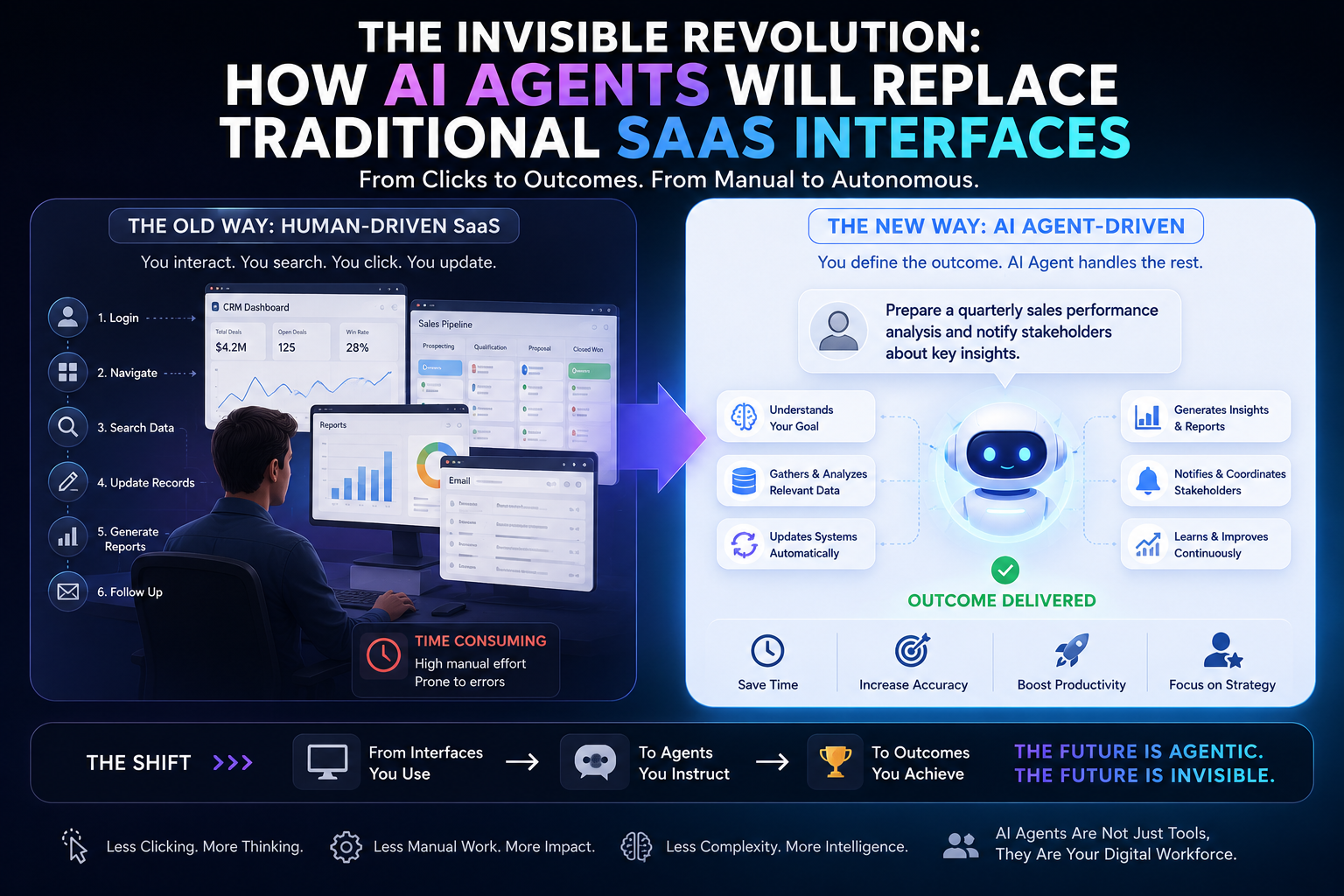
From Using Software to Delegating Work
Traditional SaaS platforms are designed around human interaction. Whether it is CRM, ERP, HR, or project management software, employees still spend a large portion of their time navigating interfaces instead of focusing on strategic work.
AI Agents change this completely.
Instead of manually performing tasks across multiple systems, users simply define the outcome they want to achieve.
For example, instead of:
opening CRM dashboards,
updating sales pipelines,
generating reports,
and scheduling follow-ups manually,
a sales leader could simply instruct an AI agent:
“Analyze all enterprise accounts at risk this quarter and prepare recovery plans.”
The agent can gather data, identify risks, create summaries, update records, and notify stakeholders automatically.
The role of employees begins shifting from software operators to decision-makers.
Why Traditional Interfaces Are Losing Relevance
Dashboards, forms, menus, and workflows were built for humans. AI agents do not need them.
Agents interact directly with:
APIs,
databases,
enterprise systems,
and business workflows.
This means the traditional SaaS interface may no longer be the center of enterprise software. In many cases, it becomes a background layer while AI handles the operational complexity behind the scenes.
The focus moves away from:
“How do I use this software?”
toward:
“What outcome do I want to achieve?”
That is a major transformation.
SaaS Is Not Dying — It Is Evolving
AI agents are unlikely to replace SaaS platforms entirely. Instead, SaaS products will evolve into intelligent backend systems that power autonomous agents.
In the future:
CRM systems will become customer intelligence engines,
ERP platforms will become operational data layers,
and enterprise software will increasingly function as infrastructure for AI agents.
The competitive advantage will no longer be based only on user interface design. It will depend on:
automation capabilities,
API accessibility,
interoperability,
and agent-friendly architectures.
The companies that adapt fastest to this shift will lead the next generation of enterprise software.
The Rise of Invisible Software
The most successful software experiences in the future may become almost invisible.
Users will care less about:
which platform performed the task,
where the data came from,
or how many systems were involved.
They will care about outcomes, speed, and intelligence.
This is similar to how consumers interact with modern technology today. People do not think about cloud infrastructure or recommendation algorithms — they simply expect results instantly.
Enterprise software is moving in the same direction.
The Challenges Ahead
Despite the excitement, AI Agents also introduce important challenges.
Businesses still need to address:
governance,
security,
compliance,
explainability,
and operational trust.
Not every workflow should become autonomous, especially in highly regulated industries where human oversight remains critical.
The future will likely be a hybrid model where:
AI Agents handle execution,
workflows provide structure,
RAG systems provide knowledge,
and humans remain responsible for strategic decisions.
Final Thoughts
The rise of AI Agents represents one of the biggest shifts in enterprise technology since the birth of cloud computing.
We are moving from a world where humans operate software to a world where humans direct intelligent systems.
Traditional SaaS interfaces will not disappear overnight, but they will gradually become less visible as AI agents take over operational work behind the scenes.
The future of enterprise software is not about more dashboards or more clicks.
It is about intelligent systems that quietly work on behalf of businesses — faster, smarter, and with far less friction.
And this invisible revolution has already begun.
Tags
#AI #AIAgents #SaaS #EnterpriseAI #Automation #DigitalTransformation #FutureOfWork #GenerativeAI #ArtificialIntelligence #AgenticAI #BusinessTechnology #FutureOfSoftware #Innovation #TechTrends #AITransformation