The 2026 AI Stack: Agents, Workflows, and RAG Explained
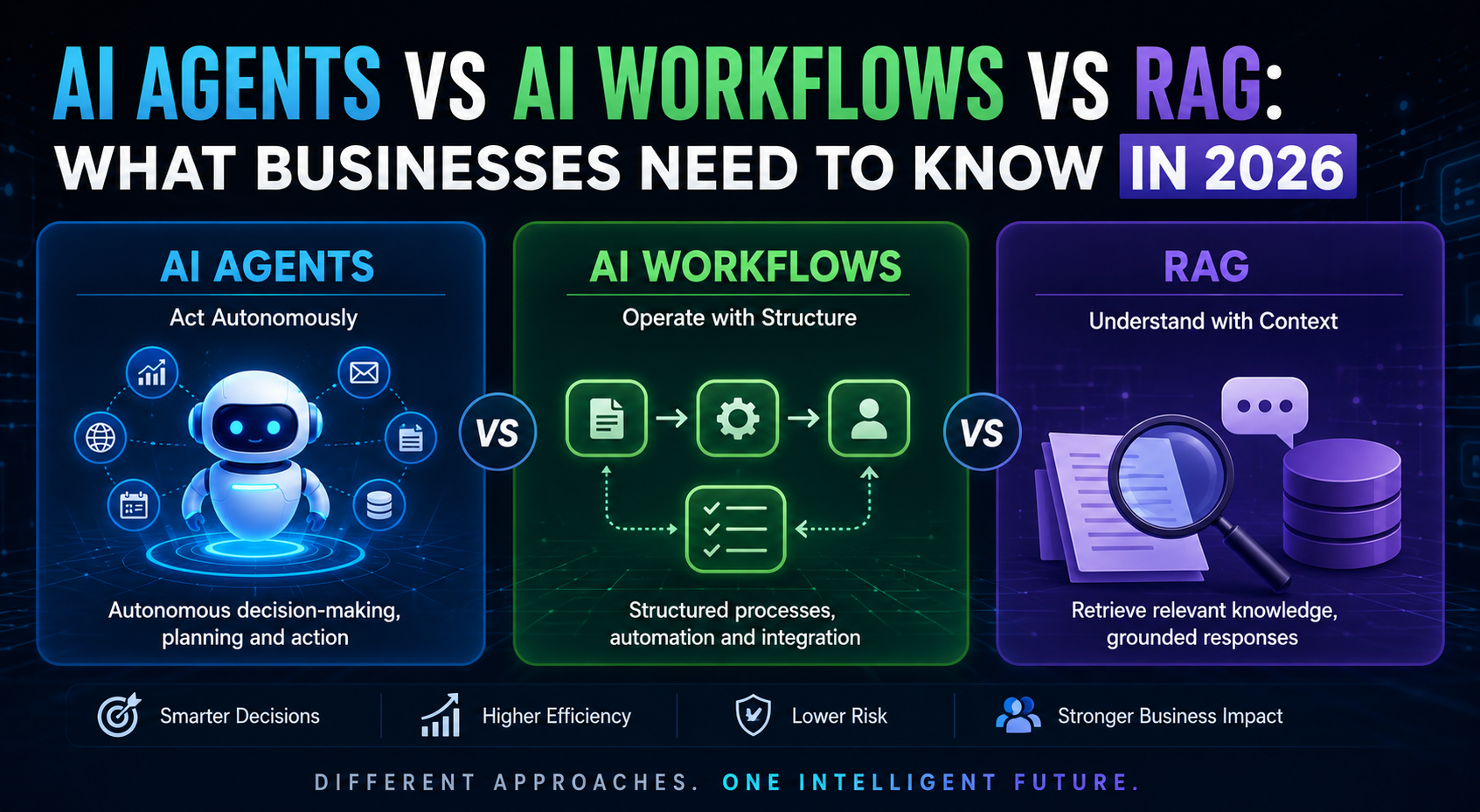
The AI landscape of 2026 has shifted from experimental "pilots" to foundational enterprise infrastructure (Dershem, 2026). As organizations move away from simple chatbots toward systemic organizational capabilities, three distinct architectures have emerged as the pillars of modern AI strategy: Retrieval-Augmented Generation (RAG), AI Workflows, and AI Agents.
Understanding the nuances between these—and how they now intersect—is critical for any leader aiming to build a scalable, "AI-embedded" business (Shao et al., 2026).
1. Retrieval-Augmented Generation (RAG): The "Knowledge Base"
In 2026, RAG has evolved far beyond its "naïve" origins of simple document lookups. It remains the gold standard for providing AI with real-time, domain-specific expertise without the cost of retraining models (Lewis et al., 2020; Wang et al., 2024).
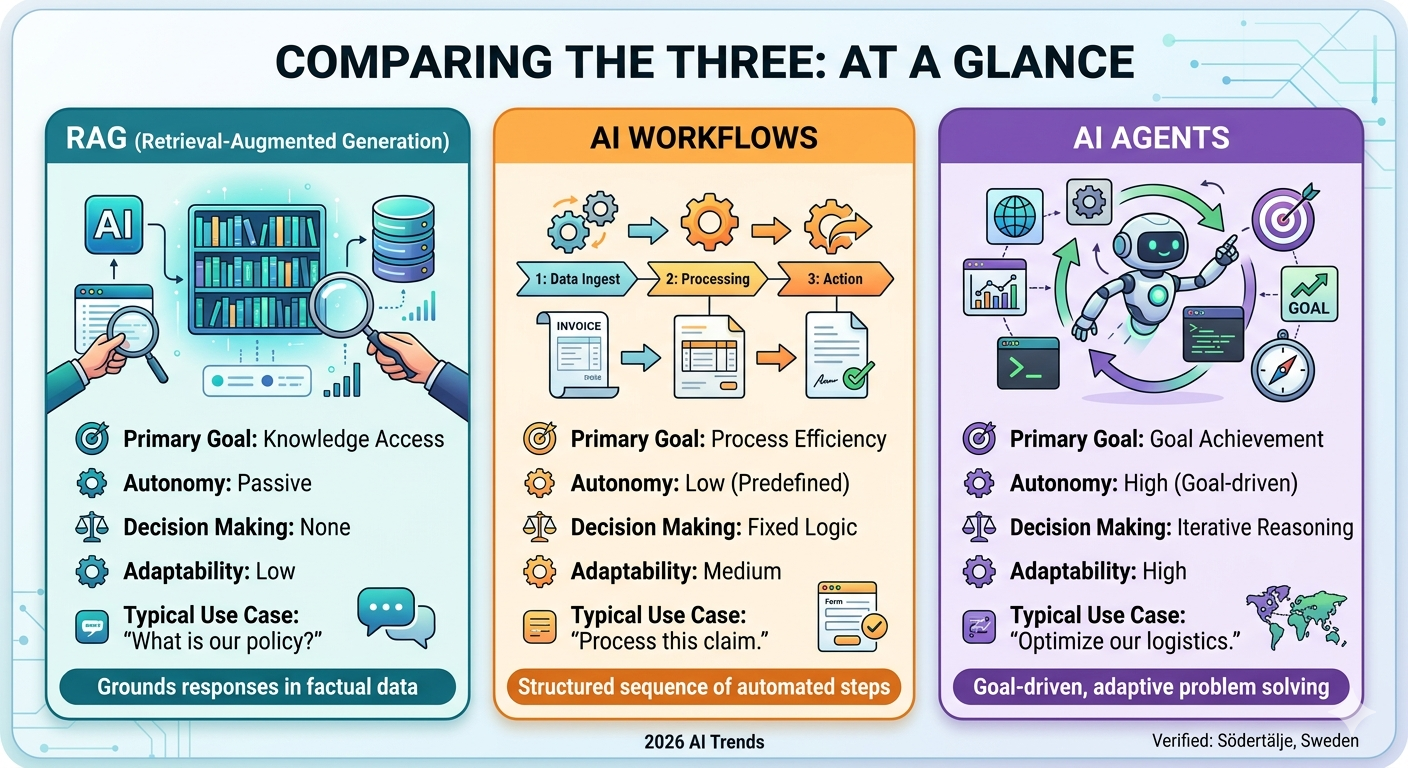
How it works: A RAG system retrieves relevant fragments from a vector database (like internal policy manuals or product catalogs) and uses them to ground the AI's response in factual, up-to-date information (Jesudason et al., 2025; Wang et al., 2026).
The 2026 Edge: "Self-improving" RAG systems now autonomously adapt their retrieval strategies based on user feedback and continuously ingest data from live streams like regulatory updates or market trends (Computer Society, 2025).
Best for: Customer support, legal research, and any task where factual accuracy and "source grounding" are non-negotiable.
2. AI Workflows: The "SOP" of the Digital Era
AI Workflows represent a structured, predefined sequence of tasks. Unlike a simple prompt, a workflow is a multi-step pipeline where the output of one AI module serves as the input for the next (Wang et al., 2026).
How it works: Think of this as a sophisticated "Standard Operating Procedure" (SOP). The system follows a fixed path: for example, Step 1 (Retrieve Data) $\rightarrow$ Step 2 (Summarize) $\rightarrow$ Step 3 (Format for Email).
The 2026 Edge: In 2026, these are often "Enhanced RAG" pipelines that use dedicated modules to rewrite queries or re-rank documents to ensure high-quality output every time (Wang et al., 2026).
Best for: Standardized processes like employee onboarding, invoice processing, and routine financial reporting where consistency and predictability are paramount.
3. AI Agents: The "Autonomous Workforce"
The breakthrough of 2026 is the rise of Agentic AI. Unlike workflows, which follow a script, agents are goal-driven. They can perceive their environment, reason through complex problems, and take actions autonomously (Shao et al., 2026; Wang et al., 2026).
How it works: An agent doesn't just follow a path; it creates one. If an agent is told to "conduct deep research on a competitor," it will decide which databases to search, whether to use a web browser, and how to refine its search if the first results are poor (Jia et al., 2026; Wang et al., 2026).
The 2026 Edge: We are seeing "Deep Research Agents" that combine RAG with iterative reasoning, enabling them to handle sparse or scattered evidence that traditional systems would miss (Jia et al., 2026).
Best for: Market analysis, molecular design, complex supply chain optimization, and "deep research" tasks that require iterative problem-solving (Jia et al., 2026; Yao et al., 2026).
The Enterprise AI Evolution
To understand where we are today, it helps to understand how enterprise AI evolved.
Phase 1: Predictive AI
Traditional machine learning focused on:
forecasting,
classification,
recommendation engines,
and analytics.
These systems were powerful but narrow.
Phase 2: Generative AI
Large Language Models (LLMs) introduced:
conversational interfaces,
text generation,
summarization,
and reasoning capabilities.
But they had one major issue:
They lacked reliable enterprise context.
Phase 3: RAG Systems
RAG solved the enterprise knowledge problem by grounding AI responses in company data.
This enabled:
enterprise search,
AI copilots,
knowledge assistants,
and document intelligence.
Phase 4: AI Workflows
Organizations then embedded AI into business processes.
Instead of just answering questions, AI began participating in operations:
invoice handling,
customer support,
IT automation,
HR screening,
supply chain coordination.
Phase 5: Agentic AI
Now we are entering the era of AI Agents:
systems capable of autonomous planning, reasoning, decision-making, and action execution.
This is the biggest architectural shift enterprises have seen since cloud computing.
But it also introduces the biggest operational risks.
What is RAG (Retrieval-Augmented Generation)?
RAG is one of the most important enterprise AI innovations of the last few years.
At its core, RAG allows AI systems to retrieve relevant information from external data sources before generating a response.
Instead of relying only on pre-trained knowledge, the model dynamically accesses:
company documentation,
databases,
internal wikis,
APIs,
ERP systems,
SharePoint,
Confluence,
PDFs,
product catalogs,
and structured enterprise data.
The retrieved information becomes contextual grounding for the AI response.
Why RAG Became Critical
Early generative AI systems had serious limitations:
hallucinations,
outdated information,
lack of enterprise-specific knowledge,
poor factual consistency.
RAG dramatically improved reliability.
Instead of asking:
“What does the model know?”
Businesses could ask:
“What can the model retrieve?”
That shift changed everything.
How RAG Works
A typical RAG pipeline looks like this:
User asks a question
Query is converted into embeddings
Vector database retrieves relevant documents
Retrieved content is added to the prompt
LLM generates grounded response
In simple terms:
RAG gives AI access to your company’s brain.
Real-World RAG Use Cases
1. Enterprise Knowledge Assistants
Employees can instantly search:
policies,
engineering documentation,
onboarding material,
operational procedures,
technical manuals.
Instead of searching through dozens of systems, employees simply ask questions conversationally.
2. Manufacturing Operations Support
Field technicians retrieve:
repair procedures,
diagnostic workflows,
maintenance records,
equipment documentation.
This significantly reduces downtime and training dependency.
3. Customer Service Copilots
Support agents receive AI-generated responses grounded in:
support articles,
CRM history,
product manuals,
previous tickets.
This improves:
resolution speed,
consistency,
and customer experience.
4. Compliance & Legal Intelligence
RAG systems help legal and compliance teams navigate:
regulations,
contracts,
governance frameworks,
policy repositories.
This is especially valuable in highly regulated industries.
Strengths of RAG
Faster Enterprise Adoption
RAG systems are relatively quick to implement.
Lower Risk
They retrieve information but typically do not execute actions.
Better Accuracy
Responses are grounded in enterprise-approved knowledge.
Easier Governance
Organizations control the data sources.
Cost Efficient
Compared to fully autonomous systems, RAG is cheaper to scale.
Limitations of RAG
Despite its value, RAG has clear limitations.
RAG systems are primarily informational.
They can:
explain,
summarize,
search,
recommend.
But they generally cannot:
autonomously complete tasks,
coordinate workflows,
make operational decisions,
or adapt dynamically.
A RAG assistant may explain:
“How to onboard a supplier.”
An AI Agent may actually:
validate documents,
create ERP entries,
schedule approvals,
notify stakeholders,
and monitor progress automatically.
That distinction is critical.
What are AI Workflows?
AI Workflows combine:
generative AI,
automation logic,
business rules,
orchestration systems,
and enterprise integrations.
Unlike RAG systems, workflows are process-driven.
They are designed to execute structured operational tasks.
How AI Workflows Work
AI becomes one component within a controlled process pipeline.
Example:
Intelligent Invoice Processing Workflow
OCR extracts invoice data
AI classifies vendor category
Business rules validate thresholds
ERP checks purchase orders
Approval routing is triggered
Payment processing continues
The AI contributes intelligence, but the overall process remains deterministic.
Why Enterprises Love AI Workflows
AI workflows fit naturally into existing enterprise environments.
Businesses already operate through:
ERP systems,
BPM platforms,
ticketing systems,
approval chains,
governance models.
Workflows enhance those systems instead of replacing them.
Common AI Workflow Use Cases
Finance Operations
Invoice automation
Expense approvals
Fraud detection
Human Resources
Resume screening
Employee onboarding
Policy automation
IT Service Management
Ticket classification
Incident prioritization
Root cause suggestions
Supply Chain Operations
Forecasting integration
Inventory management
Shipment coordination
Healthcare Administration
Claims processing
Patient intake automation
Clinical documentation workflows
Strengths of AI Workflows
Predictability
Processes follow defined logic.
Governance
Organizations maintain operational control.
Easier Compliance
Auditability is significantly simpler.
Enterprise Compatibility
Integrates well with existing systems.
Operational Efficiency
Excellent for repetitive business operations.
Limitations of AI Workflows
Workflows are not highly adaptive.
They struggle when:
environments change rapidly,
goals evolve dynamically,
reasoning complexity increases,
ambiguity is high,
unexpected scenarios emerge.
Traditional workflows are excellent at structure.
But they are weak at autonomy.
What are AI Agents?
AI Agents are autonomous AI systems capable of:
reasoning,
planning,
decision-making,
memory,
tool usage,
and multi-step execution.
Instead of simply responding to prompts, agents pursue goals.
This is the defining difference.
AI Agents Think in Objectives
Traditional AI:
“Answer this question.”
Workflow AI:
“Follow this process.”
Agentic AI:
“Achieve this outcome.”
That architectural shift changes how enterprise systems operate.
Core Characteristics of AI Agents
1. Planning
Agents break goals into subtasks.
2. Tool Usage
Agents interact with:
APIs,
ERP systems,
browsers,
databases,
SaaS platforms,
enterprise tools.
3. Memory
Agents maintain contextual understanding over time.
4. Adaptability
Agents dynamically change behavior based on outcomes.
5. Multi-Step Reasoning
Agents evaluate options and revise plans autonomously.
Real-World AI Agent Use Cases
Autonomous Supply Chain Coordination
Agents:
monitor supplier risk,
optimize inventory,
coordinate shipments,
predict disruptions,
and recommend interventions.
AI Operations Centers
Agents monitor:
cybersecurity threats,
infrastructure anomalies,
operational incidents,
and system performance.
Enterprise Research Agents
Autonomous systems gather:
market intelligence,
competitor analysis,
industry trends,
and financial insights.
Manufacturing Optimization
AI agents continuously improve:
production schedules,
maintenance planning,
throughput optimization,
and energy efficiency.
Why AI Agents Are So Powerful
They Reduce Coordination Overhead
Many enterprise inefficiencies come from human coordination delays.
Agents can dramatically reduce this friction.
They Operate Across Systems
Agents can orchestrate actions across multiple enterprise platforms.
They Scale Knowledge Work
Agents can augment analysts, planners, and operational teams.
They Improve Continuously
With feedback loops, agents become increasingly effective.
The Risks of AI Agents
This is where reality matters more than hype.
AI agents introduce serious challenges.
Governance Risk
Who is accountable for autonomous decisions?
Security Exposure
Agents accessing enterprise systems increase attack surfaces.
Reliability Problems
Agents may make incorrect assumptions or take unintended actions.
Compliance Challenges
Highly regulated industries require explainability and traceability.
Cost Complexity
Agentic systems often consume substantial compute resources.
The Biggest Misconception in Enterprise AI
Many vendors market everything as an “AI Agent.”
But most enterprise AI today is actually:
enhanced workflows,
orchestration systems,
or RAG-based assistants.
True autonomous agents remain difficult to operationalize safely at scale.
Businesses should not adopt agentic systems simply because the market says they are the future.
The better question is:
“How much autonomy does this business process actually require?”
Conclusion
RAG, AI Workflows, and AI Agents are not competing technologies — they are complementary layers of modern enterprise AI.
RAG gives AI access to trusted business knowledge
Workflows bring structure and operational control
Agents introduce autonomy and intelligent decision-making
The future of enterprise AI lies in combining these capabilities responsibly to create scalable, efficient, and human-centered systems. Organizations that understand when and where to use each approach will be better positioned to drive innovation, improve productivity, and build long-term competitive advantage.
Tags
#AI #ArtificialIntelligence #AIAgents #RAG #AIWorkflows #EnterpriseAI #GenerativeAI #Automation #DigitalTransformation #MachineLearning #LLM #FutureOfAI #BusinessTechnology #AgenticAI #AIArchitecture