The Agentic Blueprint: Navigating the 2026 AI Stack
The AI Stack of 2026 is no longer just about models and automation tools — it is about building intelligent ecosystems where data, workflows, AI agents, and enterprise systems work together seamlessly. Businesses are moving beyond standalone AI applications toward integrated architectures that combine RAG, workflows, agentic systems, cloud infrastructure, and governance layers to drive real operational value. The era of "prompt-and-pray" is over. In 2026, the AI stack has matured from experimental chat interfaces into a robust, multi-layered architecture designed for autonomous execution and enterprise-grade reliability.
If you're building or buying today, here is the blueprint for a modern AI system.
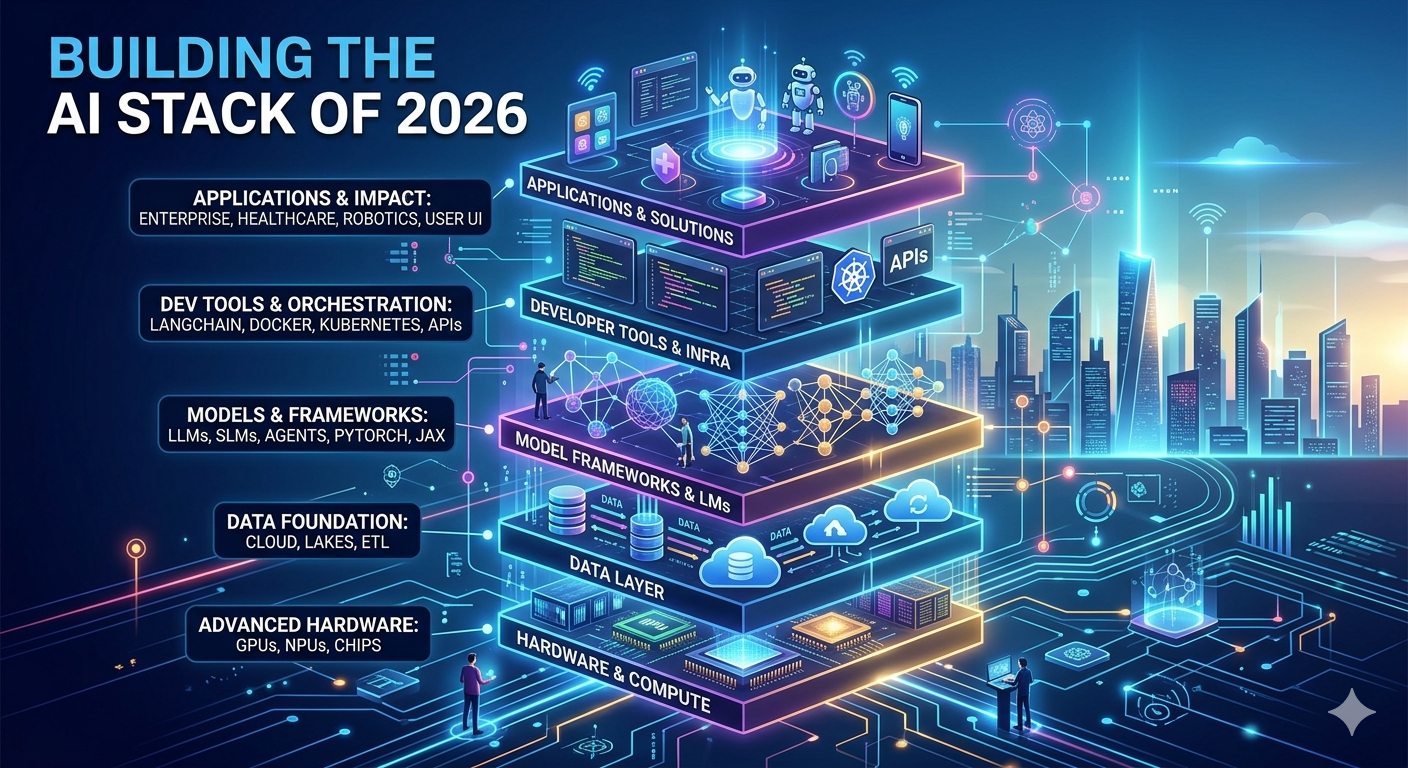
1. The Compute & Hardware Layer
AI is no longer just "in the cloud." The physical layer is now a hybrid of specialized chips:
LPUs (Language Processing Units): Specialized hardware for ultra-fast inference, making real-time agentic reasoning possible.
Edge Sovereignty: Many stacks now include on-premise "AI appliances" for sensitive data, reducing latency and ensuring compliance.
2. The Model Layer (The "Brain")
We’ve moved away from the "one model to rule them all" approach.
Orchestrated Frontier Models: Flagships like GPT-5.4 or Claude 4.6 handle complex reasoning.
SLMs (Small Language Models): Highly optimized, domain-specific models (e.g., legal or medical) handle 80% of routine tasks at 1/10th the cost.
3. The Memory & Context Layer (The "Soul")
RAG (Retrieval-Augmented Generation) has evolved into Long-Term Memory Systems:
GraphRAG: Moving beyond simple vector search to understand relationships between data points.
Semantic Memory: Agents now "remember" user preferences and past interactions across sessions, eliminating the need to re-explain context every time.
4. The Agentic Orchestration Layer (The "Hands")
This is where the magic happens. It’s no longer about a single prompt; it's about Workflows.
Agent Meshes: A "Manager Agent" breaks down a goal (e.g., "Plan the Q3 marketing budget") and assigns sub-tasks to specialized "Worker Agents."
Tool-Use Ecosystems: Native integration with APIs (Slack, Salesforce, GitHub) and even GUI-operating capabilities where the AI "clicks" buttons like a human.
5. The Governance & Guardrail Layer
The most critical addition in 2026 is the Control Plane.
Policy-as-Code: Hard-coded boundaries that prevent agents from spending money or accessing sensitive HR data.
LLM-as-a-Judge: Automated evaluation systems that scan every output for hallucinations or bias before it reaches a human.
The future AI stack is becoming more autonomous, interconnected, and business-aware. Organizations that focus on scalable AI architecture, strong governance, and seamless integration between humans and intelligent systems will gain a significant competitive advantage in the years ahead.
Key Takeaways
AI stacks are evolving from isolated tools to integrated intelligent ecosystems
RAG, AI Workflows, and AI Agents will form the core layers of enterprise AI
APIs, vector databases, orchestration platforms, and cloud infrastructure are becoming critical components
Governance, security, and explainability are now essential parts of AI architecture
Businesses adopting AI strategically — not just experimentally — will lead the next wave of innovation
The 2026 Mantra: Your AI is only as good as its memory and its guardrails. If it doesn't have context, it's just a chatbot; if it doesn't have guardrails, it's a liability.
Tags
#AI #ArtificialIntelligence #AIStack #EnterpriseAI #AIAgents #RAG #AIWorkflows #GenerativeAI #DigitalTransformation #MachineLearning #Automation #FutureOfAI #TechTrends #AIArchitecture #Innovation