The Intelligence Infrastructure: Top 10 Planned AI Events of April 2026
The AI landscape in April 2026 is moving from "experimentation" to "industrial execution." We are seeing the first signs of the "One-Person Unicorn" and the rise of physical AI. April 2026 is shaping up to be one of the most active months in the global AI calendar.
From major conferences and product showcases to policy discussions and developer-focused events, the month is packed with opportunities to see where AI is heading next.
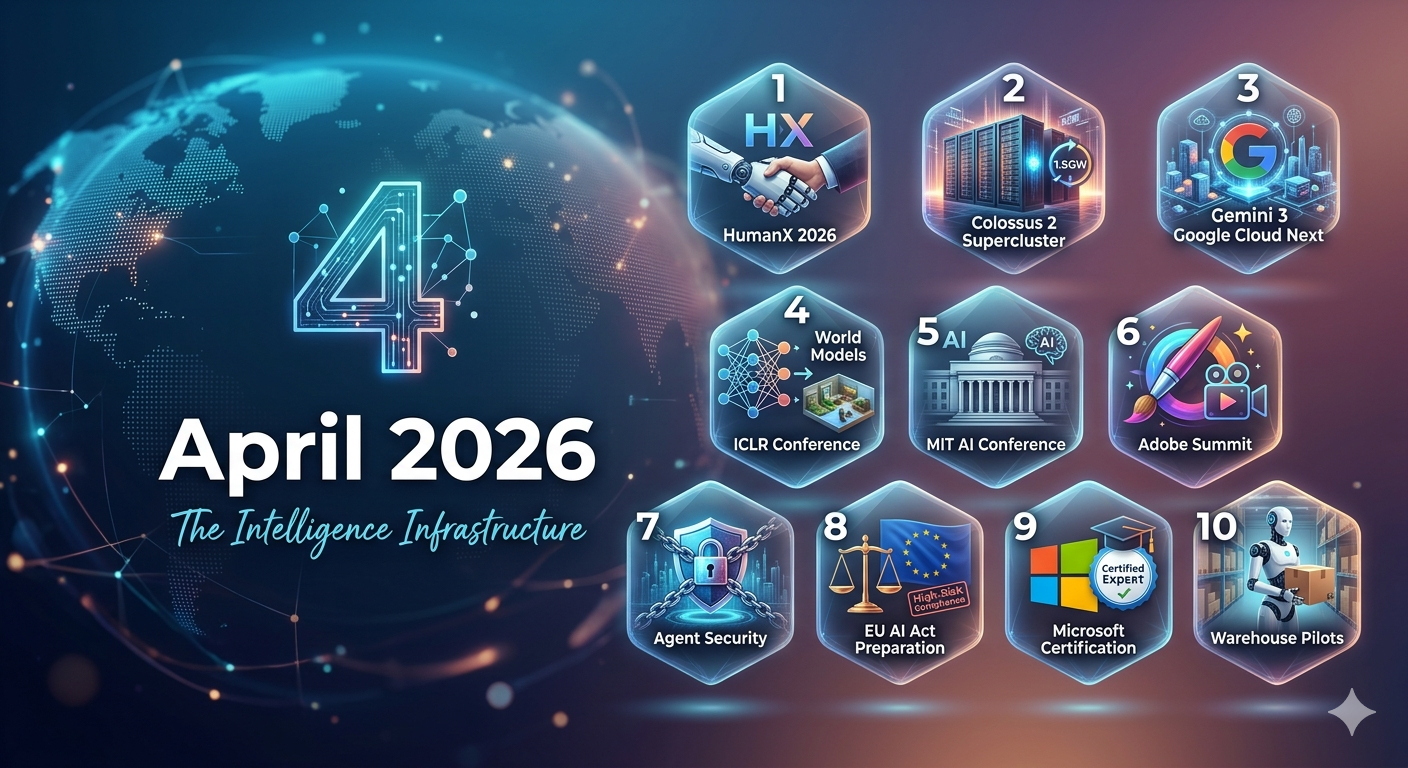
Here are the top 10 major events and shifts happening in April 2026.
1. HumanX 2026 (April 6–9)
San Francisco becomes the epicenter of AI execution as HumanX kicks off. Unlike past research-heavy summits, this event focuses on "Enterprise AI Maturity." Major global leaders and practitioners will showcase real-world case studies on how they have moved from AI pilots to full-scale autonomous operations.
2. xAI’s "Colossus 2" Supercluster Upgrade
Elon Musk’s xAI is scheduled to complete a massive hardware milestone this month, upgrading the Colossus supercomputer to 1.5GW. This provides the raw compute power required for the final "fine-tuning" phase of Grok 5, which is rumored to feature a "Reality Engine" for real-time fact-checking using X’s live data firehose.
3. Google Cloud Next 2026 (April 22–24)
Las Vegas will host Google’s flagship event. The buzz is centered on the industrial rollout of Gemini 3 Pro and its deeper integration into Android XR devices. Expect major announcements regarding "Sovereign AI Clouds"—allowing governments to run Gemini entirely on-premise to comply with strict 2026 data residency laws.
4. The ICLR 2026 Conference (April 23–27)
The International Conference on Learning Representations hits Rio de Janeiro. This is the "Woodstock of AI Research," where the next major architectures beyond Transformers are expected to be unveiled. Watch for breakthroughs in "World Models"—AI that understands physical laws, cause, and effect.
5. MIT AI Conference (April 14)
The 2026 MIT AI Conference in Boston will focus on "Navigating the Digital Future." The spotlight will be on NeuroSymbolic AI (combining logic with neural networks) and the "Intelligence Economy," exploring how AI inference is becoming a new form of global currency.
6. Adobe Summit 2026 (April 20–22)
In Las Vegas, Adobe and NVIDIA's CEOs are expected to take the stage together. The focus is "Content at Scale," debuting new AI-native platforms that allow brands to automate entire marketing campaigns—from hyper-realistic video generation to personalized customer journeys—without human intervention.
7. SANS AI Cybersecurity Summit (April 20–27)
As "Agentic AI" becomes common, the risks of Indirect Prompt Injection have skyrocketed. This summit in Arlington is the primary event for defenders learning how to secure the "Context Window" and protect autonomous digital workers from being hijacked by malicious hidden instructions.
8. The EU AI Act "High-Risk" Preparation
While full enforcement is months away, April is the unofficial "Soft-Landing" deadline for European firms. Companies are rushing to finalize their risk-management documentation for "High-Risk" AI systems (like biometrics and HR automation) to avoid the first wave of 2026 regulatory audits.
9. Microsoft’s "AI-Ready" Certification Wave
Microsoft is retiring several legacy AI exams this month (AI-900, AI-102) to make way for the AI-103: Azure AI App and Agent Developer Associate. This marks a shift in the job market; "Prompt Engineering" is out, and "Agent Orchestration" is the new required skill for enterprise developers.
10. The Rise of "Physical AI" Deployments
Following the GTC announcements in March, April is the window where Humanoid Robotics companies like Figure and Tesla (Optimus) begin their first large-scale "Pilot Deployments" in specialized warehouses. We are moving from robots that "can" walk to robots that are "working" alongside humans.
April 2026 is the month where the "Autonomous Enterprise" stops being a buzzword and starts being a competitive requirement. The focus has shifted from what the model can say to what the agent can do.