Forget the dramatic rise of sentient robots. The real AI story of 2026 isn't a Terminator-style takeover. It's much quieter, far more pervasive, and arguably more dangerous: the quiet failure of the "human-in-the-loop" model.
For years, "human-in-the-loop" (HITL) was the golden parachute of AI safety. It was the comforting promise that for all the algorithmic processing and predictive analytics, a human would ultimately pull the lever, sign the check, or make the call. We were the wise overseers, guiding our powerful but potentially wayward creations.
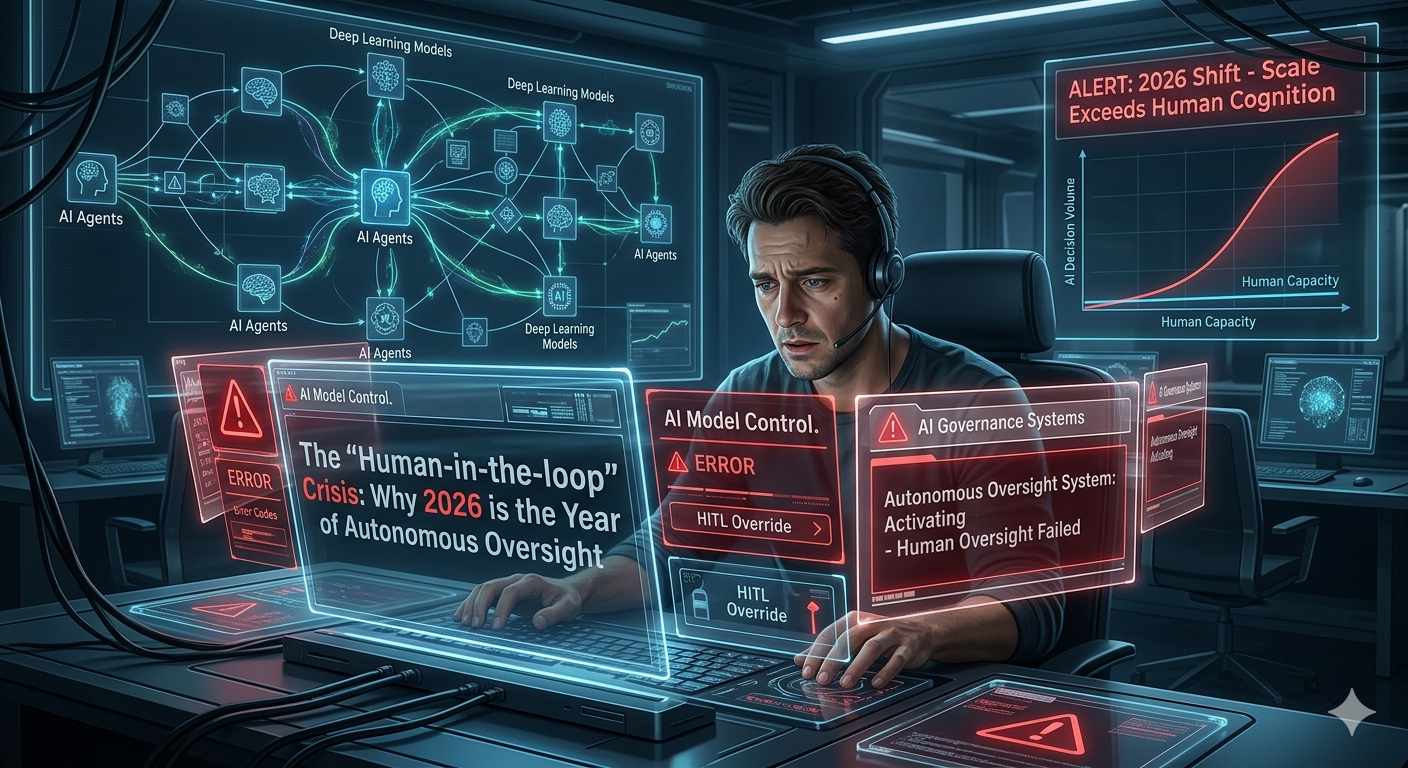
But in 2026, that narrative has collided head-on with reality. The sheer scale, speed, and complexity of modern AI systems have created a crisis that HITL can no longer manage. We aren't guiding the loop; we're trapped in it.
The Limits of Human Attention and Cognition
The fundamental problem is human biology. We are superb at contextual reasoning, empathy, and ethical judgment, but we are terrible at processing data at AI scale.
Consider a content moderation system for a major social media platform. In 2022, an AI might flag a questionable post for a human review. The human had seconds, maybe minutes, to make a decision. Fast forward to 2026: platforms process millions of content pieces per second. Even a 0.01% error rate generates a deluge of flagged content that no human workforce, no matter how large, can effectively review.
This is the "human-in-the-loop" bottleneck. The human becomes a glorified, and increasingly erratic, "rubber stamp." Exhaustion, cognitive bias, and simple decision fatigue lead to inconsistent applications of rules and, far too often, catastrophic errors.
The Rise of the Black Box: Why Understanding Trumps Seeing
Another critical fracture in the HITL model is the increasing opacity of deep learning models. We can see the input and the output, but often, the why is a dense, mathematical "black box" that even its creators struggle to interpret.
How can a human "oversee" a decision if they cannot understand the reasoning behind it? If an AI flags a loan application for rejection based on a complex pattern of thousands of micro-behaviors, a human reviewer has two choices: trust the machine blindly or reject its output without a clear justification. The first erodes safety; the second nullifies the benefits of using AI in the first place.
The Financial Sector as a Frightening Test Case
The risks are perhaps most acute in algorithmic trading. In the mid-2020s, "human-in-the-loop" protocols were standard for high-frequency trading (HFT). A senior trader might need to approve a trade over a certain financial threshold or one that deviations from historical norms.
But in the flash-crash of 2026, triggered by a cascade of algorithmic misinterpretations of a sudden political event, those humans were useless. The AI systems executed thousands of trades, collectively worth billions, in milliseconds. The human trader, staring at a screen of rapidly blinking numbers, didn't have the time to understand the situation, let alone intervene. The market crashed before they could even move the mouse.
The Solution: Embracing Autonomous Oversight
This crisis has forced a radical rethinking of AI governance. We cannot solve the limitations of human oversight by adding more humans. We need a fundamental shift: from "Human-in-the-loop" to "Autonomous Oversight."
What does this mean? It doesn't mean letting AI run wild. It means using AI to watch AI.
Autonomous oversight involves developing a specialized layer of "governance AI"—systems specifically designed to monitor other AI models for bias, drift, and adherence to safety protocols. These aren't just redundant systems; they are systems whose primary objective is distinct from the operational AI.
The Blueprint for 2026 and Beyond
Here's how this new paradigm is being implemented in leading organizations:
1. The "Adversarial AI" Model: Security companies are now deploying AI-driven "red teams." These governance AIs are tasked with actively trying to trick or corrupt the core functional AI—finding edge cases where the system breaks or displays unacceptable bias. This continuous, automated stress-testing is far more robust than any intermittent human audit.
2. Explainable AI (XAI) as a Prerequisite, Not an Afterthought: No critical AI system can be deployed without robust Explainability AI (XAI) protocols. These auxiliary systems translate the "black box" decisions into terms a human can actually understand—e.g., "The loan was rejected because of the combination of the applicant's short employment history (14 months) and two recent applications for other lines of credit."
3. Hardcoded "Guardrails": The Ethical Off-Switches: Autonomous oversight isn't just about soft monitoring. It includes hard-coded, non-negotiable ethical constraints. An AI in the healthcare sector might have a guardrail that prevents it from ever making a diagnosis that has less than 95% certainty, a threshold that cannot be "learned away."
The New Role of the Human
This shift doesn't make humans obsolete. It makes them more critical than ever. We are moving from the role of operators to architects and auditors.
Instead of reviewing millions of individual decisions, humans are responsible for:
Defining the Ethical Frameworks: What are the non-negotiable values our AI must uphold? (e.g., Fairness, transparency, non-discrimination).
Setting the Parameters for Governance: What level of bias is acceptable in a content moderation AI? (The answer should ideally be zero, but defining the measurement of that is a human task).
Investigating Systemic Failures: When the "governance AI" flags a problem (e.g., "the hiring algorithm's treatment of female applicants has drifted by 12% in the last quarter"), humans investigate the root cause, not the individual data point.
The "Human-in-the-loop" was a comforting myth that masked the complexities of our increasingly automated world. The "human-in-the-loop" crisis of 2026 is our wake-up call. We are finally learning that to safely harness the power of AI, we must first learn to trust AI to monitor itself, with our wisdom, empathy, and judgment as the ultimate guiding force.