As we move through 2026, the cybersecurity landscape is hitting a fever pitch. We are no longer talking about "future-proofing" in a vague sense. For many organizations, particularly those serving the public sector or handling high-value long-term data, the clock has officially started ticking.
The convergence of Post-Quantum Cryptography (PQC) and Artificial Intelligence (AI) has created a unique "double-edged sword" scenario that defines the 2026 security posture.
Why 2026 is the Inflection Point
While the "Quantum Apocalypse" (Y2Q) is still years away, several regulatory and technical triggers have made 2026 the year of action:
Federal Mandates & CNSA 2.0: Under the Commercial National Security Algorithm Suite 2.0, 2026 is a critical milestone. This year, traditional networking equipment like VPNs and routers are expected to begin their transition to quantum-resistant standards.
The FIPS 140-2 "Historical" Move: As of September 21, 2026, many FIPS 140-2 certificates are transitioning to "Historical" status, effectively disqualifying non-compliant systems from new federal procurement.
The "Harvest Now, Decrypt Later" (HNDL) Reality: Adversaries are currently scraping encrypted data with the intent to decrypt it once quantum computers are viable. If your data needs to remain secret for 10+ years, it is already at risk today.
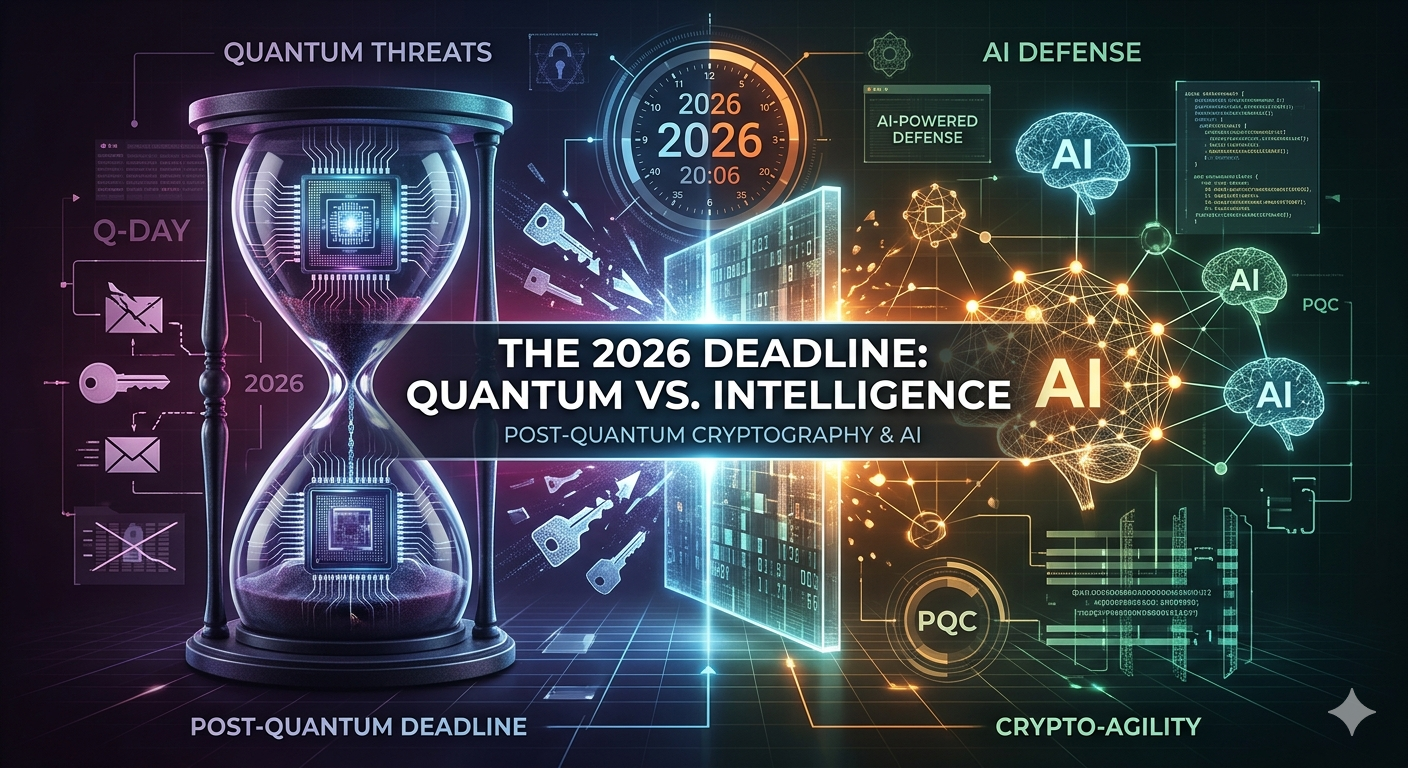
AI: The Accelerator and the Savior
In 2026, AI is playing a dual role in this transition. It is simultaneously the greatest threat to current encryption and the only way to manage the migration to PQC.
1. AI-Powered Cryptanalysis
Adversaries are using machine learning to find vulnerabilities in "classical" cryptographic implementations. AI doesn't need to break the math; it finds side-channel leaks, implementation flaws, and weak entropy sources at a speed humans can't match.
2. Autonomous Cryptographic Discovery
The biggest hurdle to PQC is simply knowing where your encryption lives. Large enterprises often have millions of "hard-coded" cryptographic instances.
The 2026 Approach: Organizations are deploying AI-driven "Crypto-Discovery" agents that autonomously crawl codebases and network traffic to map out every vulnerable algorithm.
The Path to "Crypto-Agility"
The 2026 deadline isn't just about swapping one algorithm for another (e.g., moving from RSA to ML-KEM). It's about achieving Crypto-Agility: the ability to update cryptographic standards across an entire enterprise via policy, without rewriting code.
The 2026 Readiness Checklist
Milestone Target Action
Inventory Q2 2026 Complete AI-assisted discovery of all public-key usage.
Prioritization Q3 2026 Identify "HNDL" high-risk data (Identity, Financials, IP).
Hybrid Mode Q4 2026 Deploy "Hybrid" encryption (Classical + PQC) for external TLS.
Compliance Sept 2026 Ensure all federal-facing systems meet new NIST/FIPS status.
Final Thoughts: Moving Beyond the Hype
By the end of this year, "Quantum Readiness" will be a standard line item in every CISO’s budget. The 2026 deadline is less about a single day and more about a shift in philosophy: we are moving from static security to a dynamic, AI-managed, quantum-resistant defense.
The question for your organization is no longer if you will migrate, but how much of your legacy data has already been harvested while you waited.
Is your organization currently running a hybrid-PQC pilot, or are you still in the discovery phase?