Google Cloud Next 2026: The "Infrastructure-as-Intelligence" Era
Google Cloud Next 2026 has officially wrapped, and it’s clearer than ever: we are no longer merely in the age of cloud infrastructure. We have entered the era of Infrastructure-as-Intelligence (IaI).
If the previous few years were defined by the breathless race to add AI capabilities to existing platforms, Next '26 showed that the script has been completely flipped. Google is not just putting intelligence on its infrastructure; it is building intelligence into its infrastructure from the very foundation.
This year’s conference wasn’t about incremental updates; it was about a fundamental shift in how we perceive and interact with compute, storage, data, and applications. The cloud is evolving from a programmable utility to an autonomous, context-aware digital partner.
Here’s a look at the key themes, technologies, and mindsets that defined this pivotal "Next" and what "Infrastructure-as-Intelligence" really means.
The New Architecture: A Closed Loop of Intelligence
The conventional "compute stacking" model (compute -> storage -> network -> application -> intelligence) is gone. Google’s IaI architecture, exemplified by the new Tensor Distributed Core (TDC), creates a continuous closed loop.
The AI model isn't just a workload running on the server; the server itself is dynamically reconfiguring based on the real-time needs of the model.
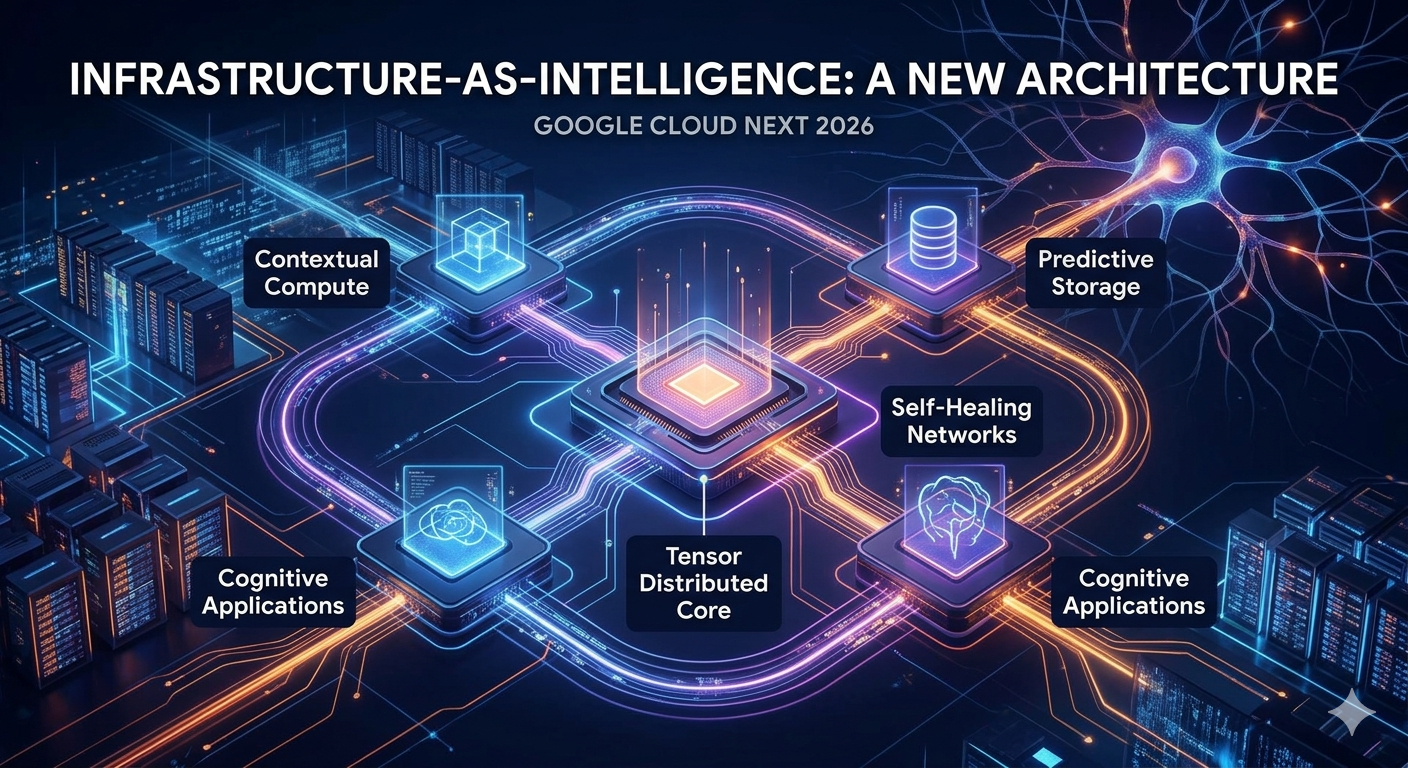
As shown in the blueprint above, the entire stack—from Contextual Compute (dynamically right-sized based on logic) to Predictive Storage (data pre-fetching using behavioral AI)—is synthesized. The ultimate goal is Cognitive Applications that require zero manual orchestration. This infrastructure doesn't just host the digital world; it understands it.
Beyond Automation: Autonomous Operations (AutoOps)
Since the beginning, cloud management has been a trade-off between control and complexity. Infrastructure-as-Intelligence changes that equation. The major shift announced at Next ‘26 is from DevOps and AIOps to AutoOps.
We are moving away from reactive scripting toward declarative intent. A developer in 2026 doesn't define how many VMs, load balancers, and Kubernetes pods they need. They declare a desired outcome and context: "I am launching a new real-time fraud detection service with sub-10ms latency for users in Europe, handling 50k requests per second."
The intelligent infrastructure interprets this intent and autonomously designs, provisions, secures, and maintains the necessary system. It doesn’t need a human in the loop for optimization because the platform is constantly learning from its own performance data to fine-tune the configuration.
Security is No Longer an Add-On; It's Cognitive
In the IaI era, security is not a perimeter; it is a feature of the compute itself. Traditional security architecture is too slow and fragmented to counteract polymorphic, AI-driven threats.
Next '26 introduced the concept of Holographic Security. Using the Tensor Distributed Cores, the infrastructure creates a real-time, high-fidelity digital twin of entire application environments. By analyzing every data interaction and process call through a cognitive layer, the platform identifies anomalies not by signature matching, but by deviation from expected intent. Security becomes Cognitive: the system predicts attacks and mutates its defensive posture milliseconds before the exploit attempts to land.
A New Developer Experience: Zero-Ops and Code Agents
The most dramatic shift is for the developer. The past 15 years have been about mastering complex infrastructure management (Kubernetes, YAML, service meshes). In 2026, the complexity is gone, absorbed entirely by the infrastructure.
Google Cloud declared the arrival of True Zero-Ops. This isn't just serverless; it's infrastructure-less from the developer's perspective. The coding experience is facilitated by Intelligent Code Agents that integrate with tools like Gemini. These agents don’t just offer autocomplete; they take declarative context from the developer and convert it directly into optimized, resilient, highly secure systems.
Developers are freed from infrastructure constraints. They focus only on the logical architecture of their application and the business problem they are solving.
The Road Ahead: Responsible Intelligence
The move to Infrastructure-as-Intelligence is the most significant architectural transformation in computing history. However, Google emphasized that with this power comes extreme responsibility.
Issues of Responsible AI (Bias mitigation, transparency, and safety) are no longer just framework discussions; they are now embedded features of the cloud infrastructure platform. The autonomous nature of IaI demands unparalleled trust. Google demonstrated new tools for Deterministic IA, ensuring that while the infrastructure may optimize itself, its compliance and governance framework remain absolute and auditable.
Google Cloud Next 2026 made it clear: the infrastructure-as-utility era is dead. Long live the Era of Infrastructure-as-Intelligence. The cloud is awake, and it's time for us to learn what we can build when the infrastructure itself thinks.