AI Hardware Roadmap 2026–2027: Every AI Chip, GPU and Accelerator Coming Next
Artificial intelligence is entering a new era where breakthroughs are no longer driven solely by software. The hardware powering AI models is evolving at an equally impressive pace, enabling faster training, lower inference costs, improved energy efficiency, and broader adoption across industries.
From cloud data centers and enterprise servers to AI-powered laptops and autonomous vehicles, the next generation of AI processors will redefine how businesses and developers build intelligent applications. In this article, we explore the AI hardware roadmap for 2026–2027, highlighting the technologies, innovations, and companies expected to shape the future of AI computing.
Why AI Hardware Is Becoming More Important
Modern AI models demand enormous computational power. As large language models (LLMs), generative AI systems, robotics, and autonomous applications continue to grow in complexity, traditional computing architectures struggle to keep up.
To meet these demands, hardware manufacturers are developing specialized processors designed specifically for artificial intelligence workloads.
Some of the biggest industry trends include:
Higher AI training performance
Faster inference speeds
Greater energy efficiency
Larger memory capacities
Improved scalability
More powerful Edge AI devices
These advancements are making AI more accessible while reducing operational costs for organizations deploying AI at scale.
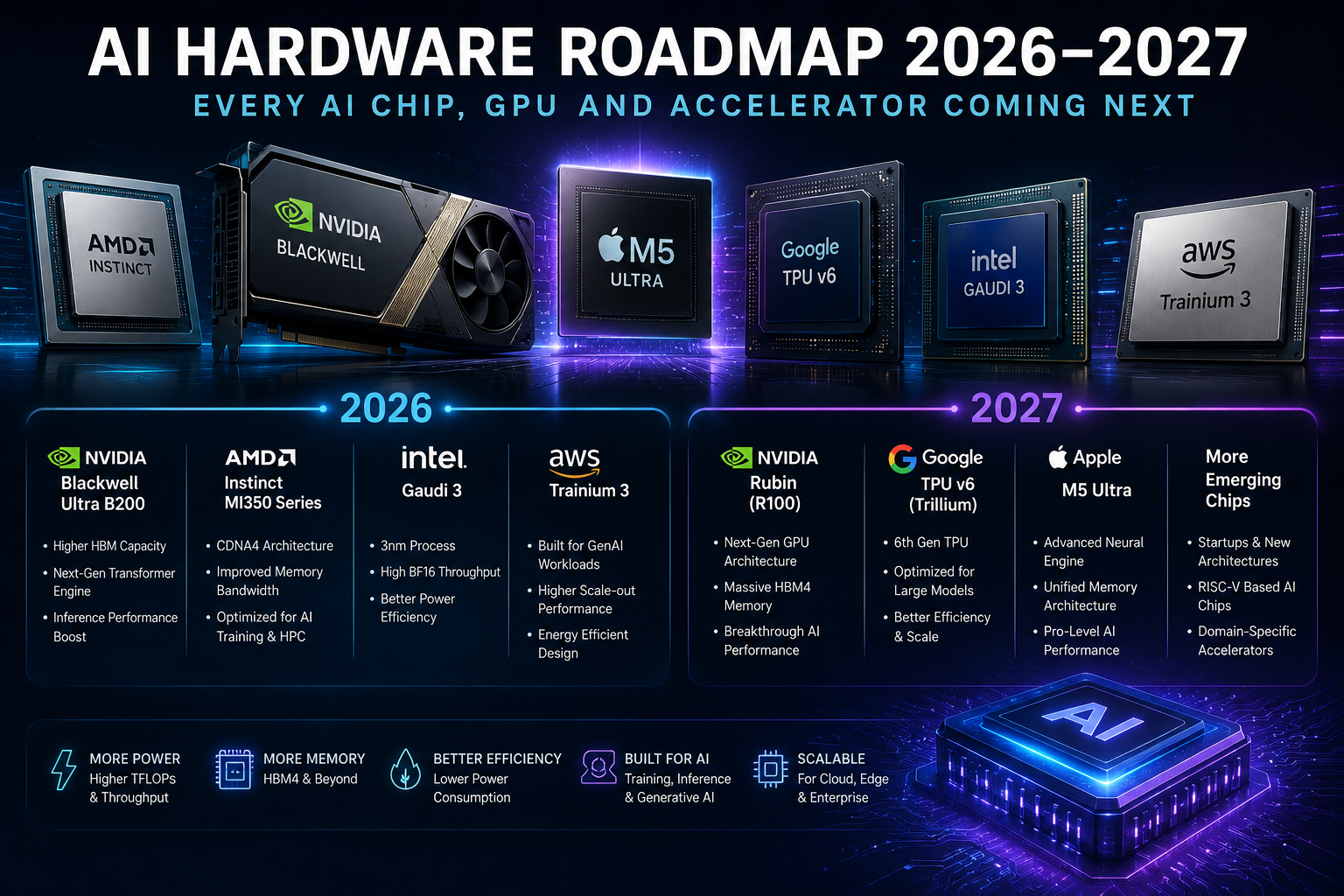
NVIDIA: Continuing to Lead AI Computing
NVIDIA remains the dominant force in AI acceleration, with its GPUs powering many of the world's largest AI models.
The company's upcoming hardware generations are expected to focus on:
Increased AI compute performance
Higher memory bandwidth
Larger High Bandwidth Memory (HBM) capacities
Improved multi-GPU communication
Better energy efficiency
These improvements will benefit industries such as:
Generative AI
Scientific computing
Healthcare research
Robotics
Autonomous vehicles
Enterprise AI
NVIDIA's strong software ecosystem also continues to make its hardware highly attractive for AI developers.
AMD's Growing Presence in AI Hardware
AMD has rapidly expanded its position in AI computing by developing powerful accelerators for enterprise workloads.
Future AI hardware is expected to emphasize:
High-performance AI training
Enterprise inference
Large memory configurations
Open software ecosystems
Cloud-scale deployments
As competition increases, organizations will have more hardware choices for AI infrastructure.
Intel's AI Strategy
Intel is investing heavily in both cloud AI infrastructure and AI-enabled personal computers.
AI Data Center Solutions
Future Intel accelerators are expected to support:
Enterprise AI deployments
Machine learning inference
High-density server environments
AI cloud services
AI PCs
AI-enabled processors with integrated Neural Processing Units (NPUs) will continue improving:
Offline AI assistants
Productivity tools
Image enhancement
Video conferencing
Battery efficiency
Local AI processing also improves privacy by reducing dependence on cloud services.
Google's Tensor Processing Units (TPUs)
Google continues advancing its Tensor Processing Unit (TPU) architecture for large-scale AI workloads.
Future TPU platforms are expected to deliver:
Faster AI model training
Improved cloud scalability
Better energy efficiency
Enhanced support for foundation models
Organizations using Google Cloud will benefit from these improvements without investing in their own AI infrastructure.
Amazon's Custom AI Chips
Amazon Web Services (AWS) has developed its own AI silicon to reduce cloud AI costs and improve scalability.
Trainium
Designed for:
Large-scale AI training
Enterprise AI workloads
Cloud optimization
Inferentia
Optimized for:
AI inference
Low-latency applications
Production deployments
Cost-efficient cloud AI
These processors provide organizations with alternatives to traditional GPU-based infrastructure.
Microsoft's AI Infrastructure
Microsoft continues expanding its AI capabilities through custom hardware supporting Azure AI services.
Expected investments include:
AI cloud accelerators
Large-scale inference hardware
High-performance networking
Data center optimization
These technologies will help power Microsoft's growing AI ecosystem across enterprise applications and cloud platforms.
Qualcomm and Edge AI
As AI increasingly moves closer to users, Qualcomm is developing processors optimized for edge computing.
Future hardware will support:
Smartphones
AI laptops
Smart devices
Automotive platforms
Extended Reality (XR)
Internet of Things (IoT)
Edge AI reduces latency while enabling real-time decision-making without relying entirely on cloud infrastructure.
Apple Silicon and On-Device Intelligence
Apple continues integrating increasingly capable AI engines into its custom processors.
Expected improvements include:
Smarter personal assistants
Faster photo editing
AI-powered video processing
Voice recognition
Local generative AI
By processing AI tasks directly on devices, Apple emphasizes privacy and efficiency.
AI Hardware for Robotics
Robotics is becoming one of the fastest-growing AI markets.
Future AI processors for robotics are expected to improve:
Computer vision
Motion planning
Autonomous navigation
Industrial automation
Human-robot collaboration
Specialized robotics hardware enables faster decision-making while maintaining low power consumption.
Automotive AI Accelerators
Self-driving technologies continue increasing demand for dedicated AI hardware.
Next-generation automotive processors will focus on:
Object detection
Sensor fusion
Real-time navigation
Driver assistance systems
Autonomous driving capabilities
These processors must balance performance, reliability, and energy efficiency.
The Rise of AI PCs
AI PCs are expected to become mainstream throughout 2026 and 2027.
Most AI-enabled computers combine:
Central Processing Unit (CPU)
Graphics Processing Unit (GPU)
Neural Processing Unit (NPU)
Together they enable features such as:
AI writing assistants
Local chatbots
Image generation
Video enhancement
Meeting summaries
Live translation
Businesses and consumers alike are expected to benefit from these AI-powered productivity tools.
Memory Innovations Driving AI Performance
Memory bandwidth is becoming one of the biggest performance factors in AI hardware.
Upcoming advancements include:
Higher-capacity HBM memory
Faster memory interfaces
Reduced latency
Better efficiency for large AI models
Improved memory technology allows accelerators to process increasingly complex workloads more efficiently.
Faster Networking for AI Clusters
Large AI training clusters require extremely fast communication between thousands of processors.
Future networking technologies will improve:
Distributed AI training
Cluster scalability
Data transfer speeds
Overall infrastructure efficiency
Networking performance is now a critical component of modern AI systems.
Sustainability and Energy Efficiency
As AI workloads expand globally, energy efficiency has become a top priority.
Manufacturers are investing in:
Better performance per watt
Advanced cooling technologies
Efficient chip packaging
Lower carbon emissions
Sustainable data center infrastructure
These improvements help organizations reduce operating costs while supporting large-scale AI deployments.
The Future of Edge AI
Not every AI application requires a cloud connection.
Edge AI is rapidly expanding across industries, including:
Healthcare
Manufacturing
Retail
Smart cities
Agriculture
Security systems
Consumer electronics
Future edge processors will become smaller, faster, and more energy-efficient, enabling intelligent computing almost anywhere.
What Businesses Should Consider
Organizations planning AI investments should evaluate hardware based on more than raw performance.
Important considerations include:
AI workload requirements
Software ecosystem compatibility
Energy consumption
Total cost of ownership
Infrastructure scalability
Vendor support
Future upgrade paths
Selecting the right hardware depends on matching technology to business objectives.
Final Thoughts
The AI hardware landscape is evolving at an unprecedented pace. Competition among leading technology companies is accelerating innovation across GPUs, AI accelerators, NPUs, TPUs, and custom silicon designed for cloud, enterprise, and edge computing.
Over the next two years, businesses can expect more powerful processors, higher memory bandwidth, improved energy efficiency, and increasingly specialized AI hardware tailored to specific workloads. These developments will make artificial intelligence faster, more accessible, and more cost-effective across industries.
Whether you're building AI applications, investing in infrastructure, or simply following emerging technology trends, staying informed about the AI hardware roadmap will help you prepare for the next generation of intelligent computing.
Frequently Asked Questions
What is an AI accelerator?
An AI accelerator is a specialized processor designed to perform machine learning tasks more efficiently than traditional CPUs.
Why are GPUs important for AI?
GPUs can process thousands of parallel calculations simultaneously, making them ideal for training and running modern AI models.
What is an NPU?
A Neural Processing Unit (NPU) is a low-power processor optimized for running AI tasks directly on devices such as laptops and smartphones.
Which companies are leading AI hardware development?
Major players include NVIDIA, AMD, Intel, Google, Amazon, Microsoft, Qualcomm, Apple, and several emerging semiconductor companies.
Why is AI hardware evolving so quickly?
The rapid growth of generative AI, large language models, robotics, autonomous systems, and edge computing has significantly increased demand for faster and more efficient AI processors.
Conclusion
AI hardware is becoming the foundation of the next generation of computing. As processors become more powerful and specialized, they will enable breakthroughs in everything from cloud computing and robotics to personal productivity and autonomous systems. The 2026–2027 roadmap signals an exciting period of innovation that will shape the future of artificial intelligence for years to come.
Tags
#AI #ArtificialIntelligence #AIHardware #AIChips #GPU #NVIDIA #AMD #Intel #GoogleTPU #AWS #Microsoft #AppleSilicon #Qualcomm #MachineLearning #DeepLearning #GenerativeAI #LLM #EdgeAI #AIAccelerators #NPU #Semiconductor #CloudComputing #DataCenter #FutureTech #Technology #Innovation #AI2026 #AI2027 #TechNews #EmergingTechnology #AIAccelerators #ChipDesign #MachineLearning #DeepLearning #EdgeAI #DataCenter
#NVIDIA #AMD #Intel #Qualcomm #Innovation #TechRoadmap #FutureTech #TechTrends #Computing #GenerativeAI #CloudComputing