The "Bring Your Own Model" (BYOM) Movement: Redefining Enterprise AI Strategy
Overview
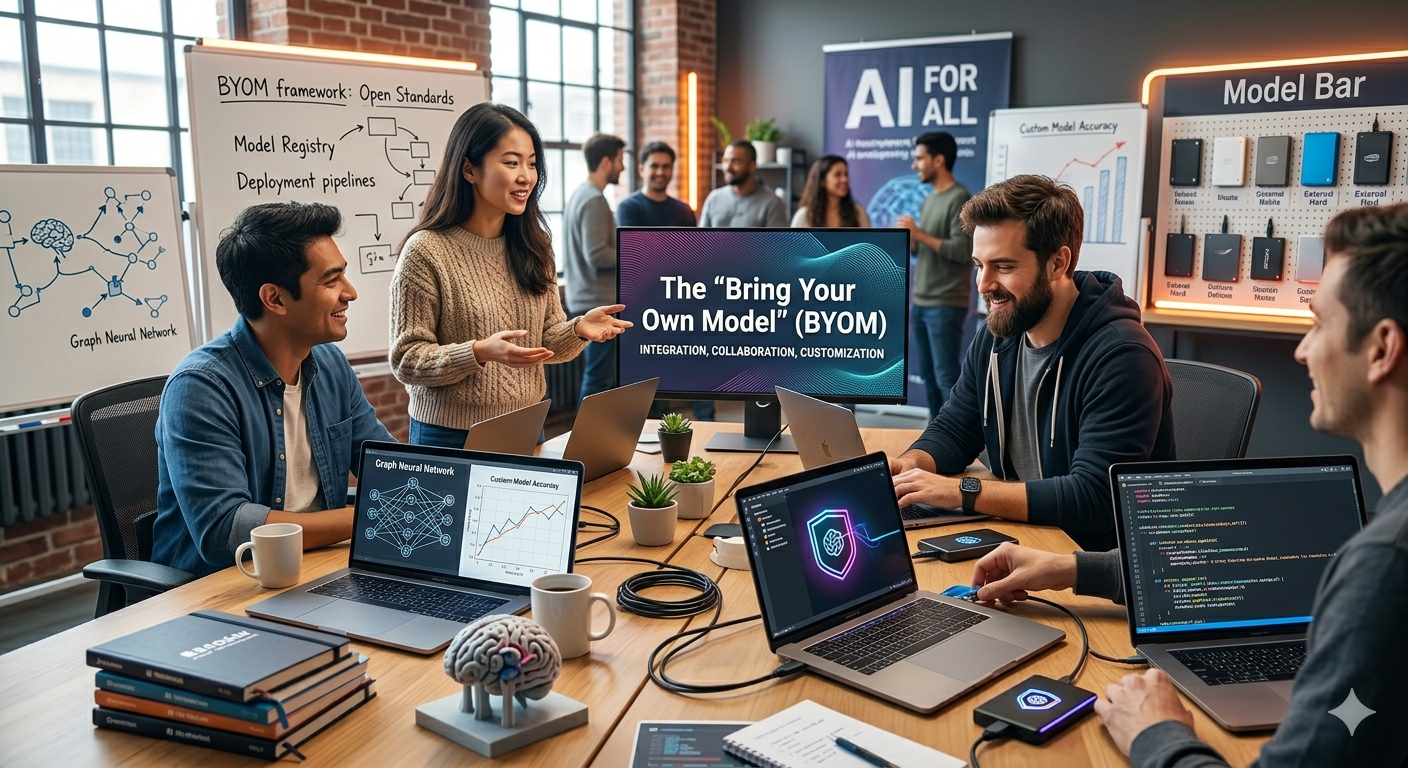
A quiet but powerful shift is reshaping how organizations adopt artificial intelligence: the rise of the Bring Your Own Model (BYOM) movement. Much like the earlier "Bring Your Own Device" (BYOD) trend, BYOM empowers teams to select, integrate, and deploy AI models that best fit their specific needs—rather than relying on a single vendor or centralized platform.
As enterprises move from experimentation to scaled AI adoption, BYOM is emerging as a defining strategy for flexibility, performance, and control.
What Is BYOM?
BYOM refers to the ability for organizations (or even individual teams) to bring and integrate their own AI models into existing platforms, workflows, or infrastructure.
These models can include:
Open-source models (e.g., LLaMA, Mistral)
Proprietary models from vendors (e.g., GPT, Gemini, Claude)
Fine-tuned internal models trained on company-specific data
Rather than locking into a single ecosystem, BYOM enables a multi-model architecture where different models are used for different tasks.
Why BYOM Is Gaining Momentum
1. Avoiding Vendor Lock-In
Organizations want flexibility. BYOM reduces dependency on a single AI provider and allows switching models based on cost, performance, or regulatory needs.
2. Performance Optimization
No single model excels at everything. BYOM allows teams to choose the best model for each use case—whether it's reasoning, coding, translation, or domain-specific tasks.
3. Cost Control
With multiple model options, companies can optimize costs by routing workloads to the most efficient or affordable model.
4. Data Privacy and Compliance
Certain workloads require stricter data controls. BYOM enables deployment of private or on-premise models to meet regulatory requirements.
5. Rapid Innovation
The AI landscape evolves quickly. BYOM allows organizations to adopt new models without overhauling their entire architecture.
Key Use Cases
Multi-Model Routing
Applications dynamically select models based on task complexity, latency requirements, or cost constraints.
Domain-Specific AI
Organizations deploy fine-tuned models tailored to industries such as healthcare, finance, or manufacturing.
Hybrid AI Architectures
Combining cloud-based models with on-premise solutions for sensitive workloads.
Experimentation at Scale
Teams can test and compare multiple models without disrupting production systems.
Challenges of BYOM
While powerful, BYOM introduces new complexities:
Integration Complexity
Managing multiple APIs, formats, and deployment environments can be technically demanding.
Governance and Risk
Ensuring compliance, fairness, and security across multiple models requires strong governance frameworks.
Monitoring and Observability
Tracking performance, cost, and reliability across models is more complex than with a single provider.
Standardization Gaps
Lack of universal standards for model interoperability can slow adoption.
How Enterprises Are Adapting
Forward-thinking organizations are building AI platforms that support BYOM through:
Model orchestration layers
Unified APIs and abstraction layers
Centralized monitoring dashboards
Policy-driven governance frameworks
Automated model evaluation pipelines
These platforms act as a control plane, allowing teams to innovate freely while maintaining enterprise-grade oversight.
The Role of AI Gateways and Model Routers
A critical enabler of BYOM is the emergence of AI gateways and model routers. These systems:
Route requests to the most appropriate model
Manage authentication and access control
Monitor usage and cost
Enforce compliance policies
They function as the "traffic controllers" of modern AI systems.
What This Means for the Future
BYOM is not just a trend—it signals a shift toward modular, composable AI ecosystems. In the future, organizations will:
Treat AI models as interchangeable components
Continuously benchmark and swap models
Build internal marketplaces for AI capabilities
Prioritize governance and transparency
This evolution mirrors the broader shift in software toward microservices and cloud-native architectures.
Key Takeaways
BYOM enables flexibility, cost efficiency, and innovation
Multi-model strategies are becoming the norm
Governance and observability are critical success factors
AI platforms must evolve to support model diversity
Closing Remarks
The "Bring Your Own Model" movement is redefining how enterprises think about AI adoption. Instead of choosing a single winner, organizations are building ecosystems where multiple models coexist and compete.
Those who embrace BYOM early will gain a strategic advantage—leveraging the best of what the rapidly evolving AI landscape has to offer while maintaining control, compliance, and agility.
In the age of AI, flexibility is power—and BYOM is how you achieve it.