Setting the Stage
Imagine your smartphone understanding you instantly—no lag, no cloud calls, no privacy concerns. It translates conversations in real time, summarizes your meetings offline, and even predicts your needs before you ask.
This is not a future vision. It’s happening now.
Welcome to the era of On-Device Intelligence—one of the most important and underappreciated breakthroughs in AI today.
What Is On-Device Intelligence?
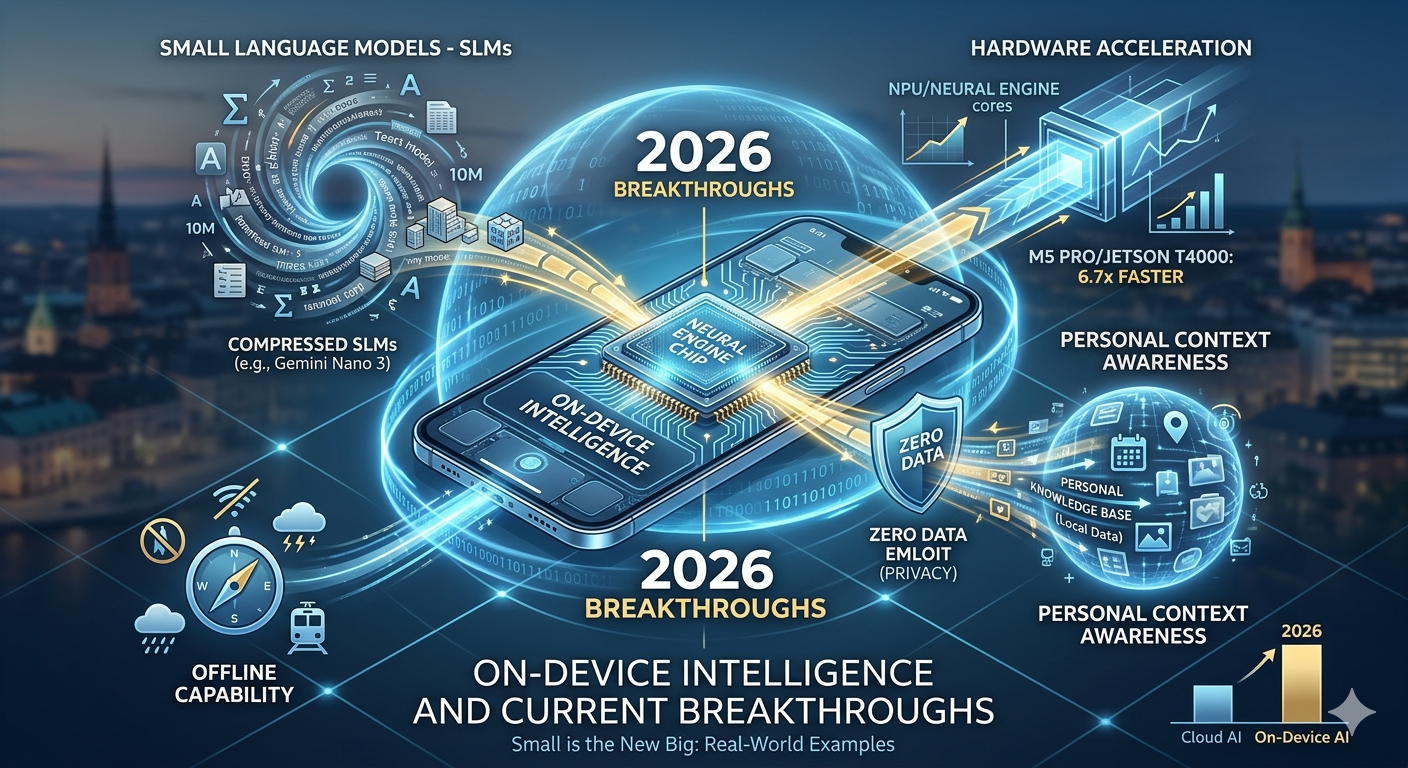
On-device intelligence refers to AI models running directly on local hardware—your phone, laptop, car, or edge device—rather than relying on cloud-based servers.
Instead of sending data to the cloud for processing, everything happens locally. The result?
Faster responses
Better privacy
Lower latency
Reduced dependency on internet connectivity
Why This Breakthrough Matters Now
For years, AI has been cloud-first. But three major shifts are driving the move toward on-device intelligence:
1. Hardware Has Caught Up
Modern chips (like Apple’s Neural Engine, Qualcomm AI Engine, and NVIDIA edge GPUs) are now powerful enough to run sophisticated models locally.
2. Models Are Getting Smaller and Smarter
Techniques like quantization, distillation, and efficient architectures have made it possible to shrink large models without losing much performance.
3. Privacy Is a Priority
With increasing regulations (like GDPR and the EU AI Act), keeping data on-device is becoming a strategic advantage—not just a feature.
Real-World Breakthroughs (With Examples)
1. Smartphones: AI That Works Offline
Modern smartphones are leading the charge.
Example:
Real-time voice transcription and translation without internet
AI-powered photo editing (object removal, enhancement) done entirely on-device
Why it matters: Users get instant results while their personal data never leaves the device.
2. Laptops: Personal AI Assistants
Laptops are evolving into personal AI hubs.
Example:
Local AI copilots summarizing documents
Offline coding assistants running lightweight LLMs
Why it matters: Developers and professionals can work securely—even in restricted or offline environments.
3. Automotive: Smarter, Safer Vehicles
In the automotive world, on-device AI is critical.
Example:
Driver monitoring systems detecting fatigue
Real-time decision-making in autonomous driving
Why it matters: Milliseconds matter. Cloud latency is not acceptable when safety is involved.
4. Healthcare: Privacy-Critical Intelligence
Healthcare is another domain where on-device AI is transformative.
Example:
Wearables detecting anomalies (heart rate, oxygen levels)
AI-assisted diagnostics on portable medical devices
Why it matters: Sensitive data stays local, improving compliance and trust.
5. Industrial & Edge AI: Intelligence at the Source
Factories and industrial systems are increasingly adopting edge AI.
Example:
Predictive maintenance on machinery
Quality inspection using computer vision directly on production lines
Why it matters: Reduces downtime and eliminates reliance on unstable connectivity.
The Trade-Offs (Let’s Be Real)
On-device intelligence isn’t perfect.
Limited compute compared to cloud
Model size constraints
Battery consumption concerns
But the gap is closing fast—and for many use cases, the benefits outweigh the limitations.
The Bigger Shift: Hybrid AI
The future isn’t purely on-device or purely cloud—it’s hybrid.
On-device for speed, privacy, and real-time decisions
Cloud for heavy computation and large-scale training
This balance allows organizations to get the best of both worlds.
What This Means for You
Whether you're a developer, business leader, or tech enthusiast, this shift has real implications:
Expect AI features that work offline by default
Prioritize privacy-first architectures
Explore edge deployment strategies
Rethink user experience around instant intelligence
Key Takeaways
On-device intelligence is moving AI closer to the user
It enables faster, more private, and reliable experiences
Breakthroughs in hardware and model efficiency are accelerating adoption
The future of AI is hybrid—combining edge and cloud
Final Thoughts
On-device intelligence is not just an optimization—it’s a paradigm shift.
It changes where intelligence lives, how fast it responds, and who controls the data.
The most powerful AI in the future may not be the one in the cloud—but the one already in your pocket.
AI is no longer just connected. It’s becoming personal, private, and always present.