In the fast-moving AI landscape of 2026, the "Context Window" has become the ultimate battlefield. For years, we measured AI by its "IQ"—how well it could code or write poetry. Today, we measure it by its "RAM"—how much information it can keep in active memory before it starts to forget.
The current heavyweights, Gemini 3.1 and the recently released GPT-5.4 (with whispers of the 5.5 upgrade), are locked in a war over who can digest the most data without "hallucinating" the middle.
The Contenders: A Tale of Two Tapes
While the "GPT-5.5" moniker is currently the subject of intense speculation and early developer previews, the battle lines are drawn between Google’s massive capacity and OpenAI’s optimized retrieval.
Feature Gemini 3.1 Pro GPT-5.4 / 5.5 Preview
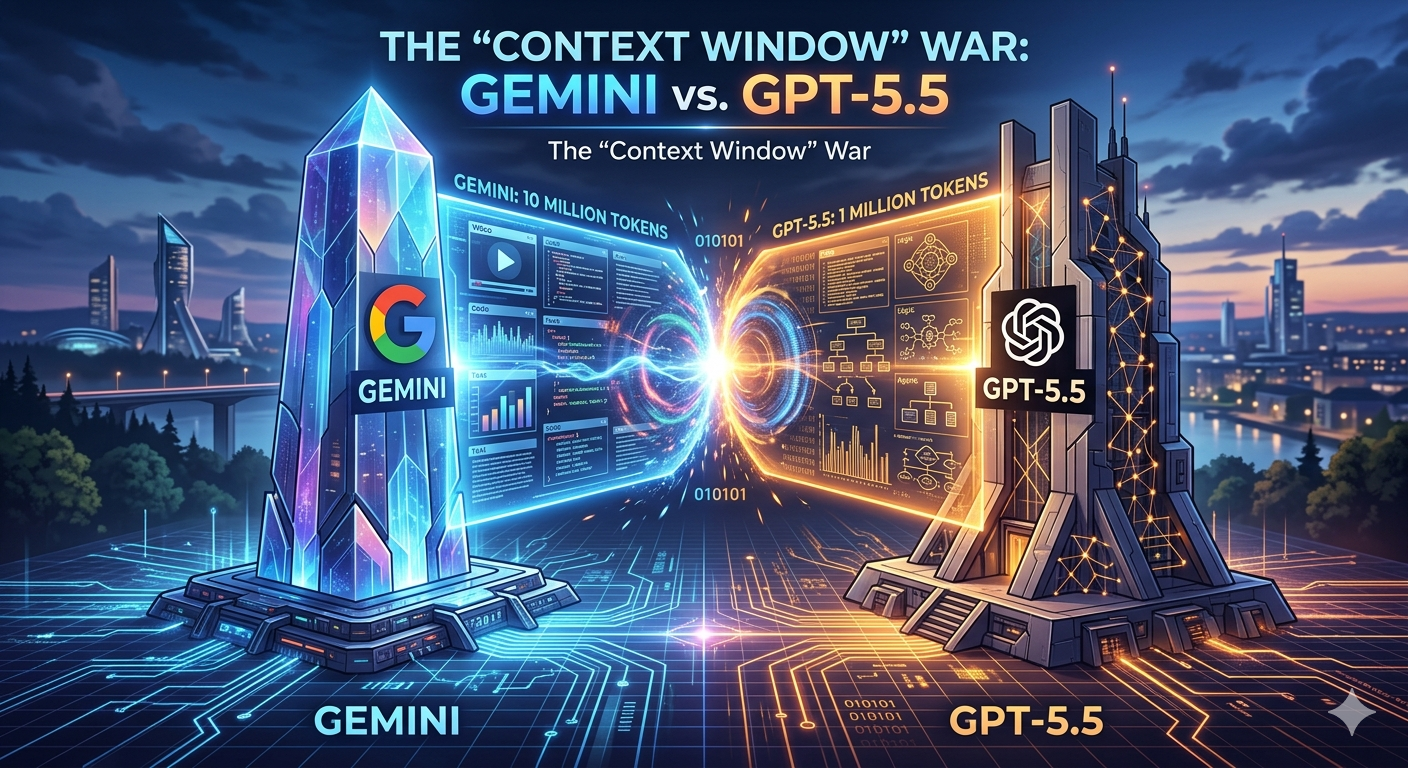
Max Context Window 10 Million Tokens 1 Million Tokens
Recall Accuracy High (99% "Needle-in-Haystack") Exceptional (Reasoning-heavy)
Multimodal Native Video, Audio, Code, Image Text, Code, Vision
Best For 20+ hour video files / Entire codebases Complex logic / Agentic workflows
Google’s Strategy: The "Infinite" Library
Google has doubled down on its lead with Gemini 3.1 Pro, offering a staggering 10-million-token window. To put that in perspective, you could upload the equivalent of 15-20 "War and Peace" novels, and Gemini would be able to tell you the color of a minor character’s hat in Chapter 4.
The Killer App: Video and Audio. Because Gemini is natively multimodal, that 10M window allows users to upload hours of raw video footage. You don't just search the transcript; the AI "sees" the entire video at once.
The Edge: It removes the need for complex RAG (Retrieval-Augmented Generation). Why build a complicated database to search your files when you can just shove the whole folder into the prompt?
OpenAI’s Strategy: Quality Over Quantity
OpenAI’s GPT-5 series (currently centered on 5.4 and the 5.5 iterative updates) has taken a different path. While their 1-million-token window is smaller than Google’s, they are winning on "Reasoning Density."
The "Thinking" Model: GPT-5.4 utilizes a "Thinking" architecture (evolution of the o1 series). Instead of just reading 10 million tokens, it spends more "compute" processing the 1 million tokens it has.
The Logic Lead: Developers often find that while Gemini can find a fact in a massive stack, GPT-5.5 is better at reasoning across those facts to solve a complex architectural bug.
Pricing Efficiency: OpenAI has introduced tiered pricing for its context, making the first 250k tokens significantly cheaper, targeting the "sweet spot" of most enterprise tasks.
The "Needle in a Haystack" Problem
The war isn't just about size; it's about fidelity. In early 2024, models had a "lost in the middle" problem—they remembered the beginning and end of a prompt but forgot the center.
In 2026, both Google and OpenAI have largely solved this for text. However, the new frontier is long-context reasoning. Can the AI find a fact on page 500 and use it to calculate a formula on page 5,000?
Current Verdict: Gemini is the king of data volume, but GPT-5.5 is the queen of data utility.
Which One Should You Use?
Choosing a side in this war depends entirely on your workflow:
Use Gemini 3.1 if: You are a developer analyzing a massive legacy codebase, a filmmaker searching hours of dailies, or a researcher with a 2,000-page PDF library.
Use GPT-5.5 if: You are building "agents" that need to follow complex, multi-step instructions without getting confused, or if you need the highest level of logic and nuance in your outputs.
Final Thoughts
We are moving toward a world where "forgetting" is a choice, not a technical limitation. As context windows expand toward 10M and beyond, the way we interact with computers is shifting from "searching for information" to "conversing with our entire digital history."
Which side are you on? The 10-million-token ocean or the 1-million-token laser?