The AI Summit Barcelona & The AI Conference SF Preview: What Engineering Leaders Are Demanding for Enterprise AI Scaling
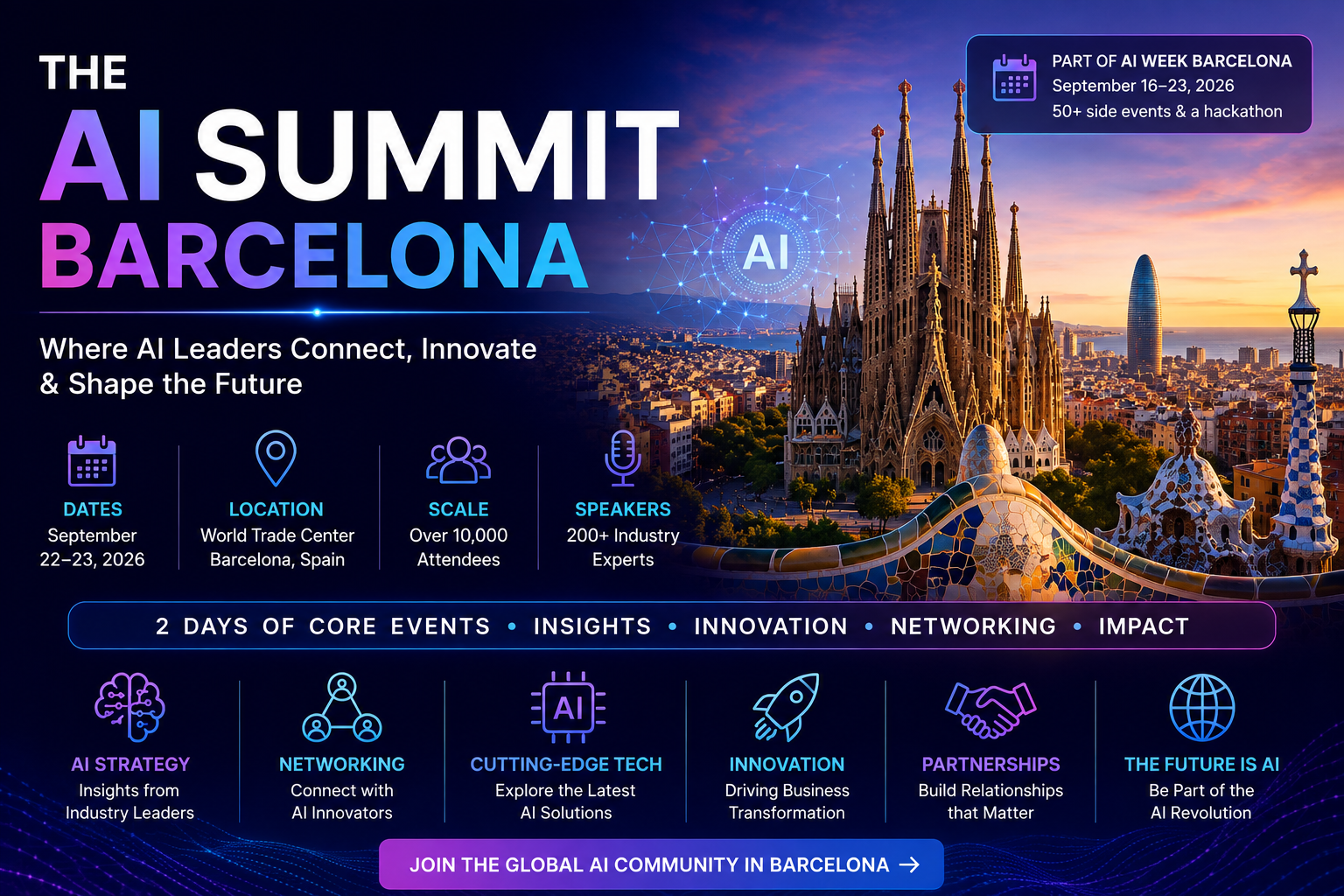
Two major AI events are arriving within days of each other in September 2026: AI Summit Barcelona in Europe and The AI Conference in San Francisco. Together, they show where enterprise AI is moving next: away from isolated demos and toward production systems that can be measured, governed, secured, and scaled.
For engineering leaders, the main question is no longer whether AI is powerful. The real question is whether AI can become reliable infrastructure inside the business.
Quick Take
- AI Summit Barcelona 2026 is scheduled for 22-23 September at WTC Barcelona and is positioned as a European AI conference with 10,000+ builders and AI leaders.
- The AI Conference 2026 in San Francisco runs from 29 September to 1 October, with 5,500 builders, researchers, and AI leaders expected.
- The enterprise AI conversation is shifting from model selection to system design: data pipelines, evaluations, governance, observability, security, and cost control.
- Engineering leaders are demanding AI that works across real workflows, not only controlled demos.
- For European SMEs, the best opportunity is to learn from both ecosystems: Europe's governance and adoption focus, and San Francisco's builder-heavy production focus.
Why These Two Conferences Matter
AI conferences used to be dominated by model launches, benchmark claims, and broad predictions. That is changing. In 2026, the more valuable sessions are likely to focus on how companies actually build, deploy, monitor, and scale AI systems.
That shift matters because enterprise AI is entering a harder phase.
Many organizations have already tested chatbots, document summarizers, coding assistants, retrieval-augmented generation systems, and early AI agents. Some pilots worked well. Many did not scale. The problem was rarely the model alone.
The harder problems usually sit around the model:
- Is the enterprise data ready?
- Can outputs be evaluated before they affect customers?
- Can agents use tools without creating security risk?
- Can teams trace why a system made a recommendation?
- Can the business prove ROI beyond excitement?
- Can legal, compliance, and engineering teams agree on acceptable risk?
That is why the Barcelona and San Francisco events are useful to compare. They represent two important sides of the same enterprise AI scaling challenge.
AI Summit Barcelona
Dates: 22-23 September 2026
Venue: WTC Barcelona
Signal: European AI adoption, business scaling, policy awareness, AI Week activity, and practical industry use cases.
The AI Conference SF
Dates: 29 September-1 October 2026
Venue: Pier 48, San Francisco
Signal: Builder-led AI systems, agentic AI, infrastructure, evaluations, governance, security, and real-world production lessons.
Barcelona Preview: Europe Wants AI That Can Be Adopted Responsibly
AI Summit Barcelona describes its 2026 edition as a two-day event during AI Week, with 10,000+ builders and AI leaders, 200+ speakers, and 50+ side events. The official schedule also highlights seven tracks and a broad mix of use cases, demos, fireside chats, and AI Week activity.
For European companies, this matters because enterprise AI is not only a technical question. It is also a trust, regulation, procurement, language, data protection, and workforce-readiness question.
European engineering leaders are likely to care about five practical themes:
- AI adoption with governance: how to move from experiments to approved workflows.
- EU AI Act readiness: how to screen use cases, document risk, and keep human oversight where needed.
- Data control: how to use business data without creating privacy or vendor lock-in problems.
- Business value: how AI reduces cycle time, support burden, compliance workload, or engineering effort.
- European competitiveness: how startups, SMEs, and larger companies can turn AI into a practical operating advantage.
Barcelona's value is that it sits close to the European enterprise reality: multilingual teams, regulated sectors, privacy expectations, and pressure to modernize without losing control.
San Francisco Preview: Builders Want AI That Survives Production
The AI Conference 2026 in San Francisco is scheduled for 29 September to 1 October. Its official page presents the event as three days with 7 tracks, 120+ speakers, and 5,500 builders, researchers, and AI leaders. Its visible tracks include AI Frontiers, AI Builders, The AI Stack, Applied AI, and AI Strategy.
This is a different signal. San Francisco is likely to be less about whether enterprises should adopt AI and more about how advanced teams are building AI systems that run in the real world.
The strongest engineering topics are likely to include:
- Agentic AI systems that use tools and act across workflows
- Multi-model and multi-LLM architectures
- Retrieval, fine-tuning, and context engineering
- Evaluation pipelines for production AI
- AI infrastructure, inference cost, and scaling patterns
- Security, governance, and failure detection
- Applied AI case studies from teams shipping real systems
For engineering leaders, this is where the conversation gets sharper. A model demo may look impressive. A production AI system must handle messy inputs, uncertain data, changing prompts, unpredictable users, integration failures, latency constraints, and compliance requirements.
The core demand from engineering leaders is simple: AI must become dependable enough to operate inside real business processes.
The Shift: From AI Experiments to AI Operating Systems
The most important theme connecting both events is the move from AI as a feature to AI as an operating layer.
In the early enterprise AI phase, companies asked:
In the scaling phase, engineering leaders ask a much harder set of questions:
This is the real enterprise AI transition. AI is becoming part of how work is routed, decisions are supported, documents are reviewed, customers are served, software is built, and operations are improved.
What Engineering Leaders Are Demanding
Across both conference themes, the clearest pattern is that engineering leaders are demanding less hype and more operational clarity. The following table captures the practical requirements that matter most when AI moves from pilot to platform.
| Demand | What It Means | Why It Matters |
|---|---|---|
| Production Reliability | AI systems must handle real users, real data, edge cases, latency, and failures. | Enterprise teams cannot scale tools that behave well only in demos. |
| Evaluation Pipelines | Outputs need repeatable tests, scoring, review loops, and regression checks. | Without evaluation, every model or prompt change becomes a business risk. |
| Data Readiness | Knowledge must be accessible, clean, permissioned, and context-aware. | Poor data quality turns powerful models into unreliable assistants. |
| Secure Agent Access | Agents need controlled permissions, tool limits, audit logs, and approval gates. | Autonomous action without control can create operational and compliance risk. |
| Cost Control | Teams need model routing, caching, batching, and inference optimization. | AI that is technically impressive but economically inefficient will not scale. |
| Governance by Design | Risk classification, human oversight, logging, and documentation must be built in. | Governance added after deployment is slower, weaker, and harder to prove. |
| Workflow Ownership | AI projects need clear owners across engineering, business, legal, and operations. | Scaling fails when AI is treated as a lab experiment instead of a managed product. |
1. Enterprise AI Needs Better Data Foundations
Most enterprise AI failures are not caused by weak models. They are caused by weak context.
A chatbot can sound confident even when it is using outdated documents, incomplete customer records, or information the user should not access. That is why data readiness is becoming one of the strongest themes in enterprise AI scaling.
Engineering leaders need AI systems that understand:
- Which documents are authoritative
- Which data is current
- Which users can access which information
- Which business process the answer supports
- Which system should be updated after an action
This is why context engineering is becoming as important as prompt engineering. The prompt is only one part of the system. The larger architecture includes retrieval, permissions, memory, workflow state, tool access, and evaluation.
2. AI Agents Need Guardrails Before Autonomy
Agentic AI will be one of the biggest themes at both events. But enterprise leaders are becoming more careful about what "agent" really means.
An AI agent is not just a chatbot with a nicer interface. A useful enterprise agent can plan steps, call tools, search data, update records, create drafts, trigger workflows, and sometimes ask for human approval.
That makes agent design powerful, but also risky.
Before companies scale AI agents, engineering leaders need clear answers to questions such as:
- What tools can the agent access?
- Which actions need human approval?
- How are mistakes detected?
- Can the agent explain what it did?
- Can the business replay the agent's decision path?
- How is sensitive data protected?
In production, the best agent is not the one with the most autonomy. It is the one with the right autonomy for the risk level of the task.
3. Evaluation Is Becoming the New Deployment Gate
Traditional software teams do not deploy important systems without tests. Enterprise AI needs the same discipline, but the testing problem is different.
AI systems often produce probabilistic outputs. The same input may not always produce the same answer. A model upgrade can improve one workflow and weaken another. A retrieval change can quietly change the context used by the system.
That is why engineering leaders are demanding evaluation pipelines that include:
- Golden datasets for expected behavior
- Human review for sensitive workflows
- Automated checks for factuality, tone, and policy compliance
- Regression testing before model changes
- Monitoring for drift and repeated failure patterns
- Business outcome metrics, not only model scores
For AI agents, evaluation becomes even more important because the system may not only generate text. It may act.
The future enterprise AI stack will treat evaluation as a core platform capability, not a final manual review.
4. Cost Control Will Decide What Actually Scales
Many AI pilots look affordable because usage is limited. Scaling across hundreds or thousands of employees changes the economics.
Engineering leaders are therefore becoming more interested in dynamic model routing. Not every task needs the largest model. A mature enterprise AI system may route different tasks across different levels of compute.
This approach can reduce cost, improve latency, and limit unnecessary exposure of sensitive data. It also forces teams to think clearly about task complexity and risk.
5. Security Must Move From Policy to Architecture
Security cannot remain a document attached to an AI project after launch. It needs to be part of the architecture.
Enterprise AI introduces new security questions:
- Can a user trick an AI system into revealing restricted data?
- Can a malicious document influence an AI agent?
- Can a model call tools it should not use?
- Can generated code introduce vulnerabilities?
- Can outputs be audited after a customer-impacting action?
Engineering leaders are increasingly looking for secure-by-design AI patterns: permission-aware retrieval, tool access controls, approval workflows, prompt-injection defenses, red-team testing, logging, and incident response plans.
Barcelona vs. San Francisco: Different Signals, Same Scaling Problem
These two conferences are not duplicates. They reflect different ecosystems and different strengths.
| Dimension | AI Summit Barcelona | The AI Conference SF |
|---|---|---|
| Best Signal | European AI adoption, policy awareness, ecosystem growth, and business use cases. | Builder-led production AI, infrastructure, agents, evaluations, and startup energy. |
| Audience Fit | European SMEs, enterprise leaders, policymakers, founders, and transformation teams. | AI engineers, platform teams, product builders, researchers, founders, and technical leaders. |
| Enterprise Question | How do we adopt AI responsibly and competitively in a European business context? | How do we build AI systems that survive production and scale technically? |
| Likely Strength | Governance, adoption, regional context, business scaling, and AI Week networking. | Technical depth, infrastructure patterns, real deployment lessons, and agentic system design. |
| What To Watch | EU AI Act readiness, SME adoption patterns, AI for growth, and practical enterprise use cases. | Evaluation, multi-LLM systems, AI stack maturity, secure agents, and cost-efficient inference. |
EU AI Act and Responsible AI Considerations
For European companies, enterprise AI scaling cannot be separated from governance. The EU AI Act does not treat every AI use case the same way. A low-risk internal productivity assistant is different from AI used in employment, credit, healthcare, education, law enforcement, or safety-critical systems.
This article is not legal advice, but engineering leaders should treat the following as practical design considerations:
- Use-case screening: classify where AI will be used and whether the workflow could fall into a higher-risk category.
- Human oversight: define when a person must approve, review, or override an AI action.
- Transparency: tell users when they are interacting with AI or relying on AI-generated content.
- Logging: keep records of inputs, outputs, tool calls, approvals, and model versions where appropriate.
- Data governance: ensure personal data and business-sensitive data are processed with clear controls.
- Vendor documentation: require evidence about model behavior, data handling, security, and limitations.
Responsible AI is not only about compliance. It is also about trust. The more AI is allowed to act inside business workflows, the more important it becomes to prove that the system is controlled.
Implementation Checklist for Engineering Leaders
If your team is following these events, do not only collect interesting ideas. Convert them into a practical internal checklist.
- Pick one workflow: choose a real business process with measurable pain.
- Define success: set metrics such as cycle time, accuracy, support reduction, engineering velocity, or cost per task.
- Map the data: identify source systems, ownership, sensitivity, freshness, and access rules.
- Choose the AI pattern: chatbot, RAG assistant, workflow copilot, agent, automation pipeline, or decision-support system.
- Design evaluation early: create tests before broad deployment.
- Add human gates: place review steps where outputs affect customers, finances, safety, employment, or legal exposure.
- Control costs: use model routing, caching, usage limits, and monitoring from the beginning.
- Document risk: record assumptions, limitations, approvals, and operational responsibilities.
- Scale only after evidence: expand when the workflow has reliable results, not just positive feedback.
Best Fit Recommendation
If you are a European SME leader, AI Summit Barcelona is likely the better event to follow for adoption strategy, European ecosystem signals, policy awareness, business use cases, and practical transformation ideas.
If you are an AI engineer, platform architect, startup builder, or technical product leader, The AI Conference SF is likely the stronger signal for infrastructure, agents, model orchestration, evaluations, and production engineering patterns.
But the most useful view comes from combining both.
Barcelona tells you how enterprise AI adoption must fit the European business environment. San Francisco tells you how advanced builders are trying to make AI systems production-grade.
For MaGeN-AI readers, the practical takeaway is clear: the next phase of AI advantage will not come from using AI casually. It will come from building AI workflows that are measurable, secure, governed, and integrated into the way the business actually operates.
FAQ
What is enterprise AI scaling?
Enterprise AI scaling means moving AI from small experiments into reliable business workflows used by teams across the organization. It requires data readiness, evaluation, governance, security, cost control, and clear ownership.
Why are AI agents important for enterprise AI?
AI agents can take multi-step actions across tools and systems. That makes them useful for workflows such as research, customer support, document review, sales operations, coding support, and compliance triage. It also means they need stronger controls than simple chatbots.
What should engineering leaders watch at AI conferences in 2026?
Engineering leaders should watch for production patterns: evaluation methods, agent guardrails, AI security, model routing, data architecture, governance frameworks, and evidence of business impact.
Is AI Summit Barcelona more relevant for European SMEs?
Yes, it appears especially relevant for European companies because it sits inside the European AI ecosystem and highlights adoption, policy, growth, and practical business use cases.
Is The AI Conference SF more technical?
Based on its official positioning and tracks, The AI Conference SF has a strong technical focus on builders, the AI stack, applied AI, infrastructure, governance, evaluation, and production deployment.