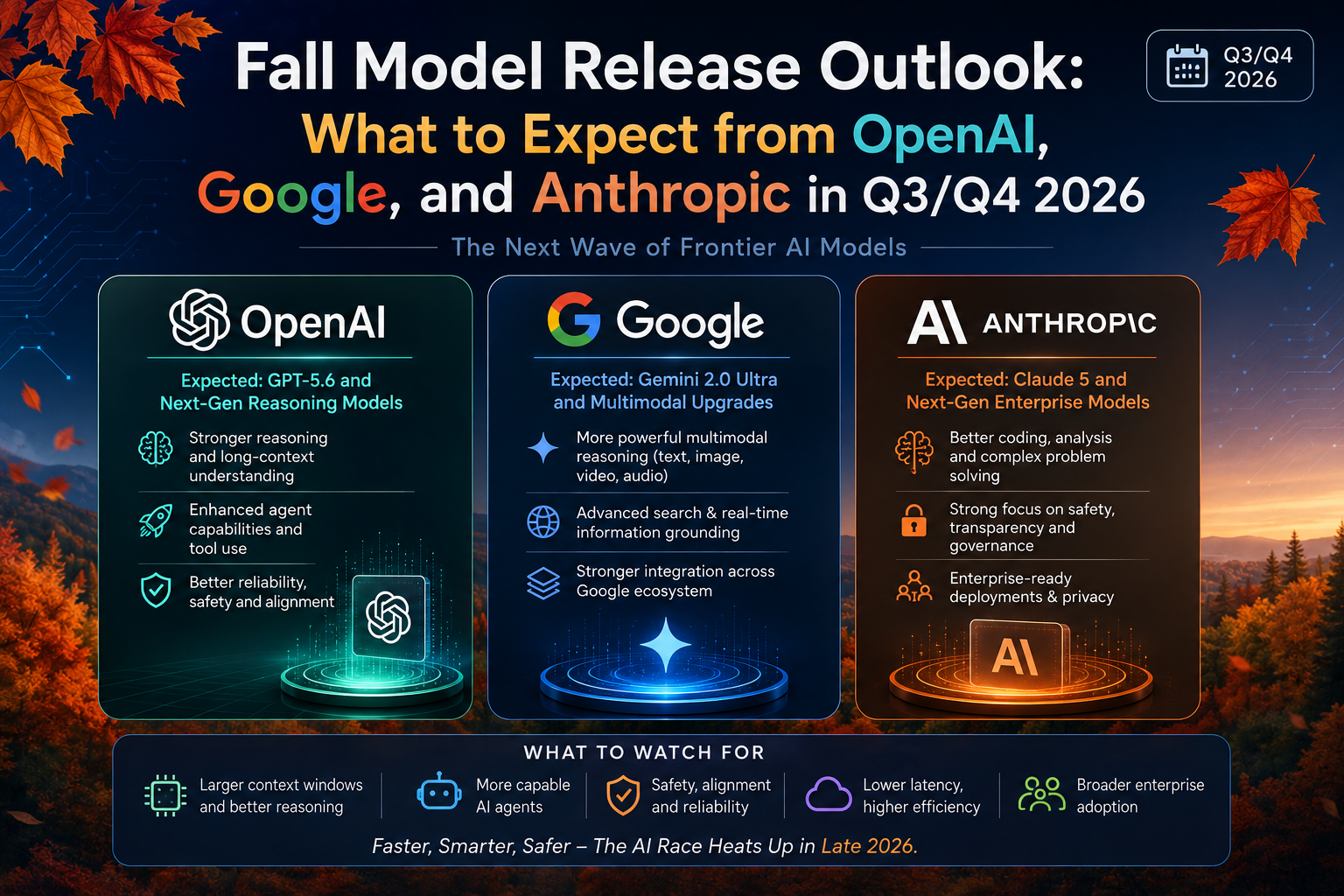
The second half of 2026 is shaping up to be less about one dramatic model launch and more about a practical race: which AI provider can make frontier intelligence faster, cheaper, safer, and easier to deploy inside real business workflows.
For European SMEs and enterprise teams, that is good news. The most useful AI systems are not chosen by benchmark headlines alone. They are chosen by how well they fit the workflow, budget, data environment, governance needs, and risk level of the business.
Source note: This article is an outlook, not a leaked release calendar. It separates confirmed vendor signals from practical expectations for Q3/Q4 2026. Source check date: 29 August 2026.
Quick Take
- OpenAI's recent GPT-5.6 activity points toward price-performance, speed tiers, coding agents, security-specialized deployments, and broader enterprise availability.
- Google's Gemini 3.7 Flash release points toward fast iteration on workhorse models for coding, agents, multimodal context, and Google ecosystem workflows.
- Anthropic's Claude Sonnet 5 and Claude 4.6 positioning point toward agentic coding, tool use, long-context work, safety controls, and enterprise productivity integrations.
- Q3/Q4 2026 model competition is likely to focus on deployment economics as much as raw intelligence.
- The strongest enterprise strategy is not choosing one model forever. It is building a model-routing and evaluation process that can adapt as vendors keep shipping.
The practical winner in fall 2026 will be the provider that helps teams turn AI from a powerful assistant into reliable operating infrastructure.
Why Fall 2026 Matters
AI model releases are arriving faster than many companies can evaluate them. A new model may improve coding, context length, tool use, or cost. Another may improve latency, safety, or multimodal reasoning. A third may be better inside a particular cloud, productivity suite, or development workflow.
That creates a new enterprise challenge. The question is no longer simply, "Which model is best?" The better question is, "Which model is best for this workflow, under this risk level, at this cost, with this data?"
For Q3/Q4 2026, engineering and business leaders should watch five model-release themes:
- Price-performance: more useful work per euro spent.
- Latency: faster response times for live workflows, voice, support, and incident response.
- Agentic reliability: better planning, tool use, recovery from mistakes, and completion of multi-step tasks.
- Enterprise controls: stronger access management, logging, governance, cloud availability, and security review.
- Evaluation maturity: clearer evidence of model behavior across real tasks, not only benchmark snapshots.
Confirmed Signals So Far
The strongest signals are not rumors. They come from what the major labs have already released or previewed during the summer.
OpenAI
Confirmed signal: GPT-5.6 general availability, a family structure with Sol, Terra, and Luna, pricing reductions, Ultrafast preview, Kiro coding workflow support, and Daybreak models on AWS.
Enterprise meaning: OpenAI is pushing model choice, deployment flexibility, faster inference, agentic coding, and specialized security workflows.
Confirmed signal: Gemini 3.7 Flash launched as a workhorse model for coding and agents, with a 1M context window, multimodal inputs, and introductory pricing through the end of 2026.
Enterprise meaning: Google is making fast, capable models feel practical for everyday workflows across developer, cloud, and Workspace-adjacent use cases.
Anthropic
Confirmed signal: Claude Sonnet 5 is positioned as Anthropic's most agentic Sonnet model yet, with planning, tool use, coding, lower-cost access, and safety assessments for agentic contexts.
Enterprise meaning: Anthropic continues to emphasize reliable agents, coding, long-context reasoning, safety, and productivity workflows.
The Market
Confirmed signal: The release cycle is becoming multi-dimensional: models, modes, pricing, cloud channels, tools, connectors, and safety systems are all changing together.
Enterprise meaning: Vendor selection now requires evaluation, routing, governance, and procurement discipline.
OpenAI Outlook: Speed, Model Families, and Enterprise Channels
OpenAI's GPT-5.6 release is important because it is not just a single-model story. The official launch describes a family of models: Sol as the flagship, Terra as a balanced everyday model, and Luna as a cost-efficient option. That structure tells enterprise teams something important: one AI model will not serve every task equally well.
The likely Q3/Q4 pattern from OpenAI is more segmentation. Expect continued emphasis on choosing the right capability level for the job, with stronger price-performance claims, more specialized deployment channels, and wider availability of high-speed or high-control options.
OpenAI's Ultrafast preview is especially relevant for live business workflows. If frontier intelligence can respond fast enough for customer support, incident response, financial research, and voice interfaces, then AI moves closer to real-time operations.
For engineering leaders, the OpenAI question in fall 2026 is not only "How smart is the model?" It is also:
- Can we route simple work to cheaper models and complex work to stronger models?
- Can we use high-speed inference where latency changes the product experience?
- Can our cloud, procurement, and security teams approve the deployment path?
- Can agentic coding tools fit our repository, testing, and review process?
- Can model upgrades be evaluated before they affect production workflows?
Google Outlook: Workhorse Models, Multimodal Context, and Ecosystem Pull
Google's Gemini 3.7 Flash announcement is a strong signal that the model race is moving toward practical workhorse models, not only premium frontier systems. Google describes Gemini 3.7 Flash as its most intelligent workhorse model for coding and agents, with improvements across software engineering, knowledge work, and web development workflows.
The model card adds several enterprise-relevant details: Gemini 3.7 Flash supports text, image, audio, and video inputs, a token context window of up to 1M, and text output up to 64K tokens. For companies with long documents, meeting recordings, product media, support history, or multimodal knowledge bases, this matters.
For Q3/Q4 2026, Google is likely to keep pushing three advantages:
- Everyday cost-performance: models that are capable enough for high-volume workflows.
- Multimodal productivity: AI that can work across text, documents, images, audio, and video.
- Ecosystem integration: stronger fit across Gemini API, Google Cloud, AI Studio, Workspace, and agent platforms.
For European SMEs already using Google Workspace or Google Cloud, the key watch item is integration quality. The strongest model on paper may not create the fastest business value if it cannot plug into the tools teams already use.
Anthropic Outlook: Agentic Work, Safety, and Enterprise Trust
Anthropic's Claude Sonnet 5 announcement signals a clear direction: stronger agentic behavior at a more practical cost. Anthropic says Sonnet 5 can make plans, use tools such as browsers and terminals, and run autonomously at a level that previously required larger models.
That matters because many enterprise workflows are not single-turn chat tasks. They involve research, comparison, data extraction, writing, system updates, code changes, approvals, and audit trails. A model that can stay on task across multiple steps can be more valuable than a model that only produces a strong first answer.
Anthropic is also likely to keep safety and trust close to the release story. Claude Sonnet 5 was published with safety assessments around undesirable behavior, hallucination, prompt-injection resistance, and cyber risk. For regulated teams, those details are not decoration. They are part of procurement, governance, and deployment approval.
In fall 2026, watch Anthropic for:
- More reliable coding and review workflows.
- Better long-context behavior for research, legal, finance, and technical documents.
- More enterprise connectors and tool-use capabilities.
- Clearer safety documentation for agentic deployments.
- More practical cost-performance options across Sonnet and Opus-class models.
The Release Pattern: Three Competing Priorities
The most important fall 2026 model-release pattern is that the labs are competing on three priorities at once: capability, speed, and control.
This is why the next model release from any major lab should be evaluated as a system release, not just a model card update. New models increasingly arrive with new modes, tool integrations, cloud channels, pricing, and safety controls.
Q3/Q4 2026 Enterprise Watchlist
The table below translates the current release signals into a practical watchlist for leaders deciding what to test next.
| Provider | Confirmed 2026 Signal | Q3/Q4 Outlook | Enterprise Watch Item |
|---|---|---|---|
| OpenAI | GPT-5.6 family, pricing changes, Ultrafast preview, Kiro coding support, AWS Daybreak availability. | More segmentation by model size, speed tier, workload type, and enterprise deployment route. | Test model routing, high-speed inference, coding-agent reliability, and security review requirements. |
| Gemini 3.7 Flash positioned for coding and agents with multimodal input and large context. | More workhorse-model competition, tighter cloud/productivity integration, and aggressive cost-performance positioning. | Measure how well Gemini fits existing Workspace, Cloud, data, and multimodal knowledge workflows. | |
| Anthropic | Claude Sonnet 5 positioned around agentic planning, tool use, coding, and safety for agentic contexts. | More emphasis on reliable agents, long-context work, enterprise connectors, and trust documentation. | Evaluate task completion quality, refusal behavior, tool permissions, auditability, and safety documentation. |
| Enterprise Buyers | All three labs are making model choice more dynamic and workflow-specific. | AI procurement will become less like buying software seats and more like managing a live model portfolio. | Create an evaluation matrix before committing large workflows to any one model family. |
What European SMEs Should Do Next
Small and mid-sized companies do not need to chase every new model announcement. They need a repeatable way to decide when a new release is worth testing.
A practical model-release review should answer:
- Which workflow could improve? Start with a real business process, not a general model comparison.
- What is the current baseline? Measure time, cost, accuracy, quality, and risk before testing the new model.
- What does the new model change? Look for better reasoning, lower cost, faster latency, better tool use, or stronger governance.
- What can go wrong? Check privacy, hallucination, prompt injection, access control, and over-automation risk.
- What evidence would justify adoption? Define a small test with clear acceptance criteria.
This keeps model-release excitement connected to business outcomes. It also prevents teams from changing models based only on social-media momentum.
Recommended Evaluation Framework
For MaGeN-AI readers, the cleanest approach is to build a simple model-evaluation board that compares each provider on the same workflow.
| Evaluation Area | What to Measure | Why It Matters |
|---|---|---|
| Accuracy | Correct answers, grounded outputs, and quality against a human-reviewed test set. | A model that sounds good but misses key facts can damage trust quickly. |
| Workflow Completion | Whether the model can complete the full task, not only the first step. | Agentic AI creates value when it handles multi-step work reliably. |
| Latency | Time to first useful answer and total task completion time. | Slow AI is less useful for support, sales, operations, voice, and incident response. |
| Cost | Input tokens, output tokens, tool calls, retries, and monthly usage at scale. | Small differences become expensive when AI reaches many teams. |
| Governance | Logging, access controls, model version tracking, human approval, and vendor documentation. | European teams need AI systems they can explain, audit, and control. |
| Integration | Fit with cloud systems, business apps, development tools, documents, and knowledge bases. | The best model is often the one that works cleanly inside existing operations. |
EU AI Act and Responsible AI Considerations
For European organizations, model releases should not be evaluated only by capability. They should also be evaluated by risk category, intended use, transparency, human oversight, documentation, and data governance.
This article is not legal advice, but the practical direction is clear: as models become more agentic and more embedded in workflows, companies need stronger controls before deployment.
- Use-case screening: identify whether the AI workflow affects employment, education, credit, healthcare, safety, legal decisions, or other sensitive areas.
- Human oversight: define where human review is required before an AI-generated output or action is used.
- Data protection: check whether personal data, customer data, or confidential business data is processed by the model or tools.
- Transparency: disclose AI use where users, employees, or customers need to know.
- Auditability: retain model version, prompts, retrieved sources, tool calls, and approvals where appropriate.
- Vendor documentation: keep model cards, safety documentation, deployment terms, and risk evidence in the procurement file.
The more a model can act, the more the business needs to know who approved that action, which tools were available, what data was used, and how mistakes can be detected.
Best Fit Recommendation
If your team wants the highest flexibility across model families, speed tiers, coding agents, and cloud deployment routes, OpenAI should be high on the Q3/Q4 2026 watchlist.
If your team already lives inside Google Cloud, Google Workspace, or multimodal document workflows, Google Gemini releases deserve close attention, especially for cost-sensitive and high-volume use cases.
If your team values agentic coding, long-context work, careful tool use, and safety documentation, Anthropic remains one of the most important providers to evaluate.
The best enterprise AI strategy for fall 2026 is not loyalty to one vendor. It is disciplined evaluation, controlled deployment, and model routing based on workflow evidence.
For MaGeN-AI readers, the practical takeaway is simple: keep watching the releases, but build the evaluation system first. That is what turns fast-moving AI news into business advantage.
FAQ
Will OpenAI, Google, or Anthropic release new major models in Q4 2026?
No company has confirmed every Q4 model release in advance. The more useful view is to watch their confirmed direction: OpenAI around model families, speed, and deployment routes; Google around workhorse models and multimodal ecosystem integration; Anthropic around agentic work, long context, and safety.
Should SMEs switch models every time a new one launches?
No. SMEs should test new models against specific workflows and switch only when the evidence shows better quality, lower cost, faster completion, or better risk control.
What is the biggest AI model trend for Q3/Q4 2026?
The biggest trend is the shift from raw model intelligence to deployable intelligence: speed, cost, tool use, cloud availability, governance, and evaluation.
Which provider is best for enterprise AI?
There is no universal answer. OpenAI, Google, and Anthropic each have different strengths. The best provider depends on the workflow, data environment, budget, risk level, integration needs, and evaluation results.
How should European companies prepare for new model releases?
European companies should define use cases, create evaluation datasets, document risk, add human oversight where needed, and track model versions before scaling AI into production workflows.