IFA 2026 Tech Trends: On-Device AI PCs, Local-First Hardware, and the Next Era of Consumer Physical AI
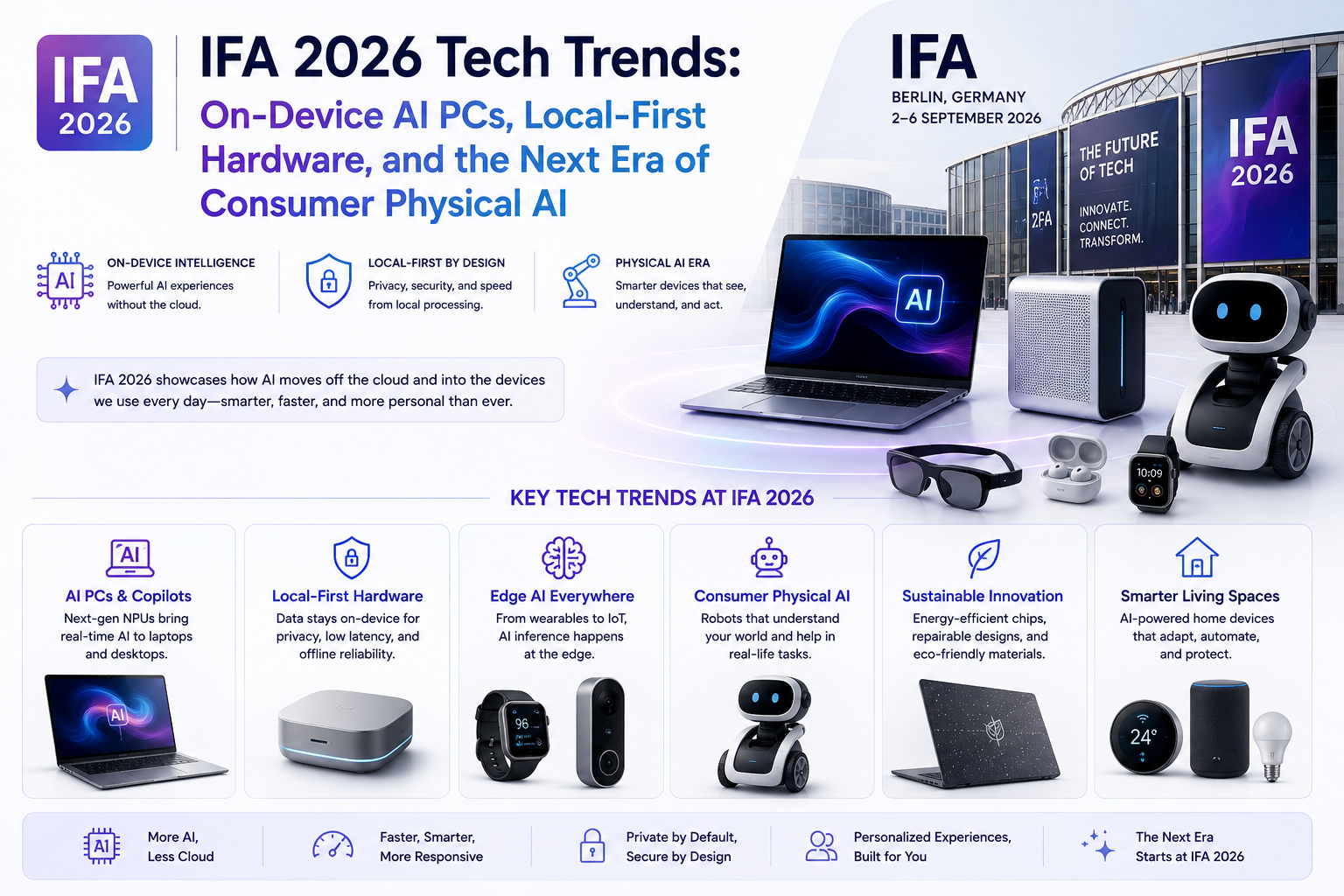
IFA 2026 is arriving at the moment consumer technology is shifting from connected devices to intelligent devices. The next wave is not only faster laptops, brighter screens, or smarter appliances. It is hardware that can sense, reason, generate, assist, and act closer to the user.
For AI readers, the big story is the convergence of three trends: on-device AI PCs, local-first hardware, and consumer physical AI. Together, they point to a future where AI is not trapped inside a cloud chatbot. It runs on laptops, phones, wearables, home devices, smart appliances, cameras, vehicles, and robots.
Quick Take
- IFA 2026 is becoming an AI hardware show. The official program highlights personal AI, physical AI, smart home, wearables, robotics, retail agents, and sustainability.
- AI PCs are moving from marketing term to hardware category. NPUs, local models, battery-efficient inference, and privacy-sensitive workflows are becoming mainstream buying criteria.
- Local-first hardware is the next consumer AI battleground. The question is no longer only "can this device connect to AI?" It is "what can this device do intelligently without sending everything to the cloud?"
- Consumer physical AI is the next visible leap. Robots, smart appliances, home devices, wearables, and sensors are beginning to combine perception, reasoning, and action.
- For European SMEs, the opportunity is practical. Better AI PCs, edge devices, local assistants, and sensor-aware tools can improve productivity, privacy, maintenance, retail, training, and customer experience.
The core IFA 2026 message: AI is becoming part of the device itself, not only a service you open in a browser.
Why IFA 2026 Matters
IFA has always been a consumer electronics stage, but 2026 gives the event a different center of gravity. The official program puts AI inside computing, smart homes, wellness, robotics, retail, interfaces, and sustainable living. That matters because consumer AI is becoming physical, personal, and ambient.
In the first wave of generative AI, people learned to type prompts into a cloud model. In the next wave, AI will increasingly appear as a feature of the device: a laptop that summarizes locally, a camera that understands scenes, a headset that responds to context, a smart appliance that adapts to usage, or a robot that can perceive and act in a shared space.
For businesses, especially European SMEs, IFA 2026 is useful because it shows what will soon enter offices, shops, service teams, homes, logistics, field work, and customer-facing environments. Consumer technology often becomes business technology faster than procurement teams expect.
The Main Trend Map
| Trend | What It Means | Why It Matters | Watchout |
|---|---|---|---|
| On-Device AI PCs | Laptops and desktops with NPUs, GPUs, and local AI runtimes that can run selected AI tasks on the device. | They reduce latency, support offline use, improve privacy for some workflows, and lower dependence on cloud inference. | Buyers should look beyond TOPS numbers and check software support, RAM, battery behavior, model compatibility, and real use cases. |
| Local-First Hardware | Devices designed to process more data locally before sending anything to the cloud. | Useful for personal productivity, smart home, cameras, health devices, retail devices, field service, and regulated data handling. | Local does not automatically mean compliant. Sensitive data still needs access control, logs, retention rules, and security testing. |
| Personal AI | AI that learns user context, supports daily tasks, and follows the user across devices and applications. | This could make AI assistants more useful than generic chatbots because they understand preferences, files, apps, and routines. | Personal memory needs user control, consent, deletion options, transparency, and clear boundaries. |
| Consumer Physical AI | Robots and intelligent machines that can perceive, decide, and act in physical spaces. | It expands AI from information work into cleaning, delivery, mobility, wellness, manufacturing support, home assistance, and retail operations. | Safety, reliability, liability, accessibility, and human oversight become much more important when AI can move or manipulate objects. |
| Smart Home AI | Appliances and home systems that use AI for automation, diagnostics, energy use, security, comfort, and maintenance. | Homes are becoming sensor-rich environments where AI can optimize tasks instead of only responding to simple commands. | Privacy risks rise when microphones, cameras, occupancy sensors, and behavioral patterns are combined. |
| AI Wearables and Spatial Interfaces | Glasses, earbuds, watches, rings, headsets, and cameras that provide contextual AI in real time. | Wearables can make AI more immediate because they capture voice, vision, location, health signals, or environment context. | Always-on sensing requires clear user controls and visible cues when recording, analyzing, or sharing data. |
| AI Retail and Agentic Commerce | Shopping journeys shaped by AI agents, recommendation engines, smart shelves, service bots, and automated negotiation. | Retailers may need to optimize for AI intermediaries, not only human search and social media discovery. | Transparency, consumer protection, bias, dark patterns, and data use must be handled carefully. |
| Sustainable AI Hardware | Devices designed with repairability, longer life, circular materials, energy efficiency, and responsible product cycles. | AI hardware growth increases pressure on energy, materials, replacement cycles, and e-waste. | A powerful AI feature is not enough if the product is hard to repair, expensive to maintain, or wasteful to replace. |
What Is Consumer Physical AI?
Consumer physical AI means AI systems that interact with the real world through sensors, motors, cameras, microphones, and physical actions. A chatbot can write an answer. A physical AI system can observe a room, interpret what is happening, plan an action, and move or control hardware.
This includes obvious robots, but it also includes less dramatic devices: home appliances, security cameras, delivery devices, smart mobility products, camera drones, exercise equipment, assisted-living devices, and retail machines. The common pattern is perception plus reasoning plus action.
Physical AI is where AI stops being only a screen-based assistant and becomes part of products that can sense and act.
Trend 1: AI PCs Become the Consumer Computing Story
AI PCs will be one of the clearest IFA 2026 storylines. The device industry needs a reason for users to upgrade, and AI gives manufacturers a new language for performance: local inference, NPU throughput, battery-efficient AI, privacy-sensitive tasks, better cameras, faster summaries, real-time translation, creator workflows, and agentic productivity.
Microsoft's Copilot+ PC guidance helped create a visible market threshold by tying modern Windows AI experiences to a high-performance NPU. Intel, Qualcomm, AMD, and other silicon vendors are now competing to make local AI capability a normal laptop specification, not a specialist feature.
| AI PC Layer | What To Watch at IFA | Practical Buying Question |
|---|---|---|
| NPU | Dedicated neural processors in consumer laptops and compact desktops. | Which local AI tasks actually run on the NPU today, and which are still cloud-only? |
| GPU | Creator laptops, gaming systems, local image generation, video tools, and larger local models. | Does the device have enough GPU memory and thermal headroom for sustained AI work? |
| Memory | More emphasis on RAM and memory bandwidth for local models and multimodal workflows. | Is the configuration strong enough for local AI, or only basic AI effects? |
| Operating System | Windows AI features, Apple Intelligence style experiences, and vendor software layers. | Are privacy settings, app permissions, and enterprise controls easy to manage? |
| Developer Stack | ONNX Runtime, Windows ML, Core ML, vendor SDKs, and model optimization tools. | Can developers deploy real local AI features, or is the product limited to bundled demos? |
Trend 2: Local-First Hardware Becomes a Trust Feature
Local-first hardware is not about rejecting the cloud. It is about deciding which tasks should happen on the device first. That matters because many consumer AI tasks involve private context: voice, camera feeds, files, location, calendar events, contacts, health signals, children, homes, and workplace documents.
The best local-first products will use a hybrid pattern. Lightweight, frequent, or sensitive tasks run locally. Heavy reasoning, large model calls, cross-device sync, and knowledge retrieval can use a cloud service when needed and when the user or organization allows it.
Privacy
Local processing can reduce how much raw personal or business data leaves the device, especially for voice, camera, document, and meeting workflows.
Latency
AI features such as camera effects, live captions, background blur, wake words, and quick summaries feel better when they respond instantly.
Cost
Repeated simple inference can be cheaper locally than sending every small request to a paid cloud model.
Resilience
Local AI can keep selected features working during poor connectivity, travel, field service, or home network outages.
Trend 3: Physical AI Moves Toward Consumers
Robotics has long promised intelligent help in the physical world. The difference now is that AI models are becoming better at vision, language, planning, and generalization. IFA 2026's Physical AI focus shows that robots and intelligent machines are becoming part of the consumer technology conversation, not only factory automation.
Google DeepMind's Gemini Robotics work and NVIDIA's physical AI model direction show the deeper technical shift. Physical AI needs models that understand scenes, instructions, timing, safety, and movement. It also needs simulation, training data, edge compute, sensors, and strict safety controls.
For consumers, the first useful wave may be modest: smarter cleaning devices, assisted-living helpers, home monitoring, delivery devices, companion-style interfaces, wellness equipment, and retail service systems. For SMEs, similar technology could support maintenance, inventory, customer service, logistics, demonstrations, training, and safety checks.
Trend 4: Smart Homes Become Contextual Homes
The smart home has spent years connecting devices to apps and voice assistants. The next phase is contextual automation. A contextual home does not only wait for a command. It understands patterns, occupancy, energy use, maintenance needs, comfort preferences, and safety signals.
At IFA, expect AI language around appliances, energy management, security, wellness, cleaning, entertainment, and home care. The key question is whether these products improve daily life or simply add another app and subscription.
| Product Area | AI Value | Risk To Check |
|---|---|---|
| Appliances | Energy optimization, predictive maintenance, food recognition, washing cycles, and usage learning. | Opaque automation, repair lock-in, and unclear data sharing. |
| Security Cameras | Local object detection, fewer false alerts, package detection, and scene understanding. | Biometric processing, bystander privacy, storage retention, and false positives. |
| Wellness Devices | Personalized routines, trend detection, sleep support, and coaching-style feedback. | Health-like claims, sensitive data handling, and unclear medical boundaries. |
| Entertainment | Adaptive audio, image upscaling, content search, accessibility, and personalized recommendations. | Over-personalization, children data, and manipulative engagement loops. |
Trend 5: AI Wearables Become Real Interfaces
AI wearables are important because they reduce friction. A laptop needs to be opened. A phone needs to be unlocked. Wearables can capture voice, gesture, vision, health signals, and location in the moment. That makes them a natural interface for personal AI.
The challenge is trust. A wearable that sees, hears, or senses continuously must be designed around consent and social acceptability. In public spaces, schools, workplaces, and healthcare-like environments, the difference between helpful context and intrusive monitoring becomes very important.
The winning AI wearable will not be the one with the most sensors. It will be the one people trust enough to use every day.
What European SMEs Should Watch
For SMEs, IFA 2026 is not only a consumer gadget show. It is a preview of the hardware that employees, customers, suppliers, and competitors will bring into work. The practical opportunity is to learn where AI can be local, where it should be cloud-connected, and where human review is still essential.
| SME Decision | Practical Move | Why It Helps |
|---|---|---|
| PC Refresh Planning | Start asking whether new laptops have a capable NPU, enough RAM, strong battery life, and manageable AI privacy controls. | Hardware bought in 2026 may define local AI capability for the next three to five years. |
| Local AI Pilots | Test local summarization, transcription, semantic search, image review, and meeting assistance on a small group first. | Small pilots reveal what actually works before the company scales devices or subscriptions. |
| Smart Device Governance | Create rules for cameras, microphones, location data, employee devices, home-office tools, and customer-facing sensors. | AI hardware can create privacy risk even when the software looks harmless. |
| Physical AI Readiness | Track use cases such as cleaning, inspection, retail service, warehouse assistance, training demos, and field support. | Physical AI will reach practical business settings before many SMEs have a policy for it. |
| Sustainability and Repair | Evaluate AI devices for repairability, battery replacement, warranty, software support period, and energy behavior. | AI hardware can become expensive quickly if it shortens replacement cycles or adds difficult-to-maintain products. |
EU AI Act and Responsible AI Considerations
AI consumer hardware can look low-risk, but risk depends on use. A laptop assistant that summarizes public webpages is very different from a camera system that identifies people, a robot that moves near children, or an AI tool used for hiring, education, credit, healthcare, or worker monitoring.
European organizations should screen AI hardware and AI-enabled devices before deployment. The goal is not to block useful technology. The goal is to understand what data is processed, where it goes, what decisions are influenced, and who remains accountable.
| Responsible AI Area | Question To Ask | Practical Control |
|---|---|---|
| Risk Classification | Could the device or AI feature affect employment, education, safety, access to services, biometric processing, or surveillance? | Classify the use case before rollout and apply stricter controls for sensitive or high-impact uses. |
| Transparency | Will users, employees, customers, or bystanders know when AI is analyzing, recording, generating, or acting? | Use clear notices, visible indicators, consent flows, and plain-language explanations. |
| Human Oversight | Can a person review, override, stop, or correct the AI system? | Keep human approval for consequential actions, physical movement, customer commitments, and automated decisions. |
| Data Governance | What data is collected, stored, processed locally, sent to the cloud, shared with vendors, or retained for training? | Document data flows, limit collection, set retention periods, and verify vendor settings. |
| Cybersecurity | Can the AI feature be tricked through prompt injection, visual attacks, voice spoofing, device compromise, or unsafe tool access? | Test adversarial inputs, update firmware, restrict permissions, and monitor logs. |
| Physical Safety | Can the system move, heat, open, lock, unlock, or otherwise affect the physical environment? | Require emergency stop behavior, safe operating zones, reliability tests, and fail-safe design. |
Responsible AI hardware means knowing not only what the model can do, but what the device can sense, store, share, and physically change.
Best Fit and Recommendation
For readers watching IFA 2026, the best strategy is to separate real utility from AI decoration. A product is not better because it has "AI" printed on the spec sheet. It is better if AI improves privacy, speed, accessibility, reliability, creativity, maintenance, or productivity in a measurable way.
For home users, look for devices that explain what runs locally, what goes to the cloud, and how to disable or delete AI memory. For SMEs, prioritize AI PCs and devices that fit your existing security policies, device management tools, and compliance requirements.
The winners after IFA 2026 will likely be products that make AI feel boringly useful: faster work, fewer clicks, better accessibility, smarter maintenance, safer automation, clearer privacy controls, and less dependency on constant cloud processing.
FAQ
What are the biggest IFA 2026 tech trends?
The biggest trends are on-device AI PCs, personal AI, local-first hardware, AI wearables, smart home intelligence, consumer physical AI, retail agents, and sustainable consumer electronics.
What is an on-device AI PC?
An on-device AI PC is a laptop or desktop designed to run selected AI workloads locally using an NPU, GPU, CPU, local runtime, and optimized software stack.
Why does local-first AI hardware matter?
Local-first AI can improve privacy, latency, offline behavior, and cost for certain tasks because the device can process data before sending anything to the cloud.
What is consumer physical AI?
Consumer physical AI refers to AI-enabled devices that sense and act in the real world, such as robots, smart appliances, cameras, wearables, mobility devices, and home systems.
Should SMEs buy AI PCs in 2026?
SMEs should consider AI PCs during normal refresh cycles, but they should test real workflows first. Look at NPU capability, RAM, battery life, privacy controls, software compatibility, and device management.