Prompt Engineering Is Dead. Context Engineering Is the Future
Artificial Intelligence has evolved at an extraordinary pace. Just a few years ago, prompt engineering was considered the secret weapon for getting better results from large language models (LLMs). Organizations hired prompt engineers, courses emerged overnight, and businesses invested heavily in crafting the perfect prompts.
Today, however, the AI landscape has changed dramatically.
As modern AI systems become more capable, a new discipline is emerging as the true competitive advantage: Context Engineering.
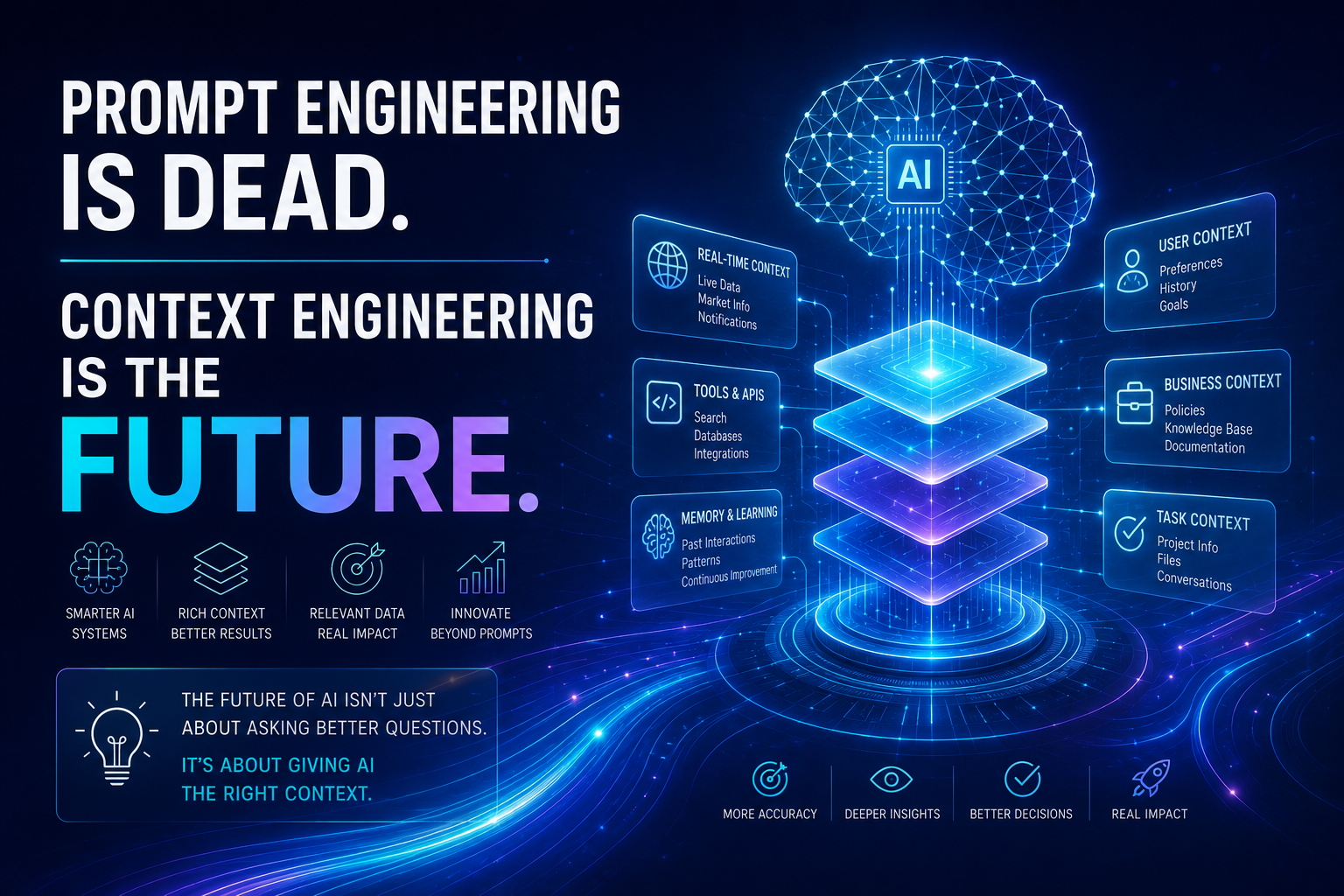
The future of AI isn't about finding the perfect prompt. It's about delivering the right context at the right time.
What Is Prompt Engineering?
Prompt engineering is the practice of designing inputs that guide AI models toward desired outputs. Examples include:
Specifying roles ("Act as a financial analyst")
Defining output formats
Providing examples
Setting constraints and instructions
For early AI models, carefully structured prompts could significantly improve performance.
Example:
Act as a professional copywriter.
Write a 300-word product description.
Use persuasive language.
Target small business owners.
While prompt engineering remains useful, it is increasingly becoming a small piece of a much larger puzzle.
Why Prompt Engineering Is Losing Importance
Modern AI models are becoming better at understanding intent, following instructions, and handling ambiguity.
A prompt that required 500 carefully crafted words in 2023 may now produce similar results with a simple request.
Several factors are driving this shift:
1. Smarter Foundation Models
New-generation AI models understand natural language far better than their predecessors.
Users no longer need elaborate prompt structures to achieve quality outputs.
2. Expanded Context Windows
AI systems can now process massive amounts of information simultaneously.
Instead of relying on prompt tricks, organizations can provide entire documents, databases, conversation histories, and knowledge repositories.
3. Agentic AI Systems
AI agents perform multi-step reasoning, access tools, retrieve information, and make decisions autonomously.
Success depends less on wording and more on the quality of information available to the agent.
4. Enterprise AI Requirements
Businesses need:
Accuracy
Reliability
Compliance
Traceability
Personalization
These goals cannot be achieved through prompt optimization alone.
They require robust context management.
What Is Context Engineering?
Context engineering is the discipline of designing, managing, and delivering all relevant information an AI system needs to perform effectively.
Instead of asking:
"How do I write a better prompt?"
Context engineering asks:
"How do I ensure the AI has the right information when it needs it?"
Context includes:
User preferences
Historical interactions
Business rules
Knowledge bases
Documents
APIs
Databases
Real-time data
Organizational policies
Task-specific memory
The prompt becomes just one component of a larger system.
The Anatomy of Context Engineering
A modern AI system typically combines multiple layers of context.
User Context
Information about the individual user:
Preferences
Goals
Expertise level
Previous interactions
Example:
A beginner and an expert asking the same question may require completely different responses.
Business Context
Organizational knowledge including:
Internal documentation
Standard operating procedures
Product information
Compliance requirements
This ensures AI outputs align with company standards.
Task Context
Specific information relevant to the current task:
Project details
Recent conversations
Uploaded files
Related documents
Real-Time Context
Dynamic information such as:
Market data
News
Inventory status
System metrics
Live customer interactions
This allows AI systems to respond accurately to changing conditions.
Why Context Engineering Produces Better Results
Higher Accuracy
AI systems perform significantly better when provided with relevant information rather than relying solely on model memory.
Context reduces hallucinations and factual errors.
Greater Personalization
Context-aware AI can tailor responses based on user behavior, preferences, and objectives.
The result is a more natural and valuable experience.
Improved Consistency
Organizations need predictable outputs.
Context engineering helps ensure AI responses remain aligned with policies, branding, and operational standards.
Enhanced Decision-Making
When AI can access relevant data sources, it becomes capable of supporting more complex business decisions.
This is particularly important for:
Healthcare
Finance
Manufacturing
Customer support
Enterprise operations
Prompt Engineering vs Context Engineering
Prompt Engineering Context Engineering
Focuses on wording Focuses on information
Optimizes instructions Optimizes knowledge
Single interaction End-to-end system design
Human-crafted prompts Dynamic context assembly
Short-term improvements Long-term scalability
Limited personalization Deep personalization
The key difference is simple:
Prompt engineering tells the AI what to do.
Context engineering gives the AI what it needs to know.
The Rise of Retrieval-Augmented Generation (RAG)
One of the biggest drivers of context engineering is Retrieval-Augmented Generation (RAG).
RAG systems retrieve relevant information from external sources before generating responses.
Instead of relying solely on training data, the AI can access:
Company documents
Product manuals
Internal knowledge bases
Research papers
Real-time databases
Benefits include:
More accurate answers
Reduced hallucinations
Up-to-date information
Better enterprise adoption
RAG is fundamentally a context engineering strategy.
AI Agents Depend on Context
The next generation of AI systems consists of autonomous agents capable of:
Planning
Reasoning
Tool usage
Task execution
These agents require:
Memory
Knowledge retrieval
State management
Workflow awareness
Without context, agents become unreliable.
With strong context engineering, agents become highly effective digital collaborators.
How Businesses Should Prepare
Organizations looking to maximize AI value should shift focus from prompt libraries to context infrastructure.
Build Knowledge Systems
Create centralized repositories for:
Documentation
Policies
Procedures
Product information
Invest in Data Quality
Poor data leads to poor AI outcomes.
Accurate, structured, and accessible information is essential.
Implement Retrieval Systems
Enable AI applications to access relevant information dynamically rather than embedding everything into prompts.
Develop Memory Frameworks
Persistent memory allows AI systems to learn from interactions and provide more personalized experiences.
Design Context Pipelines
Build workflows that automatically gather and deliver the most relevant information for each task.
The Future of AI Belongs to Context
Prompt engineering is not disappearing entirely.
Good prompts still matter.
However, they are no longer the primary differentiator.
As AI systems become more intelligent, success increasingly depends on how effectively organizations manage and provide context.
The companies that win in the next wave of AI adoption will not be those with the cleverest prompts.
They will be the ones with the strongest context architecture.
In the coming years, context engineering will become one of the most valuable skills in AI development, enterprise transformation, and digital innovation.
The future is not about asking better questions.
The future is about ensuring AI has the right knowledge to answer them.
Final Thoughts
The shift from prompt engineering to context engineering represents a fundamental evolution in artificial intelligence.
Prompts remain important, but context has become the true source of AI performance, reliability, and business value.
Organizations that embrace context engineering today will build smarter AI systems, achieve greater operational efficiency, and create more meaningful user experiences tomorrow.
Prompt engineering opened the door to AI. Context engineering is what will unlock its full potential.
Tags
#AI #ArtificialIntelligence #GenerativeAI #ContextEngineering #PromptEngineering #AIAgents #MachineLearning #LLM #LargeLanguageModels #RAG #EnterpriseAI #AIAutomation #DigitalTransformation #AgenticAI #KnowledgeManagement #AIArchitecture #TechTrends #DataDrivenAI #ContextAwareAI #AIDevelopment #IntelligentSystems #AIStrategy #FutureOfAI #FutureTech #OpenAI #GenAI #BusinessAI #Productivity #AIRevolution #TechnologyTrends