The Hidden AI War: Compute Was Phase 1 — Energy Is Phase 2
Silicon Valley has finally hit a wall that code cannot break: the laws of thermodynamics. While the first chapter of the AI era was defined by who could hoard the most processing power, the sequel is being written in Megawatts. We are transitioning from an era of digital scarcity to one of physical constraint—where the next breakthrough in intelligence won't come from a better algorithm, but from a more efficient power plant.
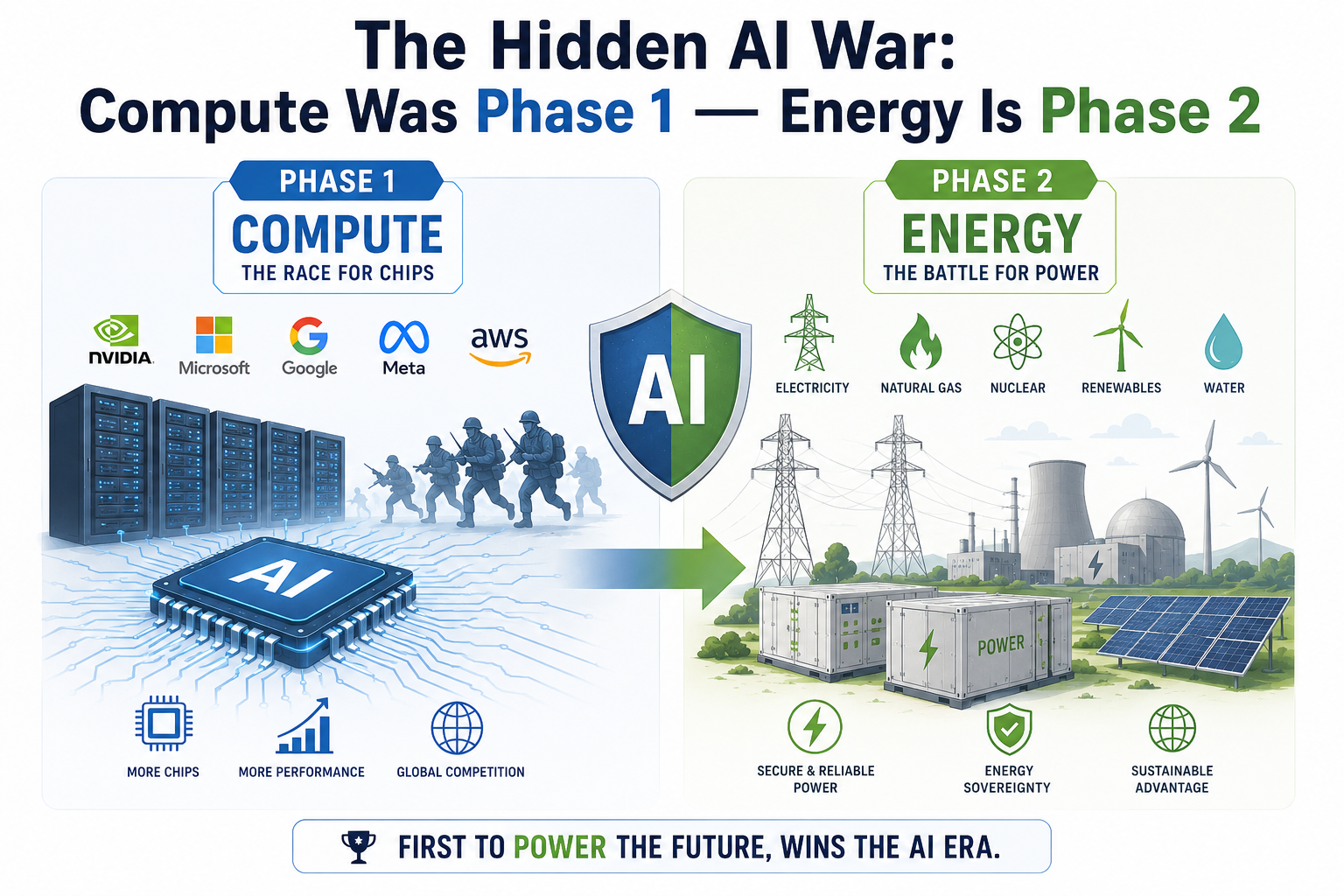
Phase 1: The Silicon Arms Race
For the past several years, the tech world was locked in a frantic scramble for "digital gold." This was Phase 1: The Compute Wars. The strategy was brute force: acquire as many NVIDIA GPUs as possible, build massive clusters, and scale parameters until the models showed emergent intelligence.
In this phase, the formula was simple: $Scaling \propto Compute$.
Success was measured in H100 counts and capital expenditure. If you had the billions to buy the chips, you were in the game. But as these clusters grew from 10,000 chips to 100,000 and beyond, the industry realized that you can't just keep adding "brains" if you don't have the "blood" to keep them alive.
Phase 2: The Battle for the Grid
We have officially entered Phase 2: The Energy Wars. The primary bottleneck is no longer how many chips you can buy, but whether you can find a spot on the planet with enough electrical capacity to plug them in.
AI is outgrowing our infrastructure. A single generative AI query consumes roughly 2.9 watt-hours of electricity—nearly 10 times that of a traditional Google search. When you scale that across billions of users and trillions of parameters, you aren't just looking at a software update; you're looking at a national security-level infrastructure challenge.
Why Energy is the New Frontier:
Grid Saturation: Data center hubs like Northern Virginia or Dublin are effectively "full." Utilities are now telling tech giants they may have to wait years for new high-voltage connections.
Thermal Limits: We are reaching the point where cooling these massive arrays requires almost as much energy as running the chips themselves.
The 24/7 Dilemma: Unlike other industries, AI training cannot pause when the sun goes down or the wind stops. It requires "base load" power—consistent, massive, and uninterruptible.
The New Weapons: Reactors and Renewables
The victors of Phase 2 won't be the companies with the cleverest Python scripts; they will be the companies that act like energy utilities. We are seeing a radical shift in how Big Tech operates:
The Three Pillars of Phase 2:
The Nuclear Option: Tech giants are bypassing the grid entirely. In May 2026, companies like NANO Nuclear Energy and Supermicro signed major deals to integrate microreactors directly into AI server racks, aiming for truly "off-grid" AI factories.
Performance per Watt: The gold standard metric has shifted from "FLOPS" to Joules per Token (J/token). Modern deployments like Llama 3 on H100 stacks have slashed energy costs to ~0.39 J/token—a 10x improvement over 2023 baselines.
Geographic Arbitrage: Data centers are moving to where the power is. Massive projects like Project Stargate are targeting 10 GW of capacity in Texas, while others tap into hydroelectricity in Scandinavia or geothermal vents to solve the base-load power crisis.
The Bottom Line
The "Cloud" was never actually a cloud; it’s a series of massive, power-hungry industrial engines. In Phase 1, we built the engines. In Phase 2, we have to figure out how to keep the lights on.
The next decade of AI progress will be measured not just in FLOPS, but in the ability to master the physical world. The code has reached its limit; now, the engineers must master the atom.
The AI revolution will not be won by the company with the most data, but by the company with the most reliable fuse box.
Tags
#AI #ArtificialIntelligence #AIInfrastructure #AIWar #Compute #Energy #AICompute #DataCenters #PoweringAI #FutureOfAI #AITransformation #Semiconductors #NVIDIA #EnergyCrisis #AIEconomy #DigitalInfrastructure #AIInnovation #TechGeopolitics #SustainableAI #NextGenTechnology