Defender-First AI Security: The Cybersecurity Breakthrough Enterprises Need
Artificial intelligence has changed cybersecurity forever. Attackers are using AI to move faster, personalize scams, find weaknesses, and automate parts of the attack chain. At the same time, defenders are using AI to detect threats earlier, investigate alerts faster, strengthen code, and reduce security team overload.
This is the new cybersecurity arms race: AI-powered attackers versus AI-powered defenders.
For enterprises, the answer is not to avoid AI. The answer is to deploy AI securely, govern it carefully, and use it to strengthen defense before attackers use it to widen the gap.
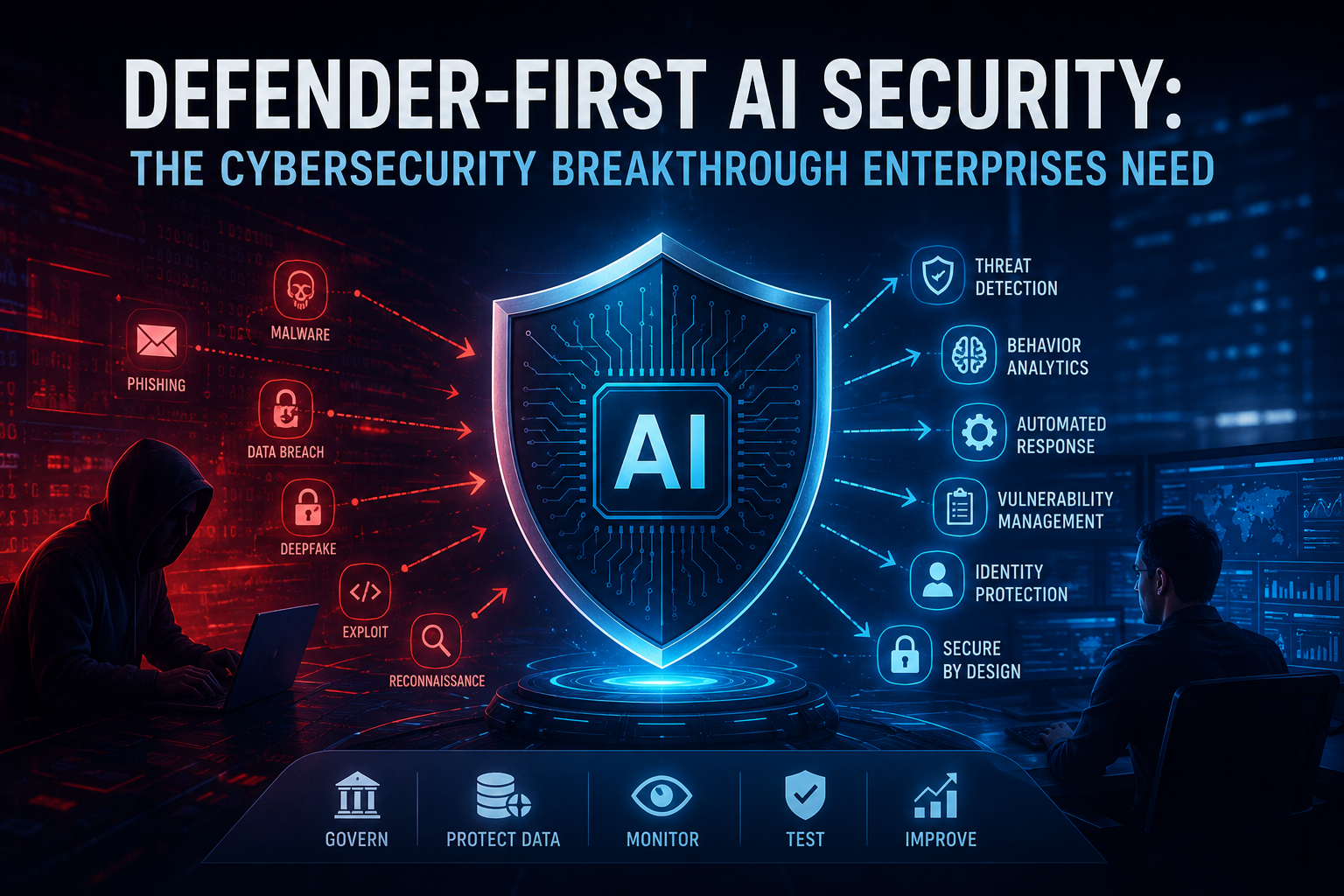
The New AI Cybersecurity Arms Race
Cybercriminals no longer need to rely only on manual research, generic phishing emails, or slow trial-and-error attacks. AI can help them write more convincing messages, translate scams into multiple languages, summarize leaked data, generate malicious code variations, and identify exposed systems more quickly.
This does not mean AI makes every attacker unstoppable. It means the cost of launching sophisticated attacks is getting lower.
Defenders face the same opportunity in reverse. Security teams can use AI to analyze logs, identify unusual behavior, prioritize vulnerabilities, summarize threat intelligence, support incident response, and assist security analysts with repetitive work.
The side that benefits most from AI will be the side that uses it with better discipline.
That is why enterprises need a defender-first AI security strategy.
What “Defender-First AI Security” Means
Defender-first AI security means using AI to strengthen protection, detection, response, and recovery before introducing unnecessary risk.
It is not just about adding an AI chatbot to a security operations center. It is about building security into every stage of AI adoption.
A defender-first approach asks:
How can AI reduce attacker advantage?
How can AI improve visibility across systems?
How can we prevent sensitive data from leaking into models?
How can we stop AI tools from becoming new attack surfaces?
How can humans stay accountable for high-impact decisions?
This approach aligns with public security guidance from organizations such as NIST, OWASP, CISA, and MITRE. NIST’s AI Risk Management Framework focuses on managing AI risks across the AI lifecycle, OWASP tracks major risks for large language model applications, CISA promotes secure-by-design technology practices, and MITRE ATLAS documents adversary tactics against AI-enabled systems.
How Attackers Are Using AI
AI gives attackers speed, scale, and personalization.
One major risk is AI-assisted phishing. Instead of sending obvious spam, attackers can create messages that sound natural, reference business context, and target specific departments or executives.
Another risk is faster reconnaissance. AI can help attackers process public information, summarize employee details, identify technology stacks, and discover likely entry points.
AI can also assist with malware development, code modification, and vulnerability research. Even when AI does not create a complete attack on its own, it can help attackers move faster through parts of the process.
Deepfakes and synthetic voice attacks add another layer of concern. A fake audio message, fake video call, or AI-generated identity can be used to manipulate employees, approve payments, or bypass weak verification processes.
The result is simple: enterprises should expect more attacks that look polished, targeted, and believable.
How Defenders Can Use AI Better
AI can also become a major advantage for defenders.
In security operations, AI can help group related alerts, summarize incidents, explain suspicious activity, and recommend next steps. This allows analysts to spend less time sorting noise and more time making decisions.
In vulnerability management, AI can help prioritize which issues matter most based on exposure, exploitability, asset importance, and business impact.
In application security, AI can assist developers by reviewing code, identifying insecure patterns, and suggesting safer alternatives.
In identity security, AI can help detect unusual login behavior, impossible travel, suspicious privilege use, and abnormal access to sensitive data.
In threat intelligence, AI can summarize large volumes of reports and connect indicators across campaigns.
The breakthrough is not that AI replaces security teams. The breakthrough is that AI gives security teams more speed, context, and coverage.
The Biggest Risk: Deploying AI Without Controls
Many enterprises are adopting AI faster than they are securing it. That creates new risks.
Employees may paste confidential data into public AI tools. Developers may connect AI agents to internal systems without strong access controls. Teams may deploy AI apps without testing for prompt injection, data leakage, insecure outputs, or third-party dependency risks.
OWASP’s work on LLM application security highlights risks such as prompt injection, insecure output handling, sensitive information disclosure, excessive agency, and supply chain vulnerabilities.
This is why AI security must be treated as enterprise security, not as an experimental side project.
Best Practices for Secure AI Deployment
1. Create a Clear AI Security Policy
Start with simple rules. Define which AI tools are approved, what data employees can use, who can deploy AI systems, and what security reviews are required.
The policy should cover public AI tools, private models, third-party AI vendors, internal copilots, AI agents, and AI features built into existing software.
A good AI policy should answer one question clearly: What is allowed, what is restricted, and what is prohibited?
2. Classify and Protect Sensitive Data
AI systems are only as safe as the data flowing through them.
Enterprises should classify data before it is used with AI. Customer records, financial information, health data, source code, credentials, legal documents, and internal strategy documents should have strict handling rules.
Use data loss prevention, encryption, access controls, and masking where appropriate. Do not allow sensitive data into AI systems unless there is a clear business need and strong protection.
3. Apply Least-Privilege Access
AI tools should not have unlimited access to enterprise systems.
If an AI assistant only needs to read documentation, it should not have access to customer databases. If an AI agent only needs to create support summaries, it should not be able to modify billing records or production systems.
Limit what AI can read, write, delete, execute, and share. Review permissions regularly.
4. Defend Against Prompt Injection
Prompt injection happens when a user, document, webpage, or external input tricks an AI system into ignoring instructions, revealing data, or taking unsafe actions.
This is especially important for AI systems connected to email, browsers, document repositories, ticketing systems, or internal databases.
Defenses should include input filtering, strict system instructions, tool-use restrictions, output validation, content isolation, and human approval for sensitive actions.
5. Validate AI Outputs Before Action
AI can be useful, but it can also be wrong.
Never allow AI output to automatically trigger high-impact actions without validation. This includes payments, account changes, legal decisions, access approvals, system shutdowns, customer notifications, and security enforcement actions.
Use human review for critical workflows. For lower-risk workflows, use automated checks, confidence thresholds, and audit logs.
6. Secure AI Agents Like Privileged Users
AI agents can search, summarize, click, execute, create tickets, update systems, and interact with tools. That makes them powerful. It also makes them risky.
Treat AI agents like privileged identities. Give them unique accounts, limited permissions, monitored activity, strong authentication, and clear approval boundaries.
Every AI agent should have an owner, a purpose, an access list, and a shutdown process.
7. Monitor AI Activity
Security teams need visibility into how AI is being used.
Log prompts, responses, tool calls, access attempts, file usage, API activity, and administrative changes where legally and ethically appropriate. Monitor for unusual behavior, such as repeated attempts to access restricted data or prompts designed to bypass policy.
AI monitoring should connect with existing SIEM, SOAR, data protection, identity, and incident response systems.
8. Red Team AI Systems
AI systems should be tested before and after deployment.
Red teaming can uncover prompt injection risks, data leakage, unsafe outputs, model misuse, weak access controls, and dangerous integrations. MITRE ATLAS provides a knowledge base of adversary tactics and techniques against AI-enabled systems, which can help security teams think more clearly about AI-specific threats.
Testing should not be a one-time event. AI systems change as models, prompts, plugins, data sources, and business processes change.
9. Secure the AI Supply Chain
Many AI systems depend on third-party models, APIs, plugins, datasets, libraries, and cloud services.
Enterprises should review vendors carefully. Ask how data is stored, whether prompts are used for training, what security certifications exist, how incidents are handled, and what controls are available for logging, retention, encryption, and access management.
AI procurement should involve security, legal, privacy, compliance, and business owners.
10. Build Security Into the AI Lifecycle
AI security should begin before deployment.
Security reviews should happen during design, development, testing, launch, and ongoing operation. CISA’s secure-by-design guidance emphasizes building cybersecurity into technology from the start rather than treating it as an afterthought.
This means threat modeling, secure architecture, privacy review, testing, monitoring, incident planning, and continuous improvement should all be part of the AI lifecycle.
What Enterprises Should Do First
Enterprises do not need to solve every AI security problem at once. They need to start with the highest-impact actions.
First, inventory all AI tools currently in use. Many organizations already have shadow AI, where employees use unapproved tools without security oversight.
Second, define approved use cases. AI for document summarization, internal search, security alert triage, and code review may be useful, but each use case needs different controls.
Third, protect sensitive data. Prevent confidential information from being copied into tools that are not approved for that data type.
Fourth, secure AI integrations. Any AI system connected to internal tools, databases, email, or production workflows needs strong access control and monitoring.
Fifth, train employees. People need to understand that AI can produce convincing but false information, and that AI-generated messages can be used in social engineering attacks.
The Future Belongs to AI-Ready Defenders
The AI security arms race is not coming. It is already here.
Attackers will use AI to scale deception, speed up reconnaissance, and exploit weak processes. Defenders must use AI to improve detection, reduce response time, strengthen software, and protect critical data.
But the winning strategy is not “AI everywhere.” It is secure, governed, defender-first AI.
Enterprises that deploy AI without controls may create new risks faster than they create business value. Enterprises that deploy AI securely can build a stronger, faster, and more resilient defense.
The cybersecurity breakthrough enterprises need is not just better AI.
It is better security around AI, better AI inside security, and better judgment guiding both.
Tags
#AI #AISecurity #Cybersecurity #DefenderFirstSecurity #EnterpriseSecurity #SecurityOperations #ThreatDetection #CyberDefense #SecurityAutomation #EnterpriseAI #ZeroTrust #SOCModernization #RiskManagement #DigitalResilience #AIInnovation #FutureOfSecurity